
Live Labs 2 is a three-year, £30 million, UK-wide programme funded by the Department for Transport that will run until March 2026, with a five-year subsequent, extended monitoring and evaluation period. Seven projects, grouped by four interconnected themes, are being led by local authorities working alongside commercial and academic partners. Following the success of the ADEPT SMART Places Live Labs programme (Live Labs 1) and its focus on innovation across local roads, Live Labs 2 concentrates on how to decarbonise local highways infrastructure and assets.
To date, decarbonisation of transport in the UK has focused mostly on electric vehicles, active travel and changing public behaviour rather than the planning and design of transport infrastructure or local roads assets. However, the UK’s local roads infrastructure and maintenance make a significant and ongoing contribution to greenhouse gas emissions, climate change impacts and future resilience.
Liverpool City Council’s project is targeting the challenge of decarbonising highways delivery and the road asset in complex city contexts, to demonstrate that this benefits the local economy and people. The project will realise an ‘Ecosystem of Things’, a scalable and transferrable systems mapping and optioneering approach at city-level to introduce innovations offering the greatest impacts within individual schemes. Within a Corridor and Place-based theme, it aims to reduce the environmental impact of Liverpool’s roads and help the city achieve its net-zero goal by 2030.
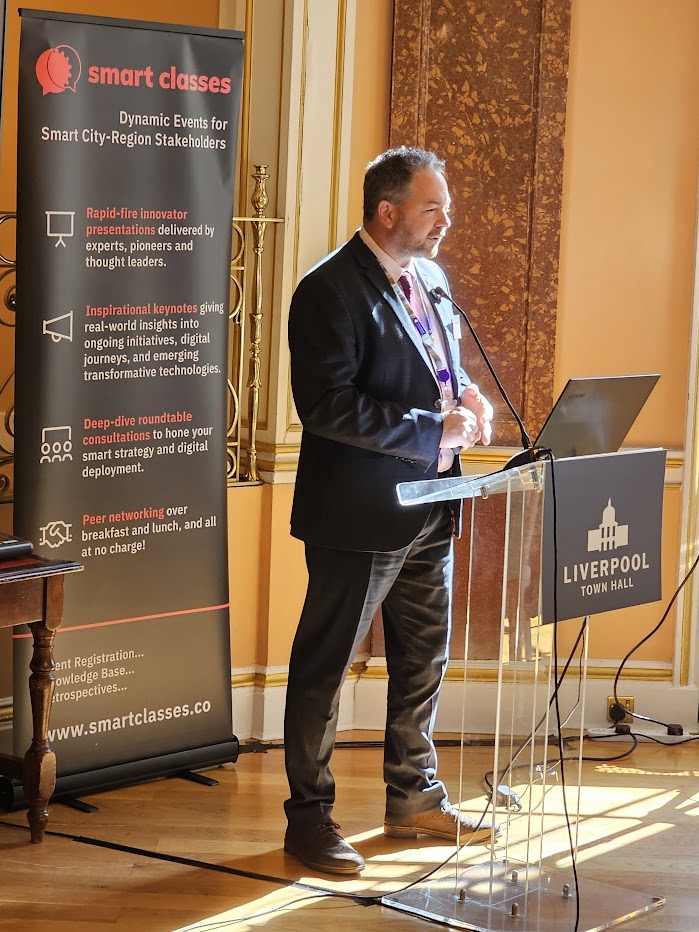
In his opening keynote at TRANSPORT Smart Class, North of England 2025, Andrew Mollon, Director of Sustainable Transport, Highways and Parking at Liverpool City Council, demonstrated how the Live Labs research is helping deliver innovative solutions to combat greenhouse emissions and climate change impacts, and improve the future resilience of Liverpool’s highways.

Summary of presentation highlights:
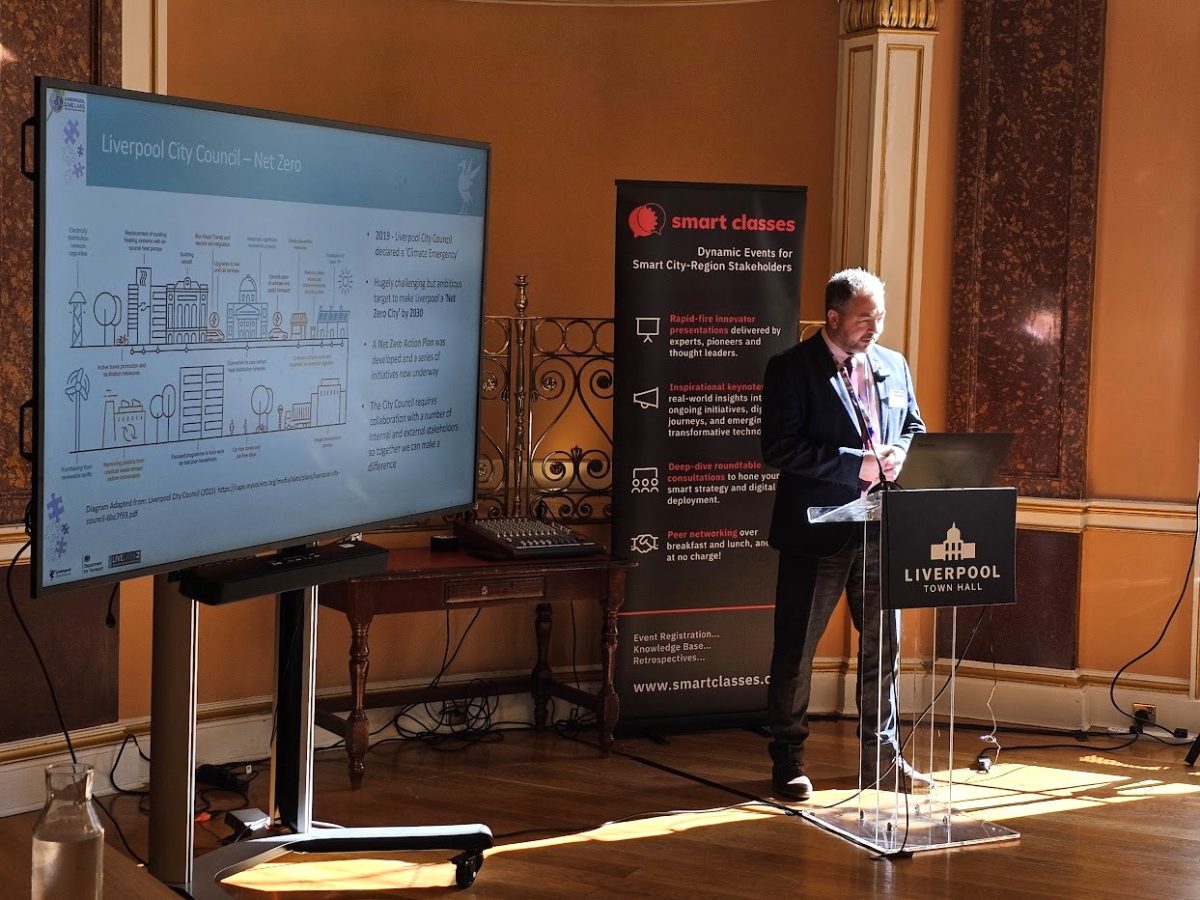
- Liverpool City Council – Net Zero: 2019 – Liverpool City Council declared a ‘Climate Emergency’; Hugely challenging but ambitious target to make Liverpool a ‘Net Zero City’ by 2030; * A Net Zero Action Plan was developed and a series of initiatives are now underway; The City Council requires collaboration with a number of internal and external stakeholders so together we can make a difference;
- * Diagram of plans mix – Electricity distribution network upgrades; Active travel promotion and facilitation measures; Replacement of existing heating systems with air-source heat pumps; Building retrofit; Bus Rapid Transit and electric rail integration; Upgrades to bus and rail services; Connection to zero carbon heat distribution networks; Nationally significant renewable projects; Electrification of vehicles and public transport; Waste prevention measures; Reduce plastic waste and improve kerbside recycling rates; Collection of food waste and treatment via anaerobic digestion; Installation of solar PV; Purchasing from renewable tariffs; Removing plastics from residual waste stream before incineration; Focused programme to fund work for fuel poor households; Car free zones and car-free days; Freight consolidation centres;
- Net Zero – Our story so far: Liverpool’s current carbon footprint shown (see Chart ) across five key sectors and their contributions; Transport is Liverpool’s second-largest emissions source, mainly from road transport, contributing 972,809 tCO2e (37%); This includes emissions from waterborne navigation, rail, aviation, on-road, and off-road transport; This highlights the importance of addressing the emissions of this sector; Liverpool City Council Highways Team has since engaged in the Live Labs Programme to support activities to reduce carbon in the sector;
- ADEPT Live Labs 2: Decarbonising Local Roads – Wessex Partnership: Net Zero Corridors; South Gloucestershire Council and West Sussex County Council: Greenprint; Liverpool City Council: ‘Ecosystem of Things’ – driving a low-carbon economy; Devon County Council: A382 (Including Jetty Marsh Link Road) – Carbon Negative Project; Transport for West Midlands: UK Centre of Excellence for Decarbonising Roads – South Campus; East Riding of Yorkshire Council: High visual efficiency for low carbon lighting – decarbonising street lighting;

- Carbon management and it’s importance – Client & Stakeholder Engagement; Technology & Innovation; Compliance with International Standards; Regulatory Compliance; Environmental Responsibility; Economic Benefits;
- Key Pillars for Decarbonisation – Governance; Strategic Vision; Policy and Regulations; Asset Management Systems; Operational Preservation; Infrastructure Design and Maintenance; Construction Practices; Operational Efficiency; Renewable Energy Integrations; Recycle/End of Life;
- Liverpool Core Collaboration – Ecosystem of things! Partnership across Local Authorities, Academia/Research, Industry Specialists, Expert Panel; Using Expertise/lessons learnt from across the wider Live Labs cohort; NB. Liverpool City Council, Liverpool John Moores University, Centre of Excellence for Decarbonising Roads, Bird & Bird, Colas, GAP Group, Pell Frischmann, Future Highways Research Group, Aberdeen City Council, Huyton Asphalt, Dowhigh, Tarmac etc;
- Full Lifecycle Innovation Ecosystem/Carbon Lens: Decarbonised Circular Supply Chain/Open-Access Recycling Assets; Net Zero Enablers & Future Infrastructure/Decarbonisation of Plant, Equipment & Welfare; Carbon Hierarchy Lens & Options Configurator for Service Level Decision Making/Processes & Tools; Governance, Policy & Procurement/Social Value; Removing Key Barriers to Deliverability/Legislation, Regulation & Contracts; New Materials, Skills & Evidence for Local Adoption/Materials Innovation;
- Pell Frischmann Configurator Tool & Carbon Hierarchy Lens – The configurator tool consists of 3 parts: 1) User Interface – interactive ‘dashboard’ 2) Option Engine – the brain of the tool 3) Databases and data feeds – information bank e.g. Cost, Traffic, Projections, Maintenance, Routing, Carbon Factors; The tool enables users to make informed decisions at the earliest possible stage of the project;
- Liverpool LiveLabs 2 Highlights…
- Procurement took kit with Bird and Bird – indicating how LA’s can seek to procure lower carbon;
- Trialled a range of lower carbon alternative material using PF Configurator tool: LuminoKrom 2.13 tCO2e (46%) carbon saving as compared to traditional streetlighting; Cold applied MMA road markings – 1,548 kgCO2e per km (89%) carbon saving; Evotherm instead of traditional HRA – 1,728.3 kgCO2e carbon saving; Milepave, Ultipave and Ultifoam (HRA replacements) to be on site by May-June on Princess Drive; Evotherm (HRA replacement) to be applied on Millersdale road;
- Trialled alternative plant and equipment (e.g. Instagrid 82% carbon saving on the generator alone) – comparing to traditional methods of construction;
- Case studies of our learning – detailing carbon analysis compared to traditional methods of construction;
- Exploring new technologies: Flowell – Light emitting marking; Wattway – Solar Roads;
- Challenges and reasons for Optimism…
- Technical /Technological Barriers – Lack of expertise within this space; Insufficient data to carry out necessary assessments; Lack of verification of that data;
- Economic – High Initial Costs; Significant investment required for new infrastructure & green construction materials;
- Environmental – Long term carbon impact; Climate adaptation and resilience;
- Financial – Lack of funding from central governments;
- Social & Policy Gaps – Need for consistent policies and regulations across regions to drive Decarbonisation efforts; Public acceptance
If you meet our regular delegate qualification criteria but were unable to join us at Liverpool Town Hall for the live in-person event on July 3rd, CLICK HERE and complete the short “Download form” (located at the bottom of the post) to receive a unique link enabling free access to the presentation video recordings and slides (including the film footage and slides from Andy’s keynote).
Those qualifying to receive the rich presentation content from this event include commissioning, procurement, trialling, partnering and policy leads, senior influencers, strategic decision makers, programme managers and planners from local authorities (e.g. city, borough, metropolitan, district and county councils); public transport operators; regional transport partnerships, sub-regional transport bodies, combined authorities, integrated transport authorities and passenger transport executives; highways authorities and road operators; government and supporting national transport agencies; non-governmental organisations; fleet operators, parking operators, prime contractors etc.


