BIM4Water is a voluntary group of industry stakeholders with a membership following of 2100+. These individuals have come together to tackle key industry challenges using digital tools and processes. This sees a diverse array of unusual participants and competitors working alongside each other in a truly collaborative way – including regulators, 22 water companies, supply chain, manufacturers, trade bodies, institutions and academia.
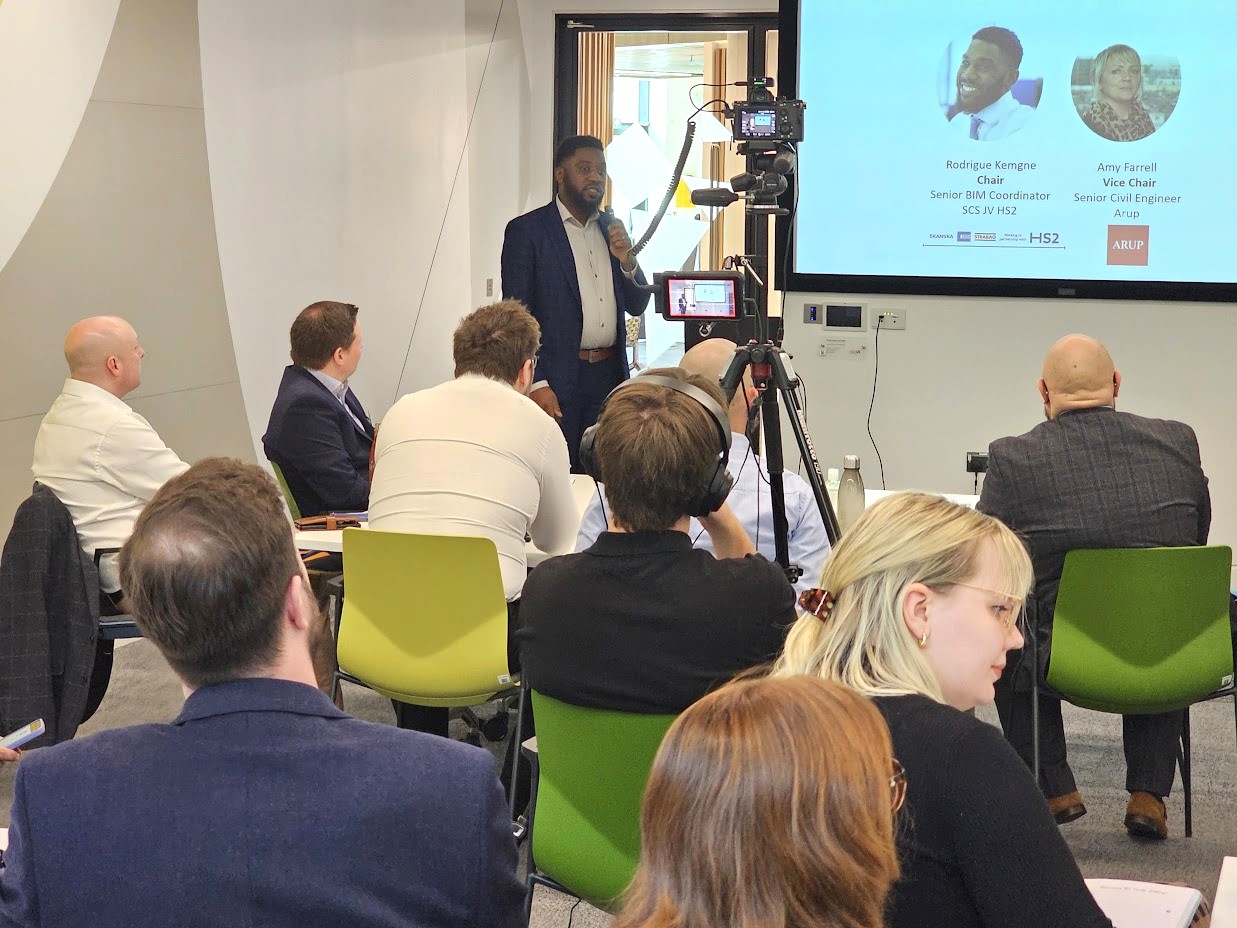
Previously BIM4Water’s Chair, Xylem’s Global BIM Manager Jamie Mills now focuses on data sharing and brings a wealth of experience as Chair of BIM4Water’s Water Data Taskforce. Rodrigue Kemgne chairs BIM4Water’s Beyond 4D Task Group and is also Senior BIM Coordinator on HS2 at the Skanska Costain STRABAG Joint Venture, leading the creation of digital twins at asset level.
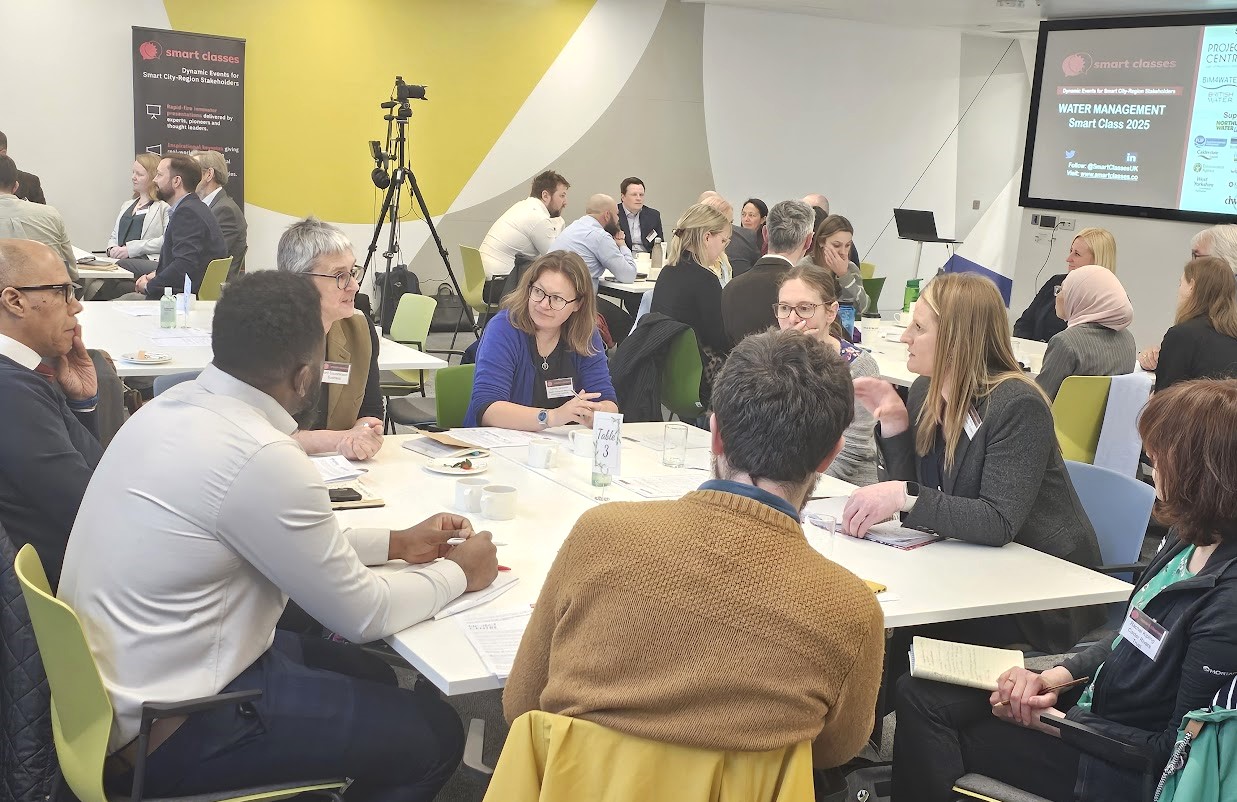
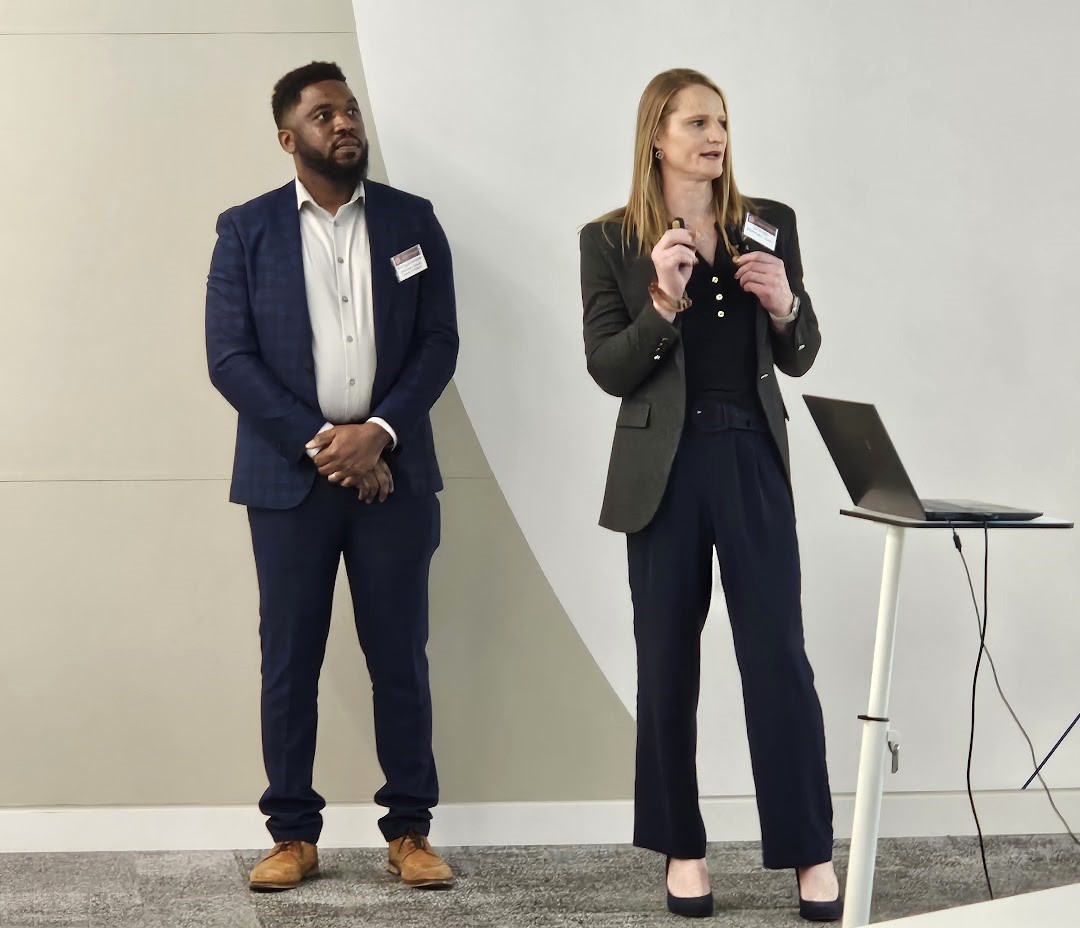
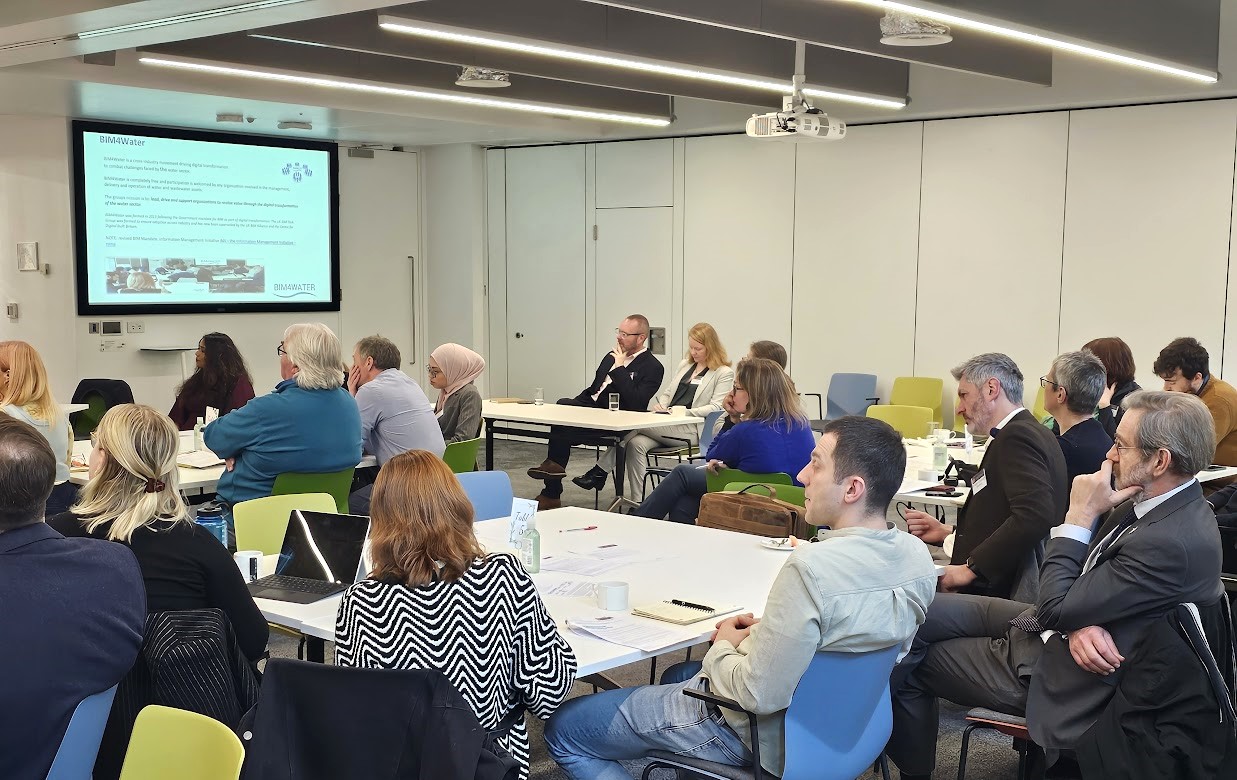
Jamie and Rodrigue joined us at WATER MANAGEMENT Smart Class 2025 to review the journey of BIM4Water to date and highlight the key work of the 4D and beyond task group and its future plans in supporting the water sector in its adoption of visualisation to drive digital transformation and great collaborative practices. Following their presentation they went on to host deeper dive roundtable sessions with each table of delegates.
Presentation highlights and notes:
- BIM? What’s it all about?
- Thinking about building something;
- Thinking about stages and the lifecycle of built assets – From planning, design, building and commission/handover to operation, maintenance, repair and decommissioning;
- Thinking about stakeholders and people – e.g. project management, engineers, specialists and other responsibilities across the client, consultant and contractor;
- Thinking about the amount of information exchanged – e.g. current and future requirements, feasibility, planning, investment, compliance, lead time, environment/carbon, delivery partners, community/disruption, construction safety, delay, supply chain, integration with existing systems, commissioning, operation, maintenance and repair, decommission;
- What happens when we get it wrong?
- Information Management Standards/EN ISOs – General schemas; Processes; Product data schemas; Information quantity & quality etc;
- What is BIM4Water?
- BIM4Water Today – Mission to lead, drive and support organisations to realise value through the digital transformation of the water sector; 2024 Collaborative Partnerships; Deliverables;
- Strategic approach and BIM4Water governance;
- Information Management up to now – Very contained, Organisational level; Recommendations published in the National Infrastructure Commission Report – Data for the Public Good, make clear recommendation for a National Digital Twin;

- National Digital Twin – Better informed, safer system level decision making; Achieving net zero, Providing climate resilience, Tackling challenges, Creating a circular economy, Protecting biodiversity, Disaster response; Data Sharing Infrastructure – Water, Energy, Transport, Health, Manufacturing, Climate data, Telecoms;
- Data for Public Good Examples – National Underground Asset Register, Creating a better place/Swimfo: Find a bathing water;
- Public/Environmental Good – Datasets on Stream Portal e.g. Environmental Impact and Sustainability, Regulatory Compliance, Environmental Management and Conservation, Public Health etc;
- Making it happen “connective tissue” – Data Sharing Infrastructure;
- Water Data Taskforce – Works to facilitate the secure and resilient open data sharing by implementing the work of other BIM4Water Task Groups; Data Sharing – Enabling interconnected systems (across the water sector and between sectors); Data Quality – Accurate, robust and secure data; WDT 2025 objectives;
- Asset Data Standardisation Group – BIM4Water joins forces with Datum360 to develop a data standard platform for the global water industry;
- Legacy & Water Industry Classification Hierarchy Standards – WICHS group works n partnership with Uniclass2015 and Water Services Association of Australia;
- Legacy & Standard Libraries Group (SLG) – Partners with SWAN digital twin-sub-group;
- Beyond 4D Task Group – 2025 update…
- The group’s aim is to develop 4D as a collaborative tool to support leaner, safer and smarter working and project management; The group’s focus is 4D enabler, contractual and procurement arrangements, and benefits; So the 4D group looks to share best practice on benefits capture, employment information requirements making sure visualisation expectations are defined, and the required LOD and right information are understood; Actively supports the industry in using these practices to make smarter safer decisions; They will then look to 5D commercial and then 6D carbon as this develops;
- Digital delivery – The creation of information models will require all new capital delivery and refurbishment projects to use digital ways of working;
- What is BIM? NBS defines BIM as a process for creating and managing information on a construction project throughout its whole life cycle;
- BIM standard BS EN ISO: 19650 – The latest BIM suite of standards to date;
- BIM Standard BS 1192 – There is no 4D nor 5D guidance in these standards;
- BIM Level 2 vs 3D Modelling – The myth of 3D modelling is BIM needs to be busted;
- Dimensions of BIM;
- The opportunities which Beyond 4D represents – 5D BIM; 5D Carbon estimating using BIM model; 6D BIM; 7D BIM; 8D BIM; nD BIM model;
- What is 4D BIM/4D Digital Twin?
- What is 5D BIM/5D Digital Twin?
- The Business case for 4D BIM;
- The Business case for 5D BIM;
- Beyond 4D Task Group Published Documents;
- Beyond 4D Task Group Strategy;
- 4D EIR (Exchange Information Requirements)- A key document for BIM project delivery;
- 4D LOIN Application Matrix and H&S guidance;
- Beyond 4D Task Group Future Releases – 5D LOIN Matrix; 5D guidance;
- How Beyond 4D helps deliver Digital Twins;
- 4D BIM Software – 4D Modelling Software; Planning/Scheduling Software;
- 4D BIM Collaboration;
- Pre-requisites for 4D BIM;
- How is 4D BIM executed?
- The “iron” triangle – 4D BIM aims to reduce construction costs, time on site, whilst increasing the quality of the built asset;
- Benefits of 4D BIM;
- Deliverables of 4D BIM;
- Applications of 4D BIM;
- How is Digital Transformation achieved? Using the McKenzie digital transformation guidelines etc
If you meet our regular delegate qualification criteria but were unable to join us at Nexus Leeds for the live in-person event on April 2nd, CLICK HERE and complete the short “Download form” (located at the bottom of the post) to receive a unique link enabling free access to the presentation video recordings and slides (including the film footage and slides from Jamie and Rodrigue’s initial presentation).
Those qualifying to receive the rich presentation content from this event include commissioning, procurement, innovation, trialling and partnering leads, senior influencers, strategic decision makers, environmental managers, policy makers and planners from UK water companies and utilities, wastewater and sewer operators, lead local flood authorities (unitary authorities and county councils), city/borough/metropolitan councils, district councils, combined authorities, internal drainage boards, regional flood & coastal committees, highways authorities, prime contractors, general insurers, large water consumers, national agencies, central governmental and regulatory bodies (e.g. Defra, DCLG, Ofwat, Environment Agency, DWI, SEPA), independent industry and consumer organisations (e.g. Water UK, CCW), river trusts, NGOs etc.