
Air pollution control didn’t start with regulations, models, or even science. It started with people getting sick—and dying—because the air itself had become dangerous. To understand how we got to today’s sophisticated air quality models, you have to go back to London.
London has struggled with air pollution for centuries. As early as the 1600s, observers were already complaining about coal smoke darkening the sky, but the Industrial Revolution transformed what had been an inconvenience into a persistent public health threat. Coal powered economic growth, but it also filled the air with soot, sulfur dioxide, and dense fog. By the 19th century, London’s “pea-soup fogs” were legendary; visibility dropped to near zero, buildings were coated in grime, and respiratory illness became common. Despite this, meaningful action lagged for decades.
London’s experience was not isolated. Similar pollution disasters occurred elsewhere, including the 1948 Donora, Pennsylvania (just south of Pittsburgh) episode in the United States, where industrial emissions trapped by atmospheric conditions led to dozens of deaths. Events like these helped push air pollution into the public and political spotlight across the Atlantic. Early efforts in the U.S. focused on understanding the problem rather than immediately regulating it. The Air Pollution Control Act of 1955 funded research, and monitoring networks began to emerge. Scientists and policymakers alike began asking a crucial question: where does pollution actually go once it is emitted?
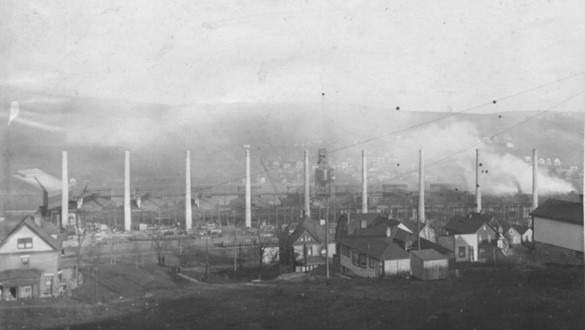
Donora Smog, 1948
A few years later in 1952 what became known as the Great Smog of London settled over the city for five days (caused by coal burning and stagnant weather conditions). When it finally lifted, thousands of people had died, and many more suffered serious health effects. This was not simply an environmental issue, it was a clear and immediate public health crisis. For perhaps the first time, air pollution was widely understood as something that could and should be controlled. The UK’s Clean Air Act of 1956 followed soon after, introducing smoke control zones and restrictions on coal burning. Air pollution control had become formalized policy.
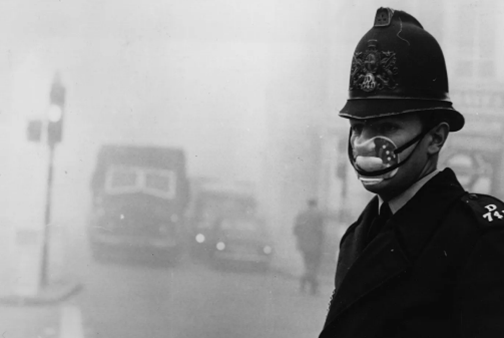
London Smog, 1952
By 1970, the United States had taken a decisive step forward with the Clean Air Act and the creation of the Environmental Protection Agency. This marked a transition from research to enforceable regulation, establishing national air quality standards and a framework for controlling emissions. But regulation alone was not enough. To regulate effectively, it was necessary to predict pollutant impacts to understand how emissions from a source would translate into concentrations experienced by people nearby.
This need gave rise to air dispersion modeling, the critical link between emissions and exposure. The scientific foundations of dispersion modeling date back to the 1930s, when researchers began developing mathematical descriptions of how pollutants spread in the atmosphere. Early work by Bosanquet and Pearson helped establish the basic framework, but a major breakthrough came in 1947 when British scientist Sir Graham Sutton introduced a formulation based on the idea that pollutant concentrations follow a normal, or Gaussian, distribution as they disperse. This concept became the basis of the Gaussian plume model, which remains a cornerstone of air quality modeling today.
As environmental regulation expanded in the 1960s and 1970s, dispersion modeling evolved rapidly alongside it. Advances in computing allowed models to move beyond theory and into practical application. Engineers and regulators could now estimate downwind pollutant concentrations, assess compliance with air quality standards, and design effective control strategies before facilities were even built. Air pollution control had entered a new phase defined not just by reacting to problems but by predicting and preventing them.
Looking back, the evolution of air pollution control follows a clear progression. It begins with crisis-driven awareness, when pollution is recognized but poorly understood. It moves into regulatory response, where governments implement laws and monitoring systems to address the problem. And it ultimately reaches a stage of scientific prediction, where modeling enables forecasting, planning, and optimization. Today, dispersion modeling is embedded in nearly every aspect of air quality management, from industrial permitting to emergency response and urban planning. It plays a critical role in understanding everything from routine emissions to complex events like wildfires and accidental releases.
While what we model has evolved over the years (originally the focus was almost exclusively on coal-fired power plants, now we also model sources like wildfires, burning Battery Energy Storage Systems (BESS), and data centers), the core challenge has not changed. The fundamental question remains: how do emissions translate into real-world exposure? The ability to answer that question depends on the continued development and application of modeling tools. Modern models are far more sophisticated than their early predecessors, incorporating detailed meteorology, chemistry, and real-time data. Yet they still build on ideas developed nearly a century ago, a testament to the strength of those original insights.
Air pollution control did not begin with equations, it began with crisis. But today, it depends on our ability to predict what we cannot see, to understand impacts before they occur, and to make informed decisions that protect public health. That is the enduring legacy of air dispersion modeling.
Bill Jones is President of Blue Sky Modeling, LLC
This article was originally published on LinkedIn on 3rd May 2026
Feature Image: City smog set of flat icons – Macrovector_official on Magnific