
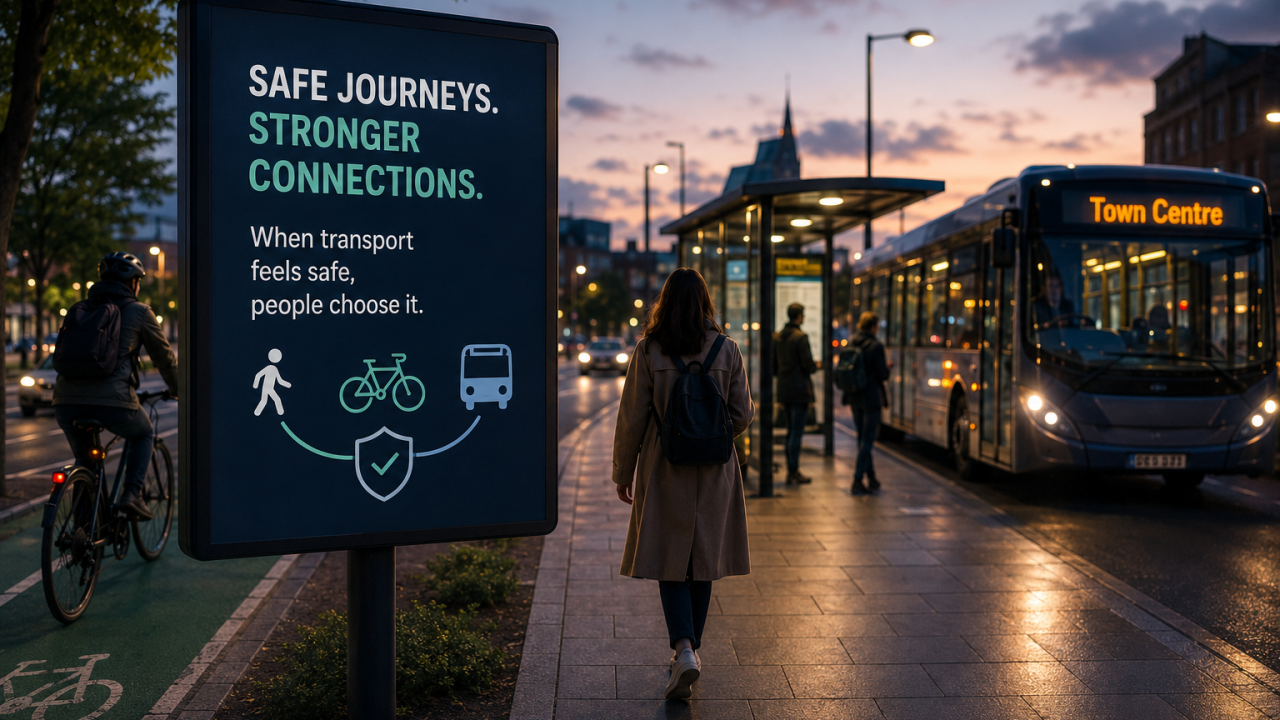
With the Better Transport Week, themed around celebrating the transport that connects people and places, and with the World Cup just getting underway and bringing its own surge of journeys, gatherings and late-night travel across cities and towns (for however long England and Scotland remains in the competition), it is an appropriate moment to reflect on what that connection actually depends upon. Transport networks are often discussed in terms of infrastructure, service levels, journey times and capacity. We model accessibility, forecast demand and design interventions to improve connectivity between homes, jobs, education and essential services. Yet beneath all of this sits a more fundamental condition that is sometimes assumed rather than explicitly addressed: whether people feel safe enough to use the system.
Transport safety has historically been one of the great success stories of modern public policy. Over the past half century, road casualties have fallen dramatically despite substantial growth in travel demand. In Great Britain, road deaths have reduced from more than 7,000 in the late 1960s to around 1,600 annually in recent years. Public transport has played a significant role in that improvement. Department for Transport statistics consistently show that bus and coach travel is among the safest motorised modes on a passenger-kilometre basis, while rail travel is safer still. These outcomes reflect sustained improvements in vehicle design, infrastructure engineering, regulation, enforcement and operational safety management.
Yet this success story contains a paradox that is increasingly important for transport strategy. While actual safety has improved, perceived safety has not always followed the same trajectory. In some cases, it has become more influential in shaping travel behaviour than objective risk itself. This is particularly evident in walking, cycling and public transport use, where concerns about personal security, traffic danger or environmental conditions continue to act as barriers to travel even when statistical risk is comparatively low.
The distinction between actual and perceived safety is not simply a matter of perception management. It has direct implications for mode choice, accessibility and social equity. Transport systems are not experienced as datasets but as environments. People respond to how spaces feel as much as how safe they are in a technical sense. A route that is statistically safe but feels intimidating may be avoided, while a less safe but more familiar environment may be preferred. This behavioural reality is central to understanding why some sustainable travel interventions succeed while others struggle to achieve expected uptake.
Nowhere is this more evident than in active travel. Despite sustained policy focus and significant investment in walking and cycling infrastructure, uptake among many potential users remains constrained by concerns about traffic conditions. Surveys repeatedly show that a large proportion of the population fall into the category often described as “interested but concerned”. These are individuals who are open to cycling in principle but deterred by perceived danger associated with motor traffic. The issue is rarely cycling itself, but the environment in which cycling takes place. Where infrastructure provides separation from traffic, perceived safety increases significantly, and so does willingness to cycle. Where cycling is required to mix with high-speed or high-volume traffic, uptake is substantially lower, regardless of whether collision rates are objectively high or low.
Walking presents a similar but often less visible challenge. It is frequently treated as the most natural and accessible form of transport, yet decisions about whether to walk are still strongly influenced by perceptions of safety, particularly after dark or in unfamiliar environments. Concerns about traffic speed, road crossings, lighting, surveillance and personal security all influence whether walking is perceived as a viable option. This is particularly significant for groups whose travel behaviour is more sensitive to environmental conditions, including women, older people and children. In practice, this means that perceived safety can suppress walking demand in ways that are not always visible in transport data.
Public transport sits at the intersection of actual and perceived safety in a different way. The journey itself is typically very safe, but the experience is shaped by the quality of the waiting environment, interchanges and surrounding public realm. Bus stops and rail stations can feel very different depending on lighting, visibility, staffing presence, maintenance and activity levels. Transport Focus research consistently shows that personal security remains a key determinant of satisfaction, particularly for evening travel. While serious incidents are relatively rare, concerns about antisocial behaviour, harassment or isolation can strongly influence whether people choose to travel, especially when alternatives are available.
What is important here is that perceived safety functions as a kind of hidden cost within the transport system. In traditional appraisal terms, we account for time, money and convenience, but we are less effective at explicitly accounting for confidence or anxiety. Yet these factors clearly influence behaviour. A route that feels unsafe carries a behavioural penalty that may not be visible in standard modelling. It may lead people to switch modes, avoid travel at certain times, or choose routes that are longer or less efficient but feel more secure. In this sense, perceived safety directly affects network performance and mode share, even if it does not appear in conventional transport statistics.
This becomes particularly significant when considered alongside active travel and public transport policy objectives. Much of current transport strategy is built around encouraging modal shift away from private car use towards more sustainable forms of travel. However, if walking, cycling or public transport are perceived as unsafe, then the effectiveness of even well-designed infrastructure or service improvements will be constrained. This is why investments in lighting, place making, staff presence, visible enforcement and high-quality public realm design should not be viewed as peripheral enhancements. They are central to creating conditions in which sustainable transport choices become realistic options for more people.
The implications also extend into road safety policy. The Vision Zero approach has been highly effective in reframing road danger around the principle that no death or serious injury is acceptable. However, much of its implementation still focuses primarily on casualty reduction metrics. While these remain essential, there is a growing case for broadening the definition of success to include behavioural outcomes linked to perceived safety. These might include increases in independent travel by children, higher rates of cycling among people who previously considered it unsafe, greater willingness to walk after dark, or increased public transport use among groups currently deterred by concerns about personal security. These are not soft indicators. They are direct measures of whether the transport system is trusted by its users.
What emerges from this is a broader reframing of safety in transport planning. Safety cannot be treated solely as a technical discipline focused on preventing collisions and injuries, important as that work remains. It must also be understood as a behavioural and experiential condition that influences whether people are willing to engage with the transport system at all. A transport network that is safe in statistical terms but not trusted by its users will not deliver its full social, environmental or economic potential.
Connections only exist where there is confidence to travel. That confidence is shaped by a complex interplay of infrastructure design, operational quality, environmental condition and social experience. It is influenced by engineering decisions made years earlier, by maintenance regimes that keep environments welcoming, and by frontline staff who provide reassurance in moments of uncertainty.
If there is a single implication for transport professionals, it is that safety should no longer be seen as a background compliance requirement or a purely operational function. It is increasingly a central determinant of whether transport systems succeed in achieving their wider objectives. The challenge for the next phase of transport policy is not only to continue improving actual safety, which remains essential, but to bring perceived safety into the mainstream of transport planning, design and appraisal.
Because ultimately, a transport system only connects people and places if people believe it is safe enough to use. And that belief, as much as any infrastructure investment or service improvement, will shape the future of sustainable transport.
Ultimately, the transport sector has become highly sophisticated at managing and measuring actual safety. We have robust systems for tracking casualties, analysing risk, and improving engineering standards across all modes. That progress should not be understated. However, the evidence increasingly suggests that this is no longer sufficient on its own to achieve wider policy goals around mode shift, inclusion and decarbonisation. A transport system can be statistically safe yet still feel inaccessible to large sections of the population. When that happens, safety becomes a constraint on demand rather than a foundation for it.
The implication for transport specialists is that perceived safety can no longer sit at the margins of appraisal, design and delivery. It needs to be treated as a core system outcome alongside reliability, accessibility and efficiency. That means giving greater weight to environmental quality, visibility, passive surveillance, traffic conditions and the lived experience of waiting, walking, cycling and interchanging. It also means recognising that interventions which improve confidence may deliver benefits that are not fully captured in traditional cost-benefit frameworks, even where they have a significant impact on behaviour.
For government and national agencies, the challenge is even sharper. If we are serious about achieving modal shift at scale, then we need to acknowledge that infrastructure alone will not deliver it. Investment in active travel, public transport and public realm improvements must be matched by a clearer focus on the conditions that determine whether people feel able to use those investments in practice. That may require a more explicit link between safety, perception and demand in policy guidance, funding criteria and evaluation frameworks.
Better Transport Week is a useful reminder that transport is ultimately about connection. But connection only exists where there is confidence. The next phase of transport policy will not be defined solely by how safely people can travel, but by whether enough people believe they can travel safely enough to change how they move.
Tim Bellamy is Assistant Director – Transport at Cambridgeshire & Peterborough Combined Authority
Tim originally published this article on LinkedIn on 19th June 2026
Feature Image: Author Sourced