Megan Black is Head of Logistics & Environment at Transport for Greater Manchester. She leads the development and delivery of freight, logistics, environmental and air quality activities, in support of Greater Manchester’s objectives and strategies.
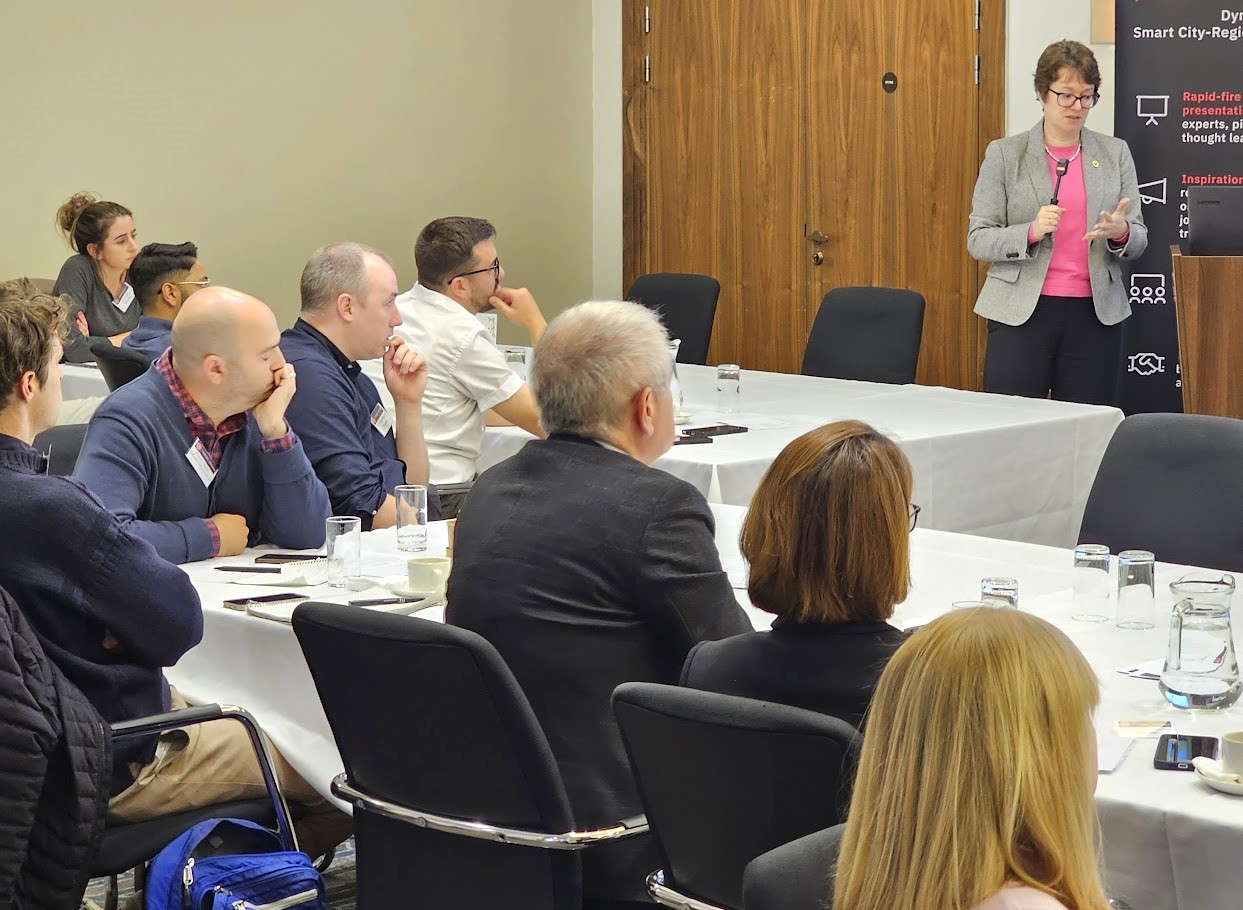
TfGM coordinate air quality work across the city-region in conjunction with all 10 GM local authorities. In her keynote presentation at EMISSIONS & AIR QUALITY Smart Class 2025, Megan outlined how transport initiatives and strategies are helping to achieve the goal of improving the air that Greater Manchester breathes.
The scope of her presentation ranged from building the Bee Network, TfGM air quality responsibilities, GM Transport Strategy 2040, LTP vision, GM Environment Plan 2025-2030, GM’s AQAP and the recently approved (January 2025) Investment led CAP, to Bee Network buses, EV and charging infrastructure, monitoring electric travel, zero emission journey tracking, local traffic management, Bee Network’s greener future, the active travel mission, and GM’s clean air data hub.

Summary of presentation highlights:
- Introducing Transport for Greater Manchester – TfGM are the local government body responsible for transport in Greater Manchester (GM) and the first city-region outside London to bring bus services under local control as part of the Bee Network; TfGM manage the Key Route Network (nearly 400 miles) keeping traffic flowing on some of GM’s busiest roads; TfGM own GM’s bus stations, stops and shelters, and invest in new, modern technologies; They also own the country’s largest light rail network with 99 stops over 100km of track on eight lines right across GM; TfGM run the Starling Bank Bike Scheme; TfGM work with Greater Manchester’s authorities improving lives by connecting people and places;
- Building the Bee Network – TfGM are integrating fares, ticketing and customer information under a single, trusted brand and building the country’s largest active travel network; Driving economic and productivity growth, enabling housing and job creation; Connecting people to new opportunities, essential services and each other; Aim is for Bee Network to be a one-stop-shop for local travel, helping people to choose and use greener ways to get around; From 5 January 2025 – bus, tram and active travel integrated; From 23 March 2025 – multi-modal fares and ticketing for bus and tram; By 2028 – eight commuter rail lines will be brought into the Bee Network, with other lines joining by 2030;
- Active Travel Network – Connecting every area and community in GM with 1,800 miles of safe routes and 2,400 new crossings, putting nearly all residents (95%) within 400 metres of a high-quality walking, wheeling and cycling route;
- Every day there are 5.6 million journeys on the city-region’s roads, trains, trams and buses; Approximately 7.2 million miles are ‘clocked up’ across the tram network each year by TfGM’s fleet of 147 trams, which currently cater for more than 41m journeys, using 42GWh of Green Energy (2023); 1634 Franchised Buses with 234 zero-emission, over 577 routes with 160 million passenger trips per year; The Mayor’s ambition is for a fully electric bus fleet by 2030; Starling Bank Bikes accommodate over 200 stations and 2,000 stands within a five-minute walk of c.200,000 residents, rolled out across parts of Manchester, Salford and Trafford;
- TfGM & Air Quality – TfGM coordinate air quality work across GM in conjunction with all 10 GM local authorities and this includes Local Air Quality Management (including the AQMA and AQAP) , the GM Clean Air Plan, Annual Status Report and GM Air Quality alerts (a free service sending out notifications on high pollution days); TfGM is a resource for LA’s, GMCA and others to advise on improving air quality; TfGM develop projects and partnerships across GM, and are currently managing a DEFRA funded project on PM2.5 and domestic solid fuel burning; Multi-year scientific research and behaviour change project to understand the risks of fine particulate air pollution across GM; Working to build an evidence base of AQ impacts across GM, based on open data;
- TfGM – part of the GM Family: GM 2040 Transport Strategy/Local Transport Plan, Five Year Environment Plan and GM Air Quality Action Plan are all (along with strategies and plans for climate adaption, energy, water management, place, nature recovery, retrofit, clean growth sector, employment & skills etc) part of the Greater Manchester Strategy and Local Growth Plan;
- GM Transport Strategy 2040 – Supporting sustainable economic growth + Protecting our environment + Improving quality of life for all + Developing an innovative city-region = Transport Vision for “World-class connections that support long-term sustainable economic growth and access to opportunity for all”; 2.8 million residents across GM, including + 250,000 since 2000; Ambition is to achieve zero net growth vehicle traffic between 2017 and 2040 with no more than 50% of trips being made by car – this will require approx. one million more trips daily made by active and sustainable transport modes by 2040;
- Local Transport Plan Vision – Supporting People and Place: GM’s plan is for the transport network to improve peoples’ lives and create great places by – Connecting and improving neighbourhoods; Creating vibrant town centres; Improving connections between places across the wider city region; Enhancing connections into and around our regional centre; Enhancing GM’s links with cities and places across the country; Enabling a globally connected city;
- Greater Manchester 5-Year Environment Plan 2025-2030 – Contains local and complimentary goals for sustainable travel and to improve air quality: AQ1 = Reduce emissions that contribute to poor air quality (PM2.5) – 22% reduction in PM2.5 exposure by January 2028; AQ2 = Reduce emissions that contribute to poor air quality (NO2) – Zero exceedance of the NO2 annual mean objective by 2026; AQ3 = Reduce emissions that contribute to poor air quality (NO2) – % of monitoring sites that meet WHO Interim Targets; AQ4 = Engage with communities and business to encourage them to adopt behaviours that contribute to improving Air Quality;
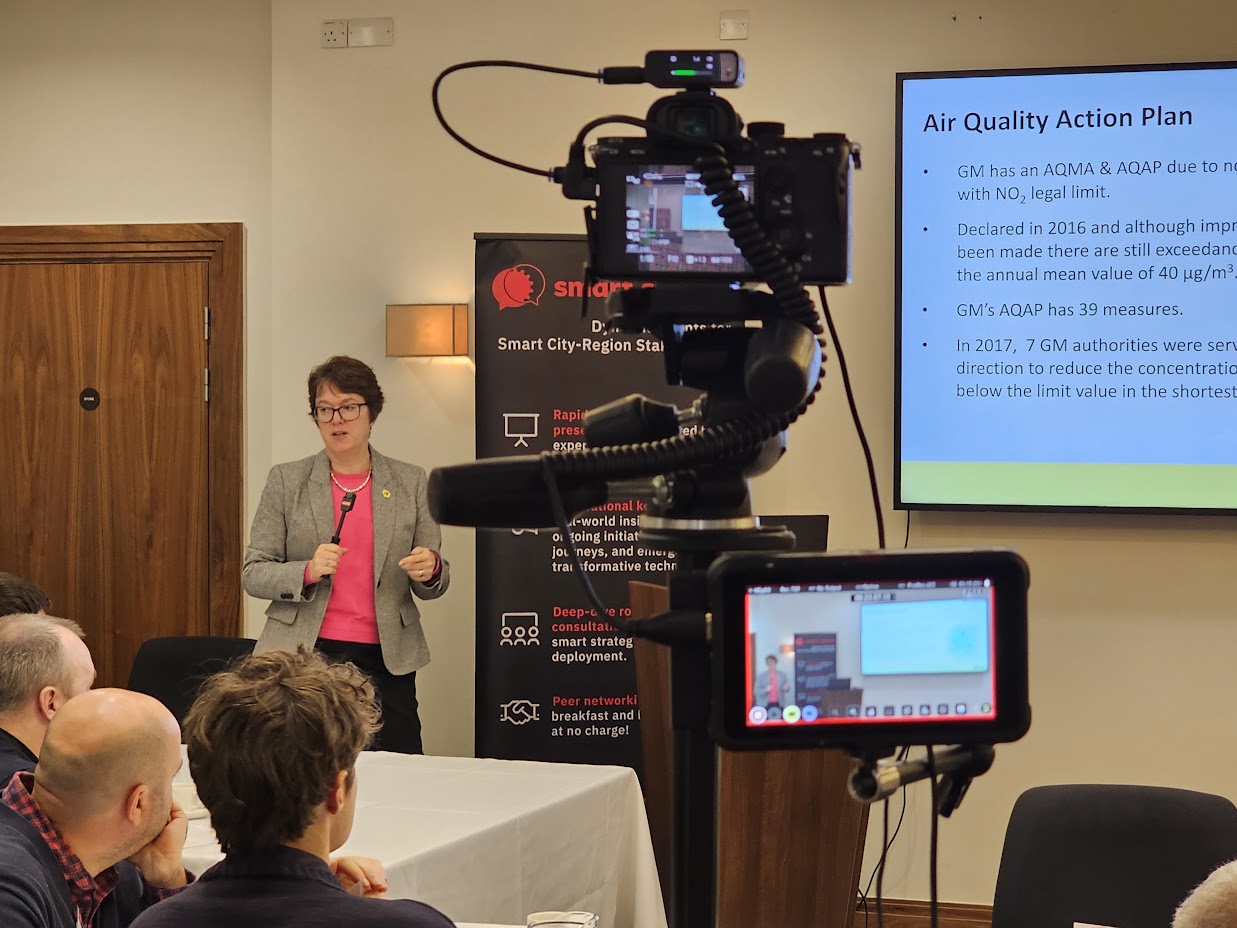
- Air Quality Action Plan – GM has an AQMA & AQAP due to non-compliance with NO2 legal limit; Declared in 2016 and although improvements have been made there are still exceedances for NO2 above the annual mean value of 40 ug/m3; GM’s AQAP has 7 headline areas, broken down into 39 specific measures; In 2017, 7 GM authorities were served with a legal direction to reduce concentrations of NO2 to below the limit value in the shortest possible time; As well as this GM has a CAP, which was declared later than the LA AQMA;
- Greater Manchester Clean Air Plan – The ten local authorities, Greater Manchester Combined Authority (GMCA and Transport for Greater Manchester (TfGM) have been working together to develop a Clean Air Plan to tackle NO2 exceedances at the roadside; LAs must consider implementing a charge based Clean Air Zone unless there are other measures that achieve compliance sooner; Target Determination in 2018; Investment-led Plan agreed in January 2025;
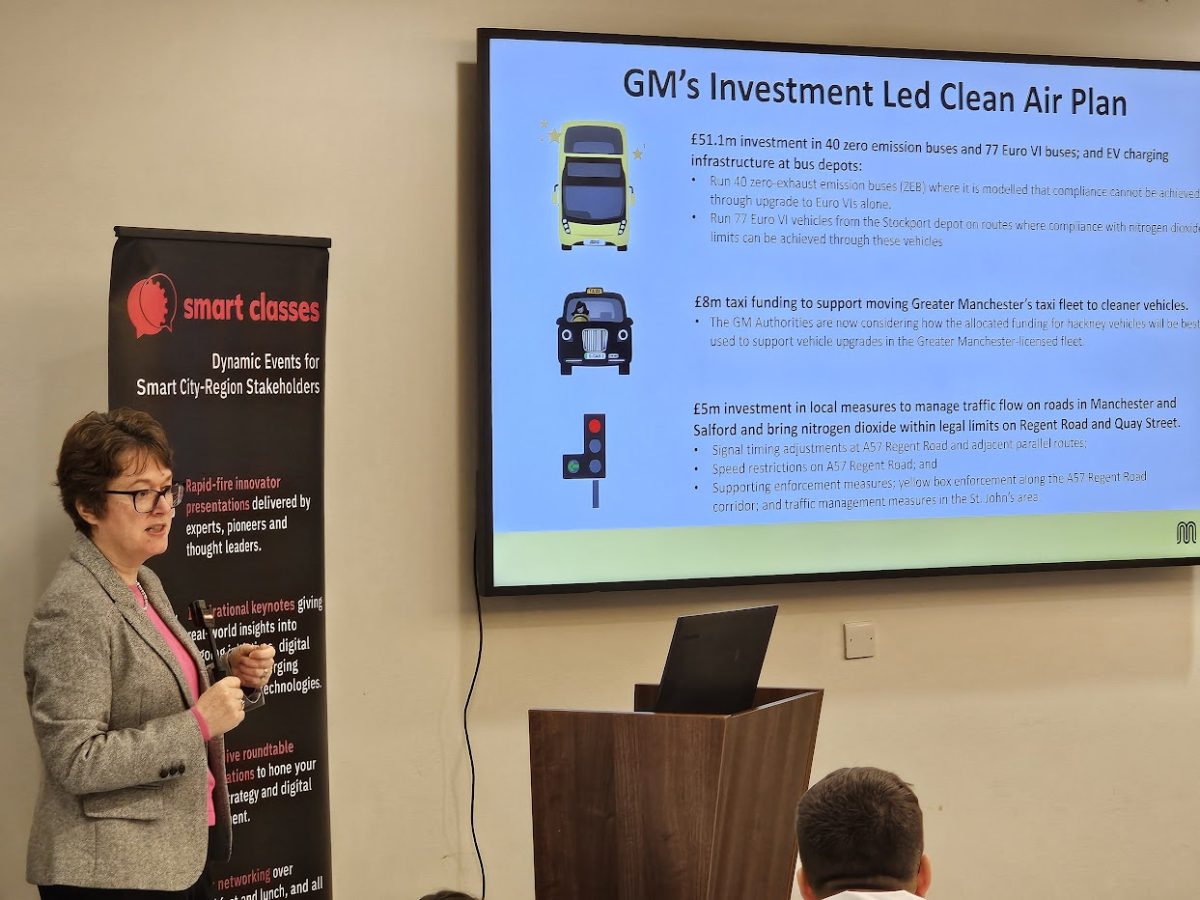
- GM’s Investment Led Clean Air Plan – £51.1m investment in 40 zero emission buses (ZEBs) and 77 Euro VI buses, and EV charging infrastructure at bus depots; £8m taxi funding to support GM’s taxi fleet to cleaner vehicles; £5m investment in local measures (e.g. signal timing adjustments, speed restrictions and yellow box enforcement) to manage traffic flow on roads in Manchester and Salford and bring nitrogen dioxide within legal limits on Regent Road and Quay Street;
- It is considered counter-productive to further reduce bus mileage, given that in the longer term the best way to reduce emissions of all kind is to encourage people to switch from the car to public and active modes – Thus, the goal is to reduce bus emissions without reducing access to bus services;
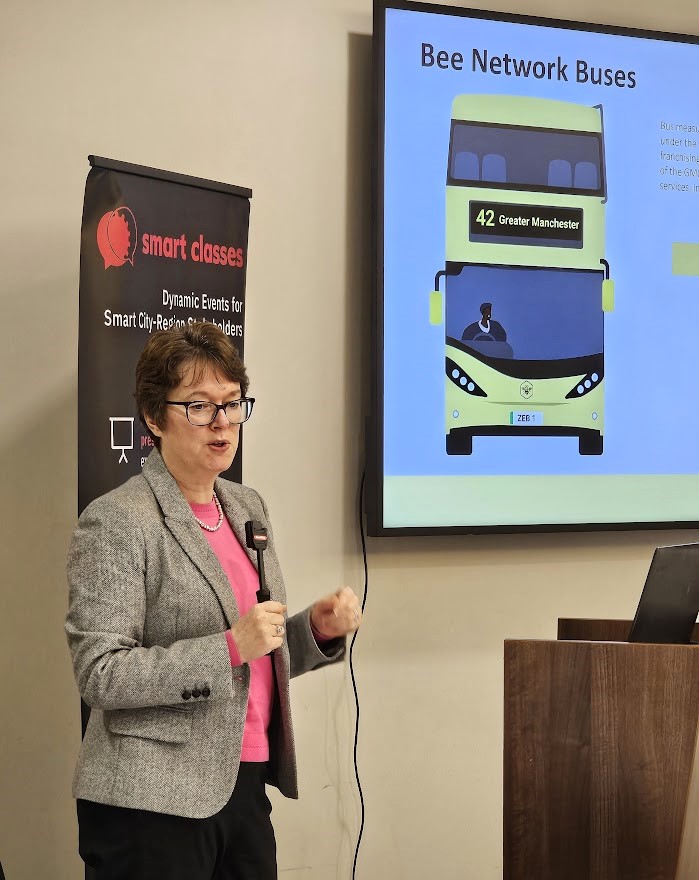
- Bee Network Buses – Bus measures represent the most important mechanism for reducing exceedances under the Investment-led Plan and are grounded in the ability of GM to operate a bus franchising scheme; TfGM is responsible for operating the franchising scheme on behalf of the GMCA and has the authority to manage franchise agreements in respect of local services, including the specification of fleet requirements and deployment; 2017 – 9% of fleet compliant with Clean Air Standards; 2025 – 75% fleet compliant with Clean Air Standards, with 292 ZEBs representing 17.2% of fleet; 2030 – Ambition for zero emission fleet; Data for first 50 vehicles in service shows they travelled 925,000 miles, equating to an in-use saving of roughly 1,000 tonnes of CO2e and could have prevented up to 208 kg NO2 during use;
- EV and Charging Infrastructure – For personal vehicles, GM has over 1,400 chargers (296 ultra, 286 rapids, 317 fast, 545 slow), and this provides over 2,200 public connection points (Sept 2024); Using LEVI funding to supply Electric Vehicle Charging Infrastructure to residents without off-street parking and in areas not considered commercially viable; Taxis and PHVs have access to over 60 taxi-only charging points across the region;
- Monitoring Electric Travel – GM has adopted two new indicators: 1) The percentage of residential properties (without access to off-street parking) that are within 300m of charging infrastructure. This allows Greater Manchester to track progress towards facilitating charging infrastructure in residential areas without a significant amount of off-street parking. 2024 baseline = 22% 2) A Zero Emission Journey Tracker. This allows GM to monitor the progress of journeys by mode that do not emit any greenhouse gases or air pollutants from their operation, which supports the ambition for the city region to be carbon neutral by 2038. 2023 baseline = 36% (TRADS data – GM residents); “We have the Right mix” – this recognises that different modes of transport have different strengths and weaknesses, and that the best transport system is one that offers a range of options that suit different needs and preferences; The zero emission tracker recognises that we need to see all journeys switch to transport modes that do not emit any GHGs or air pollutants from their operation and to monitor the transition to zero emission journeys in the region;
- Zero Emission Journey Tracker – Breakdown of Zero emission position, Baseline annual trips 2023 and GM Ambition for 1) Walking 2) Cycling 3) Bus 4) Metrolink 5) Local Rail 6) Cars 7) Taxi 8) All Trips (TRADS data 2023 – GM residents);
- Local Traffic Management – Junction redevelopment prioritises active travel to improve safety and enable more people to choose active travel for all or part of their journey; As well as traditional engineering projects we innovate how to manage our network; Work with Google using AI to optimise signal timings and reduce stop-start traffic; Oldham (J22, M60) saw 9% reduction in the number of stops (failing to get through green light), saving estimated 160 engine hours and 493 litres of fuel per year; Over half of traffic signals use adaptive control with signal timings that vary with demand to minimise delays; 118 sites include control of Metrolink trams, giving them full priority; A growing number of sites include priority for late running buses with funding for a further 140 through CRSTS; Automatic traffic counters, CCTV and upgraded traffic signals enable greater traffic monitoring, for reactive and remote adjustment of signal timings; Optimises traffic flow in response to incidents, to improve bus reliability and journey times across the network;
- Bee Network Greener Future – TfGM future-proof new infrastructure projects for increased demand, new services and the environment; The new Stockport Interchange provides high quality, accessible connections between the railway station, interchange and town centre, avoiding the A6; Incorporates new greenspace ‘Viaduct Park’ around the top of the development; Designed with future Metrolink integration in mind;
- Active Travel Mission – Three foundations are at the heart of TfGM’s Active Travel Mission: 1) Accessibility – “Active travel in GM is for everyone. It must be accessible for all and built to consistent standards that go above and beyond local and national standards. That means making space on our streets for the right infrastructure and adaptations” 2) Behaviour Change – “We have a ‘Right Mix’ for 50% of all journeys to be made by walking, cycling and public transport. We’re enabling people to change the way they travel, making journeys by foot, on a bike or on wheels and reducing the number of trips made by car” 3) Communications & Engagement – “We’re committed to keeping you updated as we roll out improvements. We promise to make sure our communications are open, honest and easy for everyone to understand, and its simple to find out how to get around actively”;
- Working with communities to design and develop projects that deliver e.g. Youth Travel Ambassador programme, Modeshift STARS online travel planning, School Streets and Living Streets;
- Clean Air GM Website – Find the latest air pollution information for Greater Manchester e.g. Diffusion tube data, Monitoring reports, Automatic monitoring stations data, Air quality forecast & alerts etc
If you satisfy our regular delegate qualification criteria but were unable to join us in Leicester on May 8th for the live in-person event at City Hall, CLICK HERE and complete the short “Download form” (located at the bottom of the post) to receive a unique link enabling free access to the presentation video recordings and slides (including the film footage and slides from Megan’s keynote).
Those qualifying to receive the rich presentation content from this event include commissioning, procurement, trialling, partnering, policy and programme leads, senior influencers, strategic decision makers, environmental managers, climate/sustainability/transport/public health officers and planners from local authorities (e.g. city, borough, metropolitan, district and county councils); public and private transport operators/service providers; sub-regional transport bodies, combined authorities, integrated transport authorities and passenger transport executives; freight and logistics operators; airports and port operators; vehicle manufacturers; energy providers; potential partners from industry (e.g. retail, construction, manufacturing and waste management sectors) and healthcare; DfT, Defra, EA, BEIS, DHSC, UKHSA and other and supporting national agencies; prime contractors; academia etc.