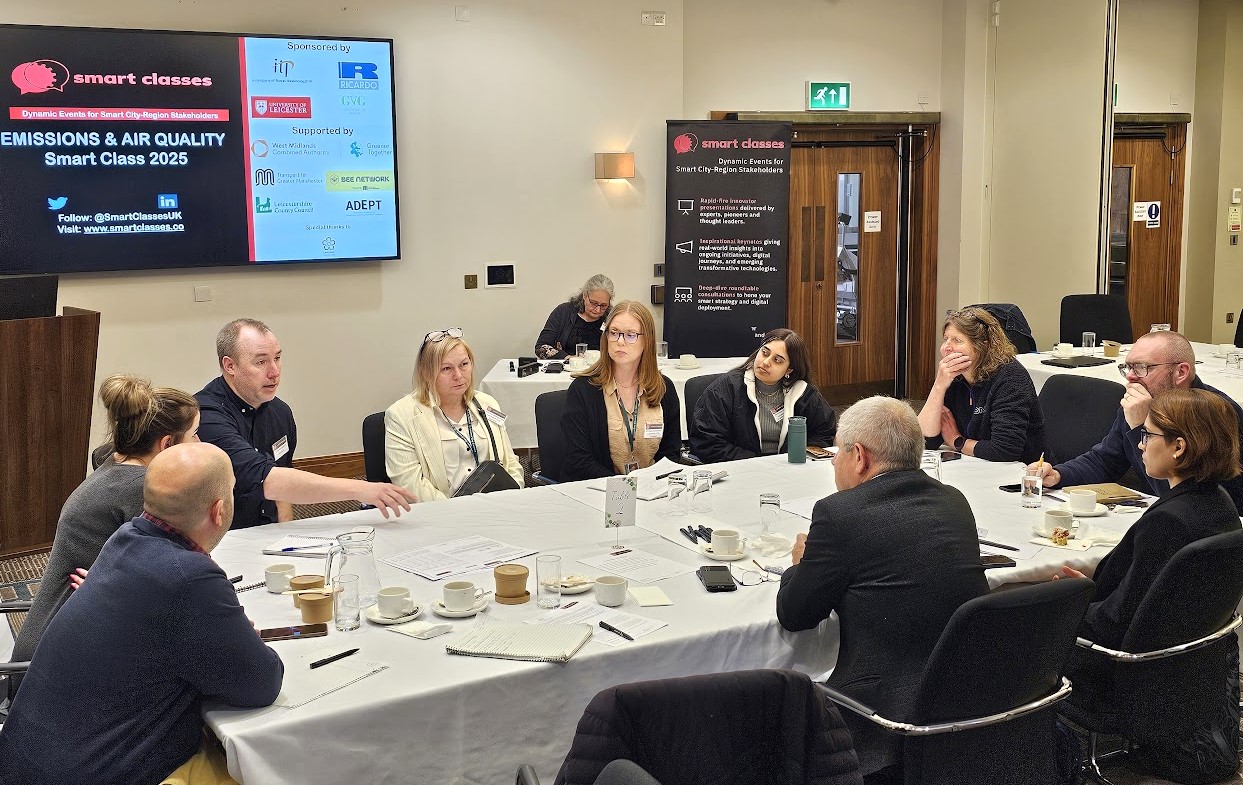
Principal Air Quality Consultant, Tim Bevington, explained at EMISSIONS & AIR QUALITY Smart Class 2025 how Ricardo is applying its world-leading expertise in air quality measurement to enable local authorities across Greater Manchester to monitor the contribution to air pollution from wood burning stoves, raise public awareness of its risks, and reduce its impact on people’s health.
On behalf of TfGM, 43 low-cost sensors (LCS) are deployed across 41 monitoring locations, monitoring PM2.5, PM10, NO2, NO, CO and O3. Ten of the 43 devices also monitor CO2. Over the monitoring period two winter behaviour change marketing campaigns will be run, specifically aimed at reducing emissions from domestic burning. The LCS network is critical in evidencing that the behaviour change campaign is having an impact on concentrations in the region.
An understanding of data quality and uncertainty is required to enable evaluation of air pollution interventions. Tim’s presentation demonstrated how Ricardo’s LCS QA/QC methodology, through co-location correction scaling, regional scaling, and data ratification, will provide an improved particulate measurement uncertainty. Three further sensors are continuously co-located at a reference site to understand on-going performance. Four LCS are installed in each borough, with two in locations with a high number of wood burning stoves and two in locations where domestic burning is known to be less likely. Rigorous data will enable researchers to better understand the different concentrations of air pollution and evaluate policy impact.
With support from Jo Solan (Senior Air Quality Consultant), Tim subsequently co-hosted in-depth roundtable sessions with the delegates.

Presentation highlights and notes:
- The Sensor Network and its Objectives…
- DEFRA Air Quality Grant funded project to support Greater Manchester’s aim to reduce PM2.5 concentrations through a reduction of domestic burning;
- Sensor network to provide an evidence base for PM2.5 and to assess the impact of behaviour change campaigns;
- First behaviour change campaign will be launched soon, targeting the whole of Greater Manchester;
- Aim to improve the uncertainty of MCERTS indicative PM measurements to provide a strong evidence base to feed into research and public communications;
- Ricardo have procured and deployed 43 indicative low-cost sensors (LCS) at 41 locations across Greater Manchester;
- Along PM2.5 and PM10, sensors also monitor NO, NO2, CO, O3 and 10 monitor CO2;
- On-going QA/QC regime for PM2.5 & PM10 measurements. Other pollutants only scaled from co-location (greater measurement uncertainty);
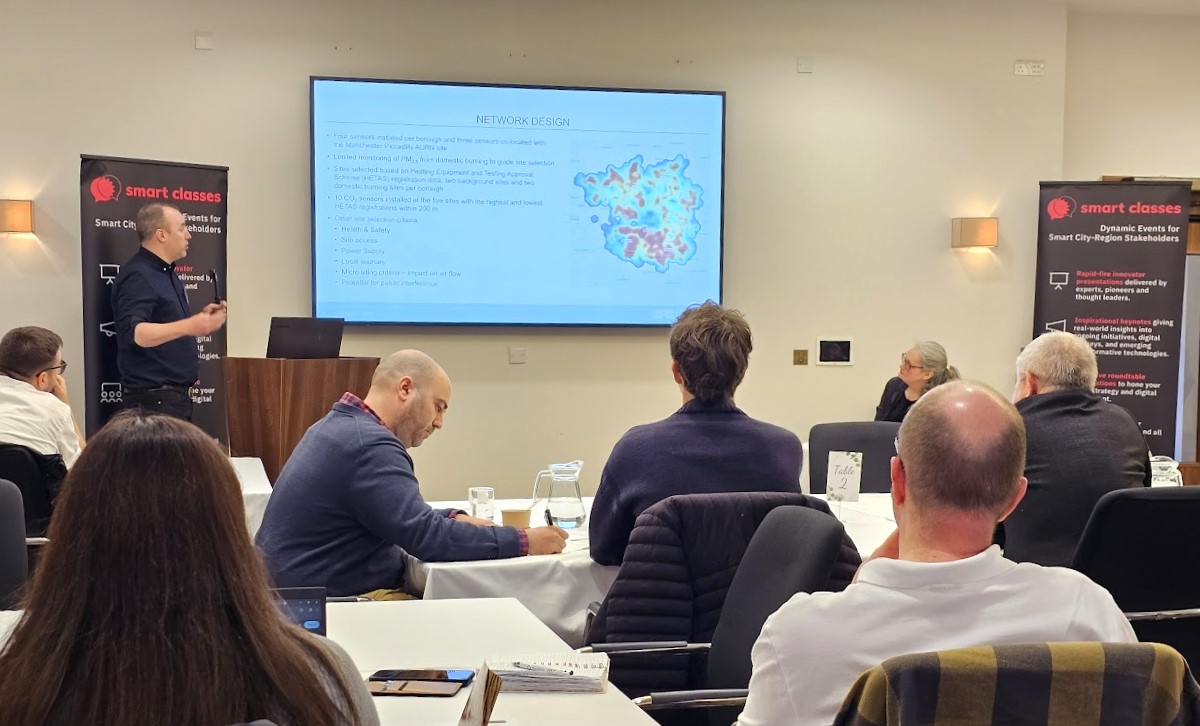
- Network Design…
- Four sensors installed per borough and three sensors co-located with the Manchester Piccadilly AURN site;
- Limited monitoring of PM2.5 from domestic burning to guide site selection;
- Sites selected based on Heating Equipment and Testing Approval Scheme (HETAS) registration data – two background sites and two domestic burning sites per borough;
- 10 CO2 sensors installed at the five sites with the highest and lowest HETAS registrations within 200 m;
- Other site selection criteria – Health & Safety, Site access, Power Supply, Local sources, Micro siting criteria – impact on air flow, Potential for public interference;

- Data Hub and Reporting…
- Data and reporting provided to the customer through a bespoke Data Hub;
- The Data Hub includes: Project details, Monitoring locations, Site types, Data explorer, Data download portal, Dynamic reports;
- Password protected area due to sensitivity of the project;
- Dynamic reports provide regular analysis of the data to increase understanding and accessibility;
- QAQC – Why?
- Need some way of linking lower cost sensor (LCS);
- BUT also need to know that reference measurements are of the required quality (International/European Intercomparisons, UK Certification, Local “calibrations”, LCS measurements of known accuracy);
- Any break in this traceability chain and you lose the link to more accurate measurements;
- …AND as a result, the ability to assess the accuracy of the LCS measurements, which has direct implications on how you can use the data;
- QA/QC and Network Performance…
- Sensor holds MCERTS indicative certification for PM measurements (50% Data Quality Objective for PM at relevant Limit Value);
- On-going QA/QC required to maintain MCERTS standard;
- Project aims to improve measurement uncertainty through proven QAQC methodology;
- Initial Co-location at reference station before project commenced;
- Co-location of any sensors following repair;
- Ongoing co-location of three sensors at Manchester Piccadilly to monitor performance and provide regional adjustment if required;
- Sensor datasets scaled automatically, based on co-location factor;
- Continuous QAQC with sensor data corrected in near real time and ratified quarterly;
- Existing reference network used to further scale the sensor network;
- Regional Adjustment – Extracting the “Regional Signal”…
- Rural background concentrations consistent across >100 km;
- Urban background concentrations consistent across areas of a city;
- How can we extract the “regional signal” from measurements? Find commonality across the reference network; Frequency analysis – extract low frequency trends e.g. 1-min to hourly peaks due to local sources; background concentrations will vary over several days;
- Regional Adjustment – Testing PM2.5…
- Four co-location sites throughout the UK (mixture of roadside and background);
- Uncorrected – wide range of performance!
- Corrected with 10-day co-location – Improvement, all LCS pass 50% target, but co-locations are required, and results are not guaranteed on an ongoing basis;
- Corrected with ongoing co-location – All achieve < 50% uncertainty providing confidence that indicative measurements can be achieved using a regional correction;
- How does this look in the real world?
- The following charts show the measurement uncertainty of one of the co-located sensors in the Greater Manchester project…
- Ongoing Co-location at Manchester Piccadilly – Raw Data;
- Ongoing Co-location at Manchester Piccadilly – Scaled Data;
- Ongoing Co-location at Manchester Piccadilly – Regionally Scaled Data;
- These plots show all three co-located sensors (uncertainty before correction and following regional adjustment)…
- QA/QC and Network Performance – PM2.5;
- QA/QC and Network Performance – PM10;
- Ricardo’s approach is always evolving as they undertake more research and hold more monitoring data. The first calibrates each individual sensor using the regional signal, the second is looking at the whole network (ref and sensor) to build a pollution map and then by using the similarities between the networks can derive correction factors…
- Method is Evolving – PM2.5;
- Method is Evolving – PM10
If you meet our regular delegate qualification criteria but were unable to join us at Leicester City Hall for the live in-person event on May 8th, CLICK HERE and complete the short “Download form” (located at the bottom of the post) to receive a unique link enabling free access to the presentation video recordings and slides (including the film footage and slides from Tim’s initial presentation).
Those qualifying to receive the rich presentation content from this event include commissioning, procurement, trialling, partnering, policy and programme leads, senior influencers, strategic decision makers, environmental managers, climate/sustainability/transport/public health officers and planners from local authorities (e.g. city, borough, metropolitan, district and county councils); public and private transport operators/service providers; sub-regional transport bodies, combined authorities, integrated transport authorities and passenger transport executives; freight and logistics operators; airports and port operators; vehicle manufacturers; energy providers; potential partners from industry (e.g. retail, construction, manufacturing and waste management sectors) and healthcare; DfT, Defra, EA, BEIS, DHSC, UKHSA and other and supporting national agencies; prime contractors; academia etc.