
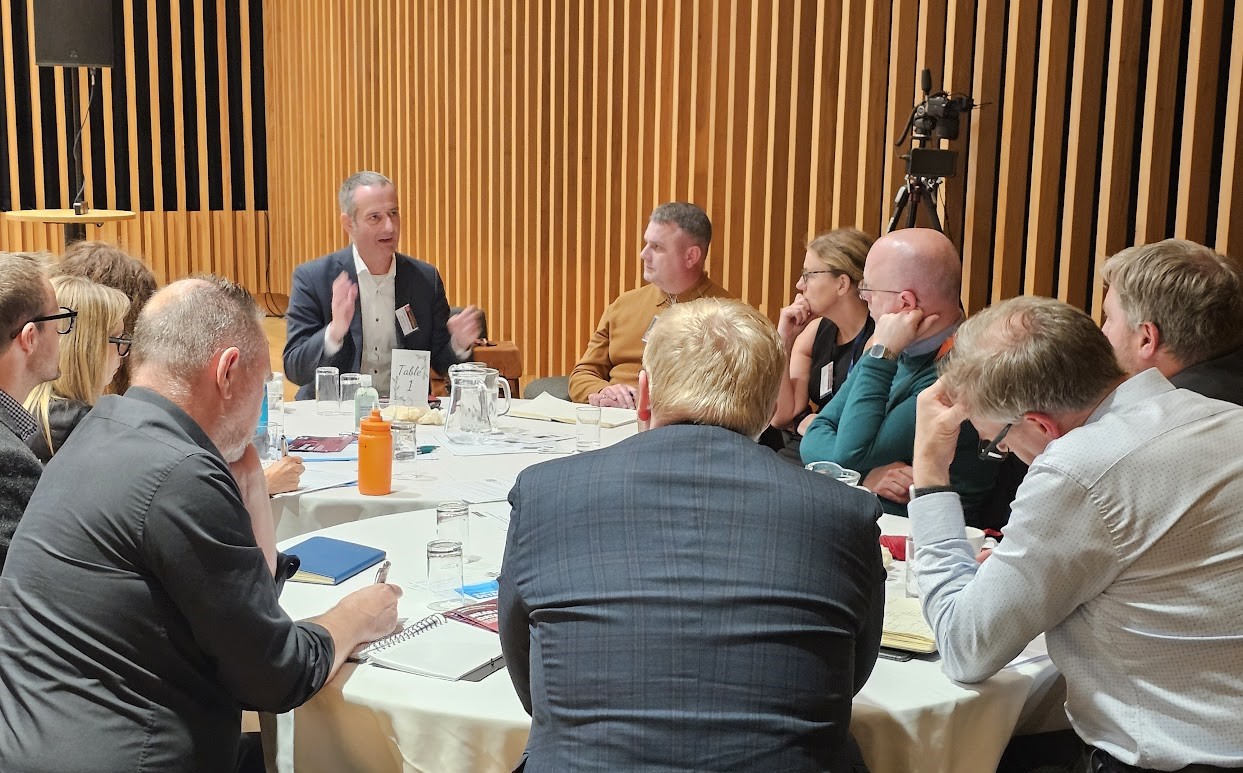
Founded in 2019 as a spinout from the University of Leeds, Slingshot Simulations is a decision intelligence solutions company applying cutting edge data science to tackle many of the biggest challenges we face today. At TRANSPORT Smart Class, North of England 2024, CEO Robert Harwood took the podium to introduce the emerging concept of place-based decision intelligence technology – digital solutions combining data, models and simulations, analytics, digital twins and AI/ML.
He discussed its potential to deliver a system level perspective of transport strategies in the context of decarbonisation, energy, climate, regeneration, socio-economics and more – and its role in supporting regional decision makers optioneer, sift and prioritise business case investments while engaging a wide range of stakeholders with data-based evidence.
The concept was impressively demonstrated through real world deployment examples with Sunderland City Council, West Yorkshire Combined Authority, Greater South East Net Zero Hub/Essex County Council and the UK Department for Transport.
Rob subsequently hosted deeper dive roundtable sessions with the support of Steven Puetz, Slingshot’s Head of Commercial Operations.

Presentation highlights:
- Place-Based Decision Intelligence: Key to Linking SDGs to Action – Transforming Infrastructure Performance Roadmap to 2030 – Societal outcomes, Policy and Systems of Systems; Decision Intelligence – Accessible data and advanced analytics (modelling and simulation, digital twins, AI/ML) to deliver an integrated systems approach to tactical actions and strategic plans spanning Transport & Mobility, Energy, Climate, Growth and Regeneration, Air Quality etc…and empowering rapid, large-scale policy optioneering in the chasm between political commitments and detailed design;
- Place-Bases Decision Intelligence: Proven ROI – Slingshot’s PBDI technology stack (top to bottom) = Decision Intelligence, Analytics, Model, Data; The power of place-based decision intelligence – 7x greater ROI: Place specific net zero scenario policy investments delivers a 14x ROI compared with 2.5x for place agnostic investments;
- Critical Barriers to Adoption Exist – The main barrier to Net Zero implementation is often generating a consensus on the way forward in a dynamic area with rapid, hard to predict changes in technology, policy and public opinion. Many boards are struggling to articulate meaningful carbon strategies and are confronted with some degree of “analysis paralysis”. They recognise the importance of having a credible roadmap to delivering Net Zero but also acknowledge that waiting for complete clarity is unrealistic and potentially damaging. Three key challenges to data-based decision making:
- 1) A Data Deluge – Teams waste >40% of their time finding, organising and linking the data they need to support decision making;
- 2) Siloed Analytics and Simulation – Today, analysis based on data relies on siloed domain experts that prevents the development of holistic system level insight for the rapid sifting of policy options at scale and speed.
- 3) Skills and Resource Gaps – With over 250,000 open data professional positions in the UK alone, expert level tools and the need for coding skills preclude many from accessing the power of cutting-edge digital solutions;

- Slingshot Simulations Technology is Directly Addressing These Challenges – Customers are seeing process speed up in the 40-60% range, saving £100ks of lengthy consultant driven studies and are able to engage a wide range of stakeholders early in the decision making process:
- 1) Prepopulated Place-based Data – Geofenced LAD regions populated with hundreds of public data sets under appropriate license;
- 2) Integrated Analysis and Rapid Sifting – Embedded relevant analytics (such as Carbon Conversion Factors) and automatic simulations (such as traffic*) and a framework that supports “co-simulation” with ability to rapidly sift policy options at scale;
- 3) Accessible No-Code Environment – Delivered in a modern, user friendly cloud-based environment that is highly accessible by the non-domain expert;
- * School Streets Initiative: The impact of traffic displacement on local air quality and congestion in surrounding areas;
- Delivery Through An Application Ecosystem:
- Compass: Carbon – A Local Area District wide analytics tool for the carbon impact analysis of place-based policy and behaviour change interventions. Prepopulated with population, demographics, socio-economics, energy, land and building use, transport and many other data sets. Rapidly determine carbon reduction impacts using DESNZ conversion factors and identify the right decarbonisation pathways for your region;
- Compass: Mobility Hub – A techno-economic feasibility assessment tool for the transformation of parking sites into net zero mobility hubs. Automatically integrate the required site location, configuration and energy grid data with renewable battery and energy economic models and EV uptake assumptions. Rapidly explore and compare design options against benefit cost ratio, CAPEX, OPEX and carbon reduction KPIs;
- Compass: Transport – A Local Area District wide analytics tool for the rapid assessment of network interventions and their impact on street level transport, emissions and carbon KPIs in context of demographics, socio-economics and land and buildings. Combining place-based data with intuitive traffic simulation, rapidly optioneer interdependent scheme options in advance of detailed design and engineering to make better decisions at lower cost up to 80% faster;
- Compass: Energy – A place-based data integration, visualisation and analytics tool to support the development of regional energy decarbonisation and local area energy plans. Prepopulated with key data sets and embedded scenario modelling analytics aligned with the energy systems catapult methodology;
- Compass: Climate – A data and modelling based approach to the development of place-based climate adaptation and resilience strategies and action plans. Prepopulated with key data sets including HADUK-Grid, UKCP18, National Biodiversity Network, Air Quality, Flood Risk, Grid Data, Water Supply and more. Scenario analysis on a grid basis to timeframes out to 2080 and beyond;
- Professional Services – To deliver solutions and configure bespoke customer applications;
- Cloud (agnostic) hosted, web accessible application ecosystem based on 10 years of foundational IP research and development; Wide adoption in public sector organisations from LA’s to national infrastructure programmes (e.g. Sunderland City Council, Coventry City Council, West Yorkshire Combined Authority, Essex County Council & Greater South East Net Zero Hub, DfT, Leeds City Council, HS2, North Northamptonshire Council); Integrated into the broader digital tool ecosystem (GIS, traffic simulation etc); G-Cloud framework supplier;
- Recent Public Sector Case Studies:
- Sunderland City Council: Integrated Transport, Carbon and Regeneration Planning…
- Project: Smart City Digital Twin – Sunderland City Council is working to become a connected, dynamic, healthy, and vibrant carbon neutral city by 2040; Challenge(s) – To gain deeper insights into the present and future conditions of the city’s transportation and environmental status and better inform and aid decision making regarding future activity and investment in Sunderland; Solution – Phase 1: Proof of Value – Evaluation of 12 proposed transport interventions (spanning bus lane creation to full network closure) in context of traditional transport KPIs and the city’s carbon reduction target and integration with regional Vivacity traffic sensor data [4 weeks]…Phase 2: Deployment – Strategic technology adoption for integrated transport, carbon, energy investment optioneering (2024-);
- Essex County Council/Greater South East Net Zero Hub: Mobility Hub Techno-Economic Feasibility Assessment Tool…
- Project: Multi-Mode Mobility Net Zero Hub Digital Toolkit (in partnership with Urban Foresight) – Create a highly accessible, no code digital twin toolkit for the techno-economic feasibility assessment of transforming park and ride facilities into net zero energy hubs with scenario evaluation and sensitivity analysis projects in 5-year increments to 2050; Challenge(s) – Interdependent, complex Excel based techno-economic models + Geospatial variation of site characteristics (including grid data) + Multiple siloed organisational stakeholders; Solution – Combining public sector data with validated technical and economic models (renewable energy, building use, financials) into a single application with stakeholder managed accessibility and guided step by step workflows. Available for discrete projects or on an ongoing multi-project basis. Data and chart export for on going business case use [8 weeks];
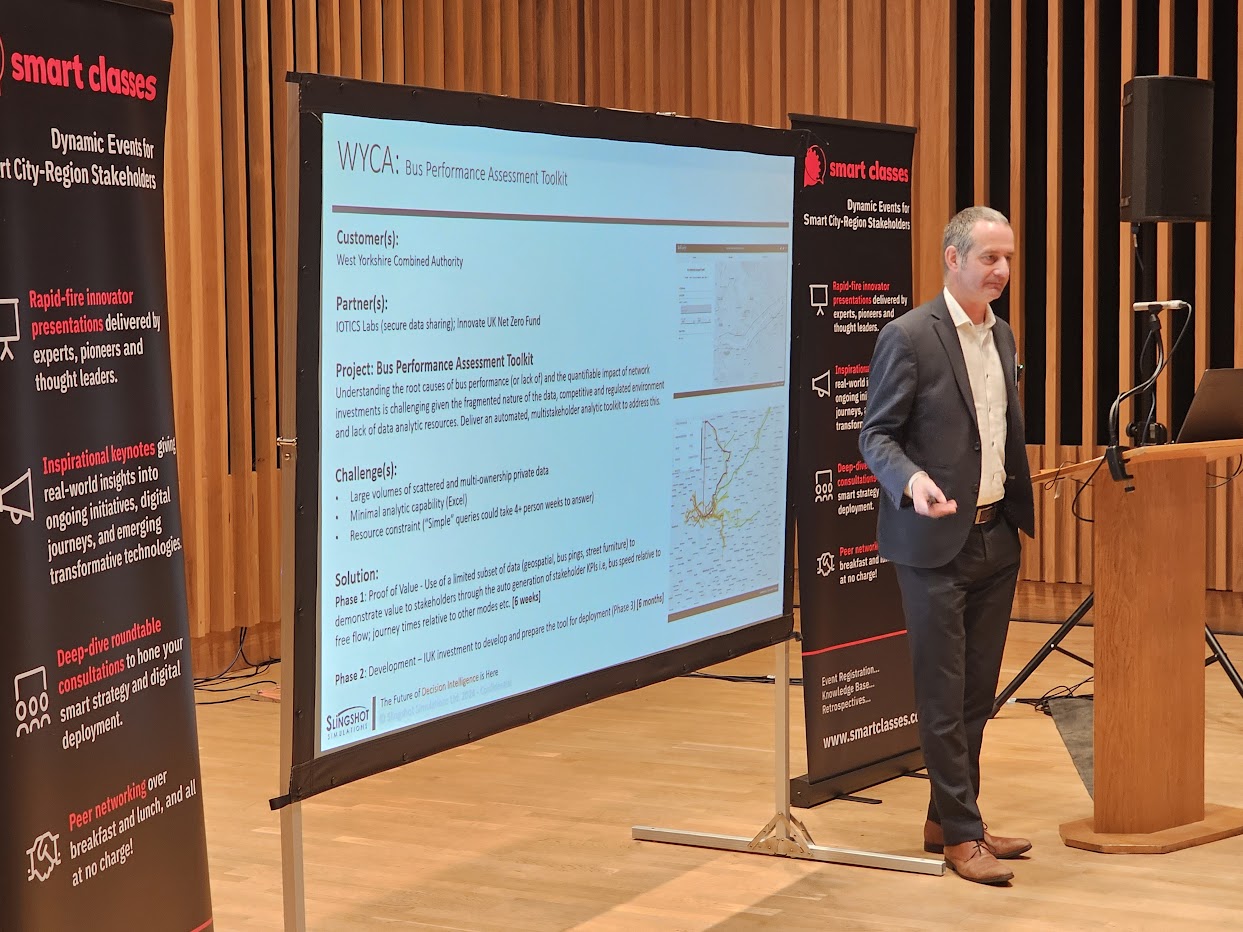
- West Yorkshire Combined Authority: Bus Performance Assessment Toolkit…
- Project: Bus Performance Assessment Toolkit (in partnership with IOTICS Labs and Innovate UK Net Zero Fund) – Understanding the root causes of bus performance (or lack of) and the quantifiable impact of network investments is challenging given the fragmented nature of the data, competitive and regulated environment and lack of data analytics resources. Deliver for WYCA an automated, multi-stakeholder analytic toolkit to address this; Challenge(s) – Large volumes of scattered and multi-ownership private data + Minimal analytic capability (Excel) + Resource constraint (“Simple” queries could take 4+ person weeks to answer); Solution – Phase 1: Proof of Value – Use of a limited subset of data (geospatial, bus pings, street furniture) to demonstrate value to stakeholders through the auto generation of stakeholder KPIs. i.e, bus speed relative to free flow, journey times relative to other modes etc (6 weeks)…Phase 2: Development – IUK investment to develop and prepare the tool for deployment (Phase 3) [6 weeks];
- Department for Transport: Network Climate Resilience Assessment…
- Project: Digital Twin for Climate Resilient Transport Network Analysis (in partnership with Connected Places Catapult) – DfT recognises the increasing gap between the adaptability of the transport network and the pressure it faces to adapt in response to the increasing risks from climate induced events, such as extreme heat, high winds and flooding. For example, Storm Eva in 2015 caused severe flooding that resulted in a £37MN direct cost to the city of Leeds and £500MN to the wider city region. This project focused on evaluating and optioneering mitigation strategies in advance; Challenge(s) – Connectivity traditionally siloed flood data and simulation with traffic simulation + Accessibility to digital solutions for the non expert user; Solution – Slingshot’s transport application delivered key outcomes that included [6 weeks): Rapid Identification of Transport Problem Areas Due to Displacement + Vulnerable Property & People Identification + Predicted Impact on Relative Emissions Due to Displacement and Rerouting.
If you satisfy our regular delegate qualification criteria but were unable to join us in Manchester on June 6th for the live in-person event at The Stoller Hall, CLICK HERE and complete the short “Download form” (located at the bottom of the post) to receive a unique link enabling free access to the presentation video recordings and slides (including the film footage and slides from Rob’s initial presentation).
Those qualifying to receive the rich presentation content from this event include commissioning, procurement, trialling, partnering and policy leads, senior influencers, strategic decision makers, programme managers and planners from local authorities (e.g. city, borough, metropolitan, district and county councils); public transport operators; regional transport partnerships, sub-regional transport bodies, combined authorities, integrated transport authorities and passenger transport executives; highways authorities and road operators; government and supporting national transport agencies; non-governmental organisations; fleet operators, parking operators, prime contractors etc.


