
As Senior Policy Advisor at the Chartered Institution of Highways and Transportation, Sara Zuin’s work focuses on resilience and adaptation to extreme weather events, infrastructure maintenance and EV uptake.
Manufacturers have highlighted that their ability to increase EV sales highly depends on customer confidence that there will be an accessible, affordable and energy-efficient charging infrastructure available. With the support of their Partnership Network, Technical Champions and sector experts, CIHT has recently developed a major new report, “Rolling out the Electric Charging Infrastructure – advice for local authorities”.
Sara joined us at TRANSPORT Smart Class, London & South East England 2025 to assess the UK’s current EV charging landscape and share valuable insights from the report. Her keynote presentation addressed:
- How Local authorities have a central role in shaping the roll out of the charging infrastructure, stimulating private investments and ensuring accessibility for all
- A series of principles and guidelines for local authorities to consider when rolling out their public charging infrastructure
- Key issues to be considered in site selection, implementation and post implementation of charging points

Summary of presentation highlights:
- Introducing CIHT…
- The Chartered Institution of Highways & Transportation is a charity, learned society and membership body who represents and qualifies professionals who plan, design, build, manage, maintain and operate transport and infrastructure; CIHT aims to be the prime source of advice for national and local government and other strategic stakeholders when they are seeking technical expertise and knowledge to guide future policy and investment; CIHT’s strength relies in the ability to tap into the knowledge and expertise of their membership and bring it to policy makers, government and strategic stakeholders;
- A natural home for people working in highways & transportation infrastructure, CIHT has 12 UK Regions and Nations, plus a number of international groups including the Republic of Ireland, Hong Kong and Malaysia; CIHT has a Partnerships Network, which includes over 100 Corporate Partners, as well as academic institutions and public sector bodies; Awarded a Royal Charter (2009); Provide education and support by providing industry-recognised qualifications; Developing professional standards; Delivering research and insights on key transportation-related issues; and offering vital industry related updates on new developments in technology and best practice; Currently over 10,500 members;
- Context…
- In 2022, the UK Government published “Taking charge: the electric vehicle infrastructure strategy”, arguing that the installation of charge points across the country will be instrumental in encouraging drivers to switch to EVs;
- In January 2024, the government introduced a zero emission vehicle (ZEV) mandate for car manufacturers – This specifies the minimum proportion of car manufacturers’ sales that must be zero-emission vehicles, with increasing proportions of sales until reaching 100% of new EV car and van sales in 2035; 2030 is the start of a 5 years phasing;
- Manufacturers have highlighted that their ability to increase EV sales highly depends on customer confidence that there will be
an accessible, affordable and energy-efficient charging infrastructure available; - In December 2024, the National Audit Office, said that the Government was broadly on track to meet its EV charge point targets, but that there were some important challenges relating to location, additional costs and delays in delivery;

- How are we currently doing against the target set by the ZEV Mandate?
- Electric cars on UK roads: Private cars – Just 3% of cars (1.09 million) were battery electric in the UK at the end of June 2024, and 8% were hybrid electric (using an electric motor as well as petrol/diesel); Battery electric cars accounted for 19% of all new car registrations
at the end of June 2024, an increase from 1% in 2018. (CBP-7480.pdf); - Buses: At the end of June 2024, there were 4,160 licensed battery electric buses and coaches in the UK; This equates to 3% of all buses and coaches in the UK;
- Second hand market: The UK’s used car market is over three times bigger than the new car market; However, the second-hand market for EVs is less developed – only 4.9% of used car transactions were hybrid, 3.3% electric and 1.2% plug-in hybrid in the first quarter of 2025;
- Public chargepoints…
- In 2022 the government anticipated that by 2030 there will need to be around 300,000 public chargepoints as a minimum in the UK, but there could potentially be double the number; As of 1 April 2025, there were 76,507 public electric vehicle charging devices installed in the UK, which is in line with DfT’s expectations of what would be required at this point;
- However, there is an uneven geographical distribution of charging devices within the UK – Some UK local authorities have bid for UK government funding for charging devices, and others have not; Most of the provision of this infrastructure has been market-led, with individual charging networks and other businesses (such as hotels) choosing where to install devices; London had a much higher level of charging provision per 100,000 of population than any other part of the UK, with 263 devices per 100,000; In comparison, the
average provision in the UK was 113 per 100,000; - In addition to the public chargepoint network, it is estimated that there are around 680,000 home chargers installed across the country; According to a survey conducted by Zap-Map in 2022, about 84% of EV drivers have access to a charging point at home; A vast majority (90%) also use public chargepoints as well, with most utilising them more or less monthly;
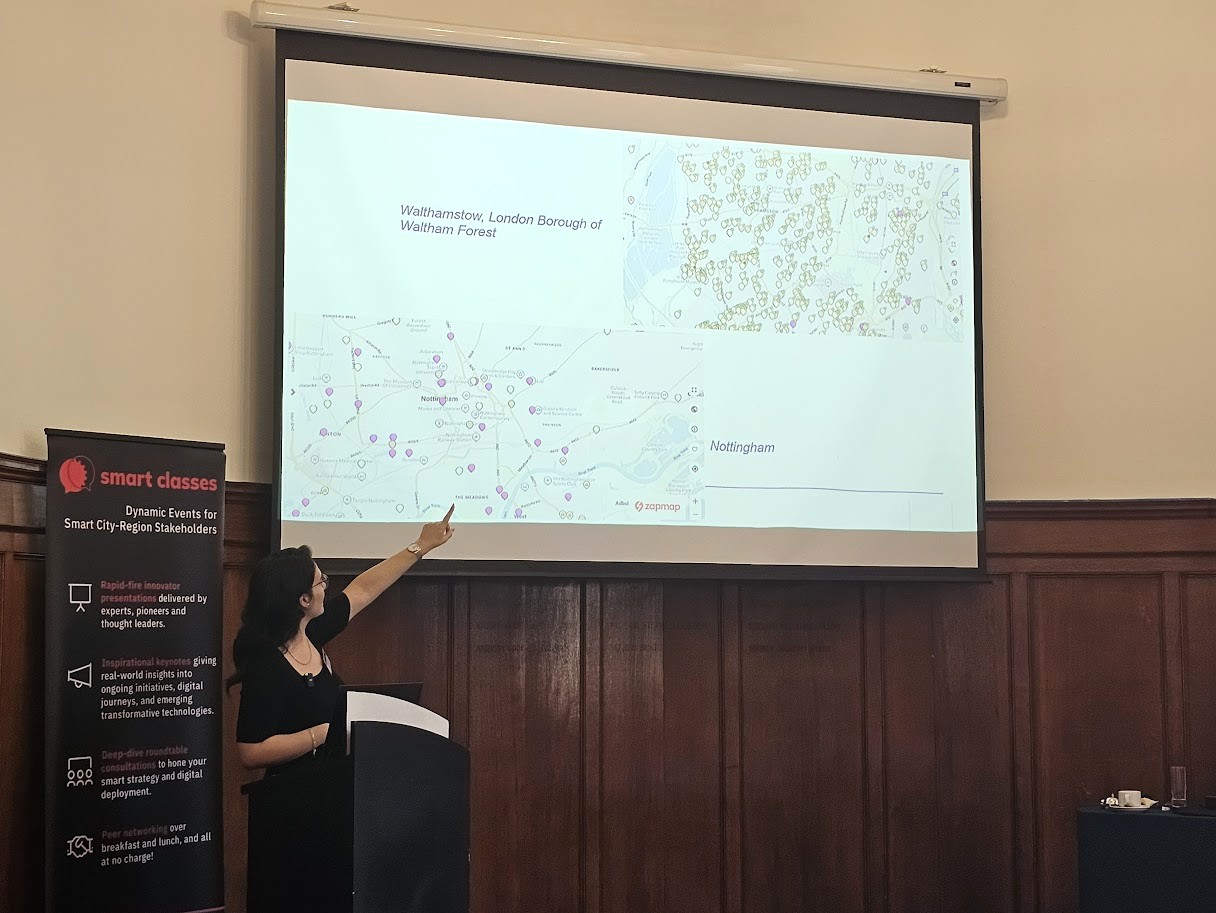
- Interactive maps like ZapMap give us a feel of the spread of EV charging infrastructure – They show EV chargepoints that can be publicly used and have been signed up to the system; Scan QR code on slide to browse around the country!
- Examples from ZapMap of Walthamstow (part of the London Borough of Waltham Forest) and Nottingham city centre;
- When we look at the roll out, how it it is happening across the country, at what pace, what strategies are being adopted etc, the main actor are local authorities;
- The role of Local Authorities in delivering EV charging infrastructure…
- The uptake of EVs and the rollout of the charging infrastructure are interlinked – More infrastructure encourages EV adoption; more EVs create demand for additional, and more diverse, charge points; Over time, as different vehicle types become more common (e.g. vans, accessible vehicles), infrastructure will need to expand both in number and in variety to meet diverse needs;
- 1) Low EV uptake and Limited Infrastructure – Few EVs on the road, mainly privately owned cars; Most owners rely on home charging; A small number of public chargepoints exist, mainly for top-up charging;
- 2) Local authority-led expansion – LAs deliver more public chargepoints, especially on-street units; This availability encourages more people to switch to EVs; Strategic thinking is essential on the type of infrastructure delivered;
- 3) Market driven expansion – As EV numbers grow, areas become commercially attractive for private charging operators; Private funding focuses on ultra-rapid chargers, off-street facilities, and high-demand areas;
- 4) Addressing the gaps – Private investment covers profitable areas, LAs focus on underserved areas (e.g. rural, low-income areas); Priority for LAs is accessibility to charging for all residents;
- 5) Mature, mixed EV network – Mixed infrastructure that can charge different vehicles; No geographic gaps; Chargers of all speeds located strategically to meet all needs;
- Local authorities are not expected to deliver every element of the infrastructure needed to meet long-term demand. Instead, their role is strategic:
- To stimulate early EV adoption by seeding areas with enough public charge points to give residents confidence to switch; To create the conditions that attract private investment, making local areas rich of EVs and therefore giving investors confidence that charge points will be used; To safeguard accessibility by serving areas that the market alone will not reach;
- The private sector will take on much of the charging infrastructure delivery as demand grows, but the leadership of local authorities remains critical in shaping a charging network that is widespread, reliable and accessible;

- Role of the CIHT report and what it explores…
- This report is specifically aimed at local authorities and focuses on supporting their strategic role in the rollout of EV charging infrastructure;
- This means planning for both present requirements and future growth, as EV adoption increases and vehicle types become more varied; Choices made now about the location, type, and accessibility of charge points will determine how the network develops over time and how widely it can be used;
- Not meant to be a prescriptive guidance, choices that LAs will have to take really depend on their local areas, needs, demands and strategies;
- Brings together all the relevant information that LAs need to be aware of together so it is the “go-to” document by those interested in installing EV charging infrastructure. This includes: Funding, Public Consultation, Commercial Models and procurement, Traffic Order Regulation, Post implementation issues, Planning applications and licenses, Power Upgrades and Grid Upgrades, Private charging, EV charging bay network design, Costumer Accessibility, Use of EV charging Apps, EV charging infrastructure location, Physical implementation;
- Deep dive: Engaging with the public and bringing along the local community…
- Understanding Demand – Consult residents on where they would like public chargepoints, especially next to which local services; Focus on areas with high parking pressure and limited off-street options;
- Managing Concerns and Resistance – Early consultation helps reduce pushback and improve transparency with local residents and businesses;
- Avoiding Delays – Waiting too long to consult can cause significant delays; Incorporating community feedback early, especially in site selection and infrastructure type, can avoid re-doing work to fix issues;
- Choosing the Right Infrastructure – Consult to identify appropriate infrastructure types, particularly in terms of location, accessibility needs and the suitability of cross-pavement solutions;

- While different local authorities might consult on specific aspects of their EV charge point strategy, below are some general recommendations of what should be included:
- Clearly explain why a public charging network is needed and how it supports broader local strategies such as decarbonisation, air quality improvement, and reduced vehicle emissions;
- Set out where charge points will be deployed and the reasoning behind site selection – considering accessibility, demand, and integration with local services; While you may not wish to ask for residents whether they agree with all sites, if a site selection impacts a specific group of residents (such as occupiers of adjacent properties) it is recommended that their input is sought before implementation;
- Define how each charge point is expected to be used – is it for residents? Long stays? Overnight charging? Short term visitors using fast charging (e.g. in a car park)?
- Outline the responsibilities of the local authority and the CPO, and what residents can expect in terms of user experience, including apps, payments, and access times;
- Consider setting up an online platform where residents can nominate potential charge point locations; This can help identify demand hot spots and build local buy-in;
- An e-Learning course based on the content of the report will be developed in 2026 via CIHT Learn, which is free for CIHT members to access.
If you meet our regular delegate qualification criteria but were unable to join us The Wellington Hotel, Westminster, for the live in-person event on October 9th, CLICK HERE and complete the short “Download form” (located at the bottom of the post) to receive a unique link enabling free access to the presentation video recordings and slides (including the film footage and slides from Sara’s keynote).
Those qualifying to receive the rich presentation content from this event include commissioning, procurement, trialling, partnering and policy leads, senior influencers, strategic decision makers, programme managers and planners from local authorities (e.g. city, borough, metropolitan, district and county councils); public transport operators; regional transport partnerships, sub-regional transport bodies, combined authorities, integrated transport authorities and passenger transport executives; highways authorities and road operators; government and supporting national transport agencies; non-governmental organisations; fleet operators, parking operators, prime contractors etc.