The Innovate UK Catapult Network provides a unique combination of cutting-edge R&D facilities and world-class technical expertise to support UK business innovation. Connected Places Catapult is the UK’s innovation accelerator for the Built Environment, Local Growth, and Transport.
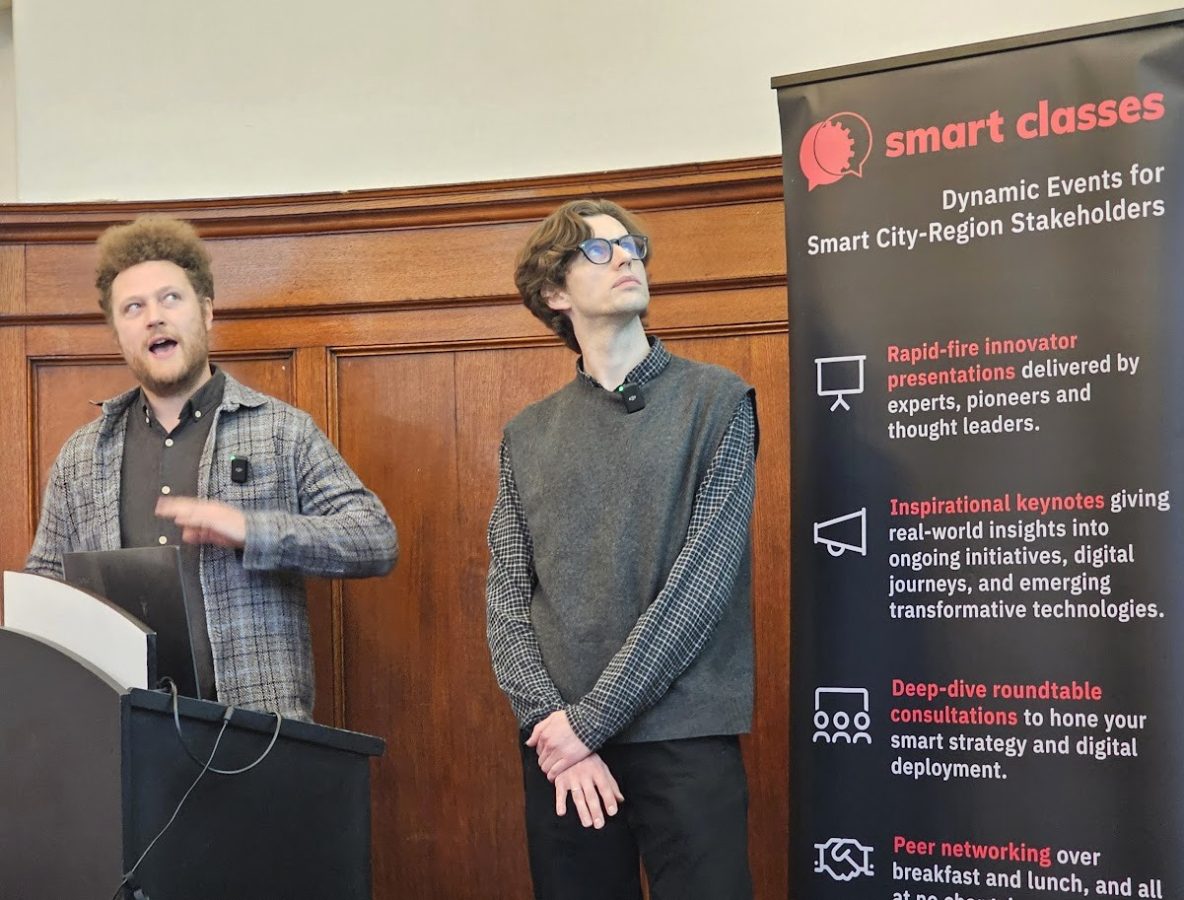
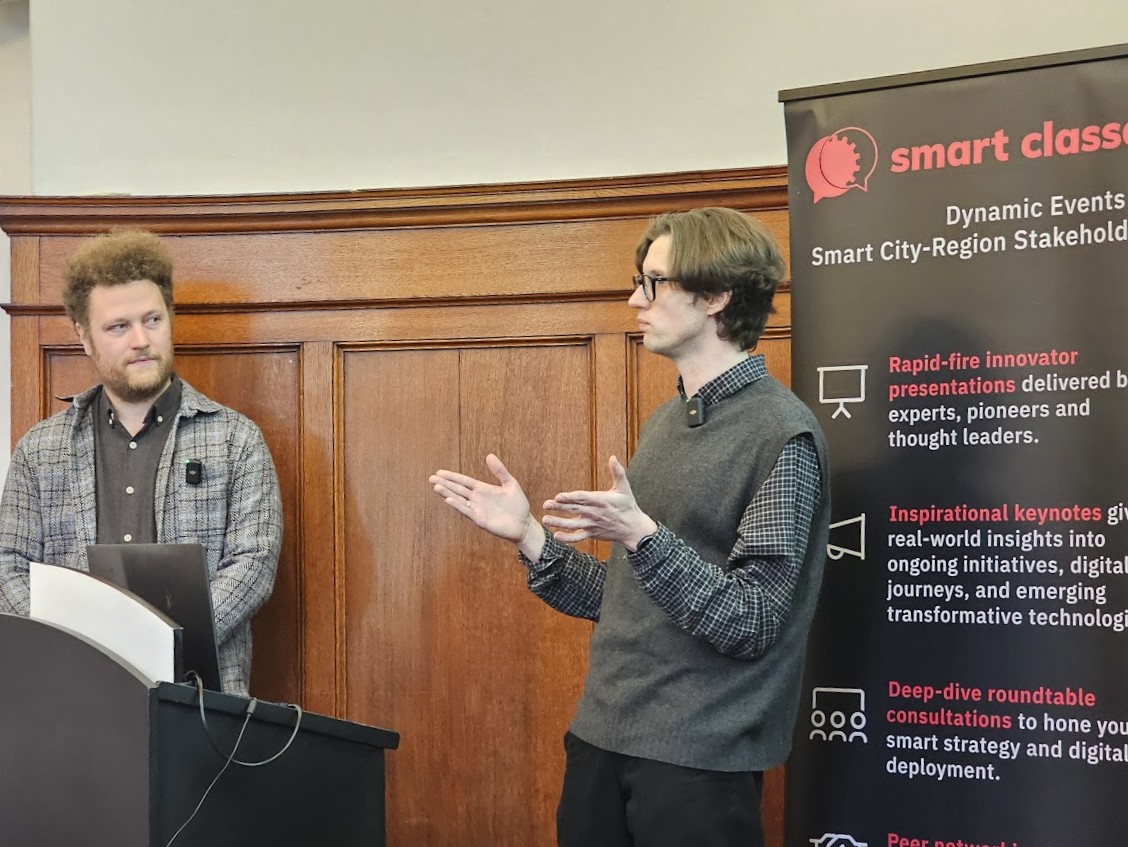
In their joint presentation at PUBLIC REALM & URBAN SPACES Smart Class 2025, Geoffrey Stevens (Director of Built Environment and Urbanism) and Joshua Thomas (Head of Built Environment and Urbanism – Technical) shared insights from CPC’s work establishing the Public Realm Innovation Lab. The Lab partners with local authorities, developers and communities to test and co-create solutions that make public spaces more inclusive, sustainable and successful. By addressing fragmented policies, limited evidence and weak community engagement, the Lab aims to pilot real-world interventions and generate evidence to improve public spaces and attract investment.
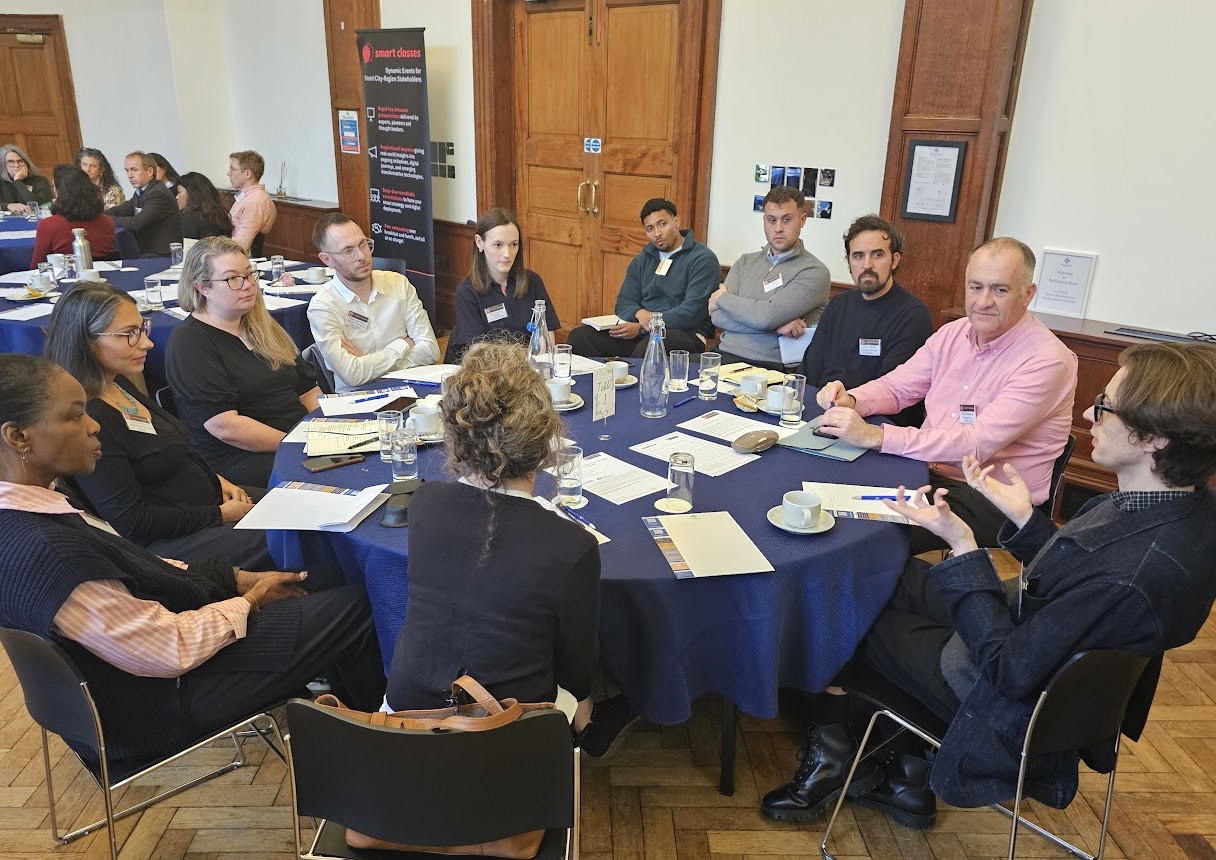
Following the presentations and Q&As, Joshua hosted deeper dive roundtable discussions with all delegates in attendance.
Presentation highlights and notes:
- Bridging the Gap – As the UK’s Accelerator for the built environment, transports and cities, the Connected Places Catapult (CPC) bridges the gap between discovery and the market; This means they take great ideas and innovations and help turn them into real-world solutions that can be adopted and scaled across communities, towns, and cities; CPC focus on addressing market barriers and ensure the best innovations reach the people and places that need them most;
- As one of nine Catapults supported by Innovate UK, CPC are part of a national network (across 65+ locations) accelerating innovation across different sectors – Cell and Gene Therapy, Compound Semiconductor Applications, Connected Places, Digital, Energy Systems, High Value Manufacturing, Medicine Discovery, Offshore Renewable Energy, Satellite Applications; Their unique funding model allows CPC to seed and encourage innovation where others are investing, while also taking calculated risks in areas where the market might not otherwise go; This way, CPC can experiment, push boundaries, and create lasting impact;
- Who do CPC work with? A diverse range of stakeholders across multiple sectors, industries, and levels of Government, including: SMEs and businesses, who bring creativity and innovation to the table; Academia and knowledge partners, who provide the research and expertise to turn ideas into reality; Public bodies, who help ensure innovation aligns with the needs of communities and policymakers; “We work together to address market barriers and unlock the opportunities of innovation”;
- CPC exist to help organisations innovate and are backed by government funding, not profit-driven; Impartiality is central to CPC’s role and their success is measured by the value they create for the UK economy through innovation; Their funding is split evenly between
government grant, collaborative R&D, and commercial work – giving CPC the flexibility to invest, co-invest or be commissioned for maximum impact; - Innovation Toolkit – CPC bring a powerful set of tools and capabilities to bridge the innovation gap, tackle market barriers, and deliver tangible results for their clients and partners: Discover and Define – Research and intelligence, Appraisals and diagnostics, Foresight and futures, Roadmaps and playbooks; Test and Scale – Competitions and open calls, Testbeds and living labs, Demonstrators, pilots
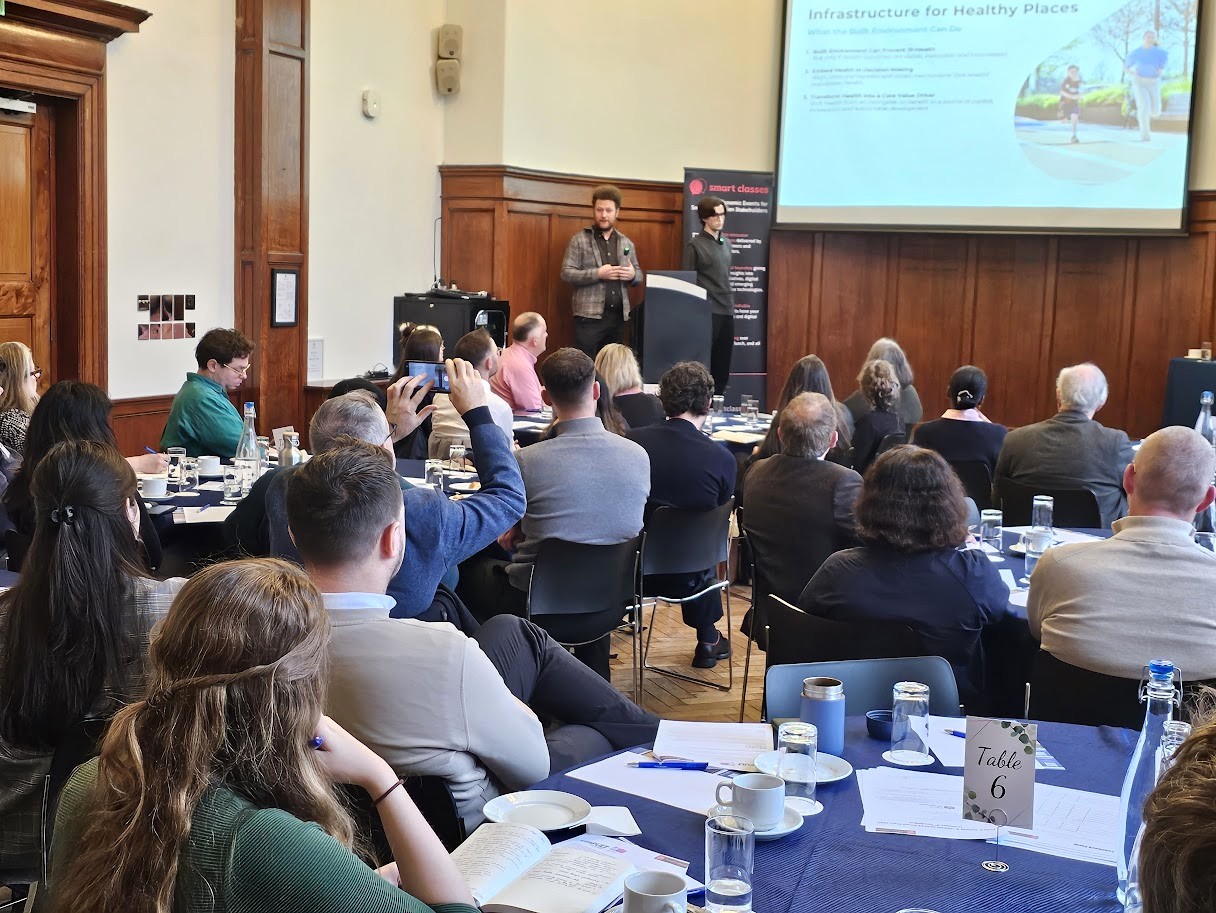
and live trials, Accelerators, Digital Twins; Measure and Learn – Evaluation and impact assessment, Standards, Communities of practices; Grow and Connect – Investment strategies, Business cases. Clusters and funding programmes, International trade and investment, Summits and events, Partnerships and networks; - Infrastructure for Healthy Places…
- “Where and how we design streets, parks and buildings directly affects health. Safe, walkable public spaces and well ventilated, accessible buildings reduce illness, improve mental wellbeing and encourage active lifestyles – preventing problems before they reach hospitals” – High-quality public spaces drive economic growth, improve wellbeing and strengthen climate resilience; They attract investment, increase property values and deliver social benefits; Yet their full potential remains untapped;
- The Built Environment Shapes Health:
- 1) Physical Inactivity (linked to lack of walkable streets and public spaces) – Physical inactivity costs the NHS around £0.9–1.06 billion per year in direct healthcare costs (Public Health England 2022); Broader economic impact (including productivity loss) is £7.4 billion annually (Public Health England 2022); Inactivity contributes to chronic diseases like heart disease, diabetes, and some cancers (Public Health England 2022);
- 2) Obesity and Sedentary Lifestyle (linked to car-dependent design and lack of active travel infrastructure) – Obesity alone costs the NHS over £6.5 billion annually, rising to £11.4 billion when including associated conditions (Source: Department for Healthy and Social Care/Department for Science, Innovation and Technology 2025); Sedentary behaviour adds another £0.7–0.8 billion per year in NHS costs (cardiovascular disease, diabetes, cancers), (Source: Department for Healthy and Social Care/Department for Science, Innovation and Technology 2025);
- 3) Poor Housing and Building Design (ventilation, damp, accessibility) – Poor-quality housing costs the NHS £1.4–2.5 billion per year, mainly due to respiratory illness, falls, and excess cold (Source: BRE 2023); Damp and mould alone cost the NHS £38 million annually, while excess cold hazards cost £857 million (Source: BRE 2023);
- 4) Air Pollution (linked to street design and ventilation) – Air pollution costs the NHS and social care £157 million per year currently, projected to reach £5.3 billion by 2035 (Source: Imperial College London/Public Health England 2020); Including wider health impacts, cumulative costs could hit £18.6 billion by 2035 (Source: Imperial College London/Public Health England 2020);
- 5) Mental Health (linked to urban design, green space, and walkability) – Mental health problems cost the UK economy £117.9 billion annually, with a significant share borne by the NHS (Source: NHS England 2022); Urban living increases risk of mood disorders by up to 39%, anxiety by 21%, and doubles schizophrenia risk (Source: NHS England 2022);
- Why Infrastructure for Healthy Places Matters:
- 1) Places Shape Health – Where we live, work and move determines physical and mental health;
- 2) Built Environment Harms – Poor air quality, unsafe streets, isolation and unfit homes persist because health isn’t valued in economic decisions;
- 3) Misaligned Costs and Benefits – Developers bear the cost of designing for health, while benefits like reduced healthcare demand and stronger communities accrue elsewhere;
- 4) Health Must Be Measurable and Rewarded – To create resilient communities, health needs to be visible, valued and incentivised in development;
- What the Built Environment Can Do:
- 1) Built Environment Can Prevent Ill-Health – But only if health outcomes are visible, investable and incentivised;
- 2) Embed Health in Decision-Making – Align costs and benefits and create mechanisms that reward population health;
- 3) Transform Health into a Core Value Driver – Shift health from an intangible co-benefit to a source of capital, innovation and sustainable development;
- Outcomes CPC Are Working Towards:
- 1) Funding and Scaling Healthier Places – Enabling investors, developers and local authorities to fund, assure and scale healthier places through trusted evidence, impact measurement and financial models;
- 2) Fixing Fragmented Frameworks – Working towards a shared framework that brings government, industry and academia together around common indicators, so investment in preventative health – through better building and public realm design – becomes measurable, comparable and attractive alongside other priorities;
- 3) Unlocking Smart City Potential – Using health as a tangible driver to revive stalled smart city markets with measurable outcomes like air quality, safety and wellbeing;
- 4) Turning Data into Impact – Using data platforms, IoT sensors and urban analytics to create incentive schemes and impact dashboards that show measurable returns for preventative public realm design;
- 5) Proving What Works – Developing demonstrators, pilots and practical proof-of-concept prototypes – such as digital dashboards, IoT sensors, and urban analytics platforms – to show how health-positive public realm interventions deliver measurable benefits like reduced hospital admissions, improved wellbeing scores and economic returns;
- The Opportunity Is Now – HM Treasury’s “The Green Book: Central Government Guidance on Appraisal and Evaluation”; Ministry of Housing, Communities & Local Government’s “Pride in Place” (25th September 2025); UK Government/NHS “Fit for the Future – 10 Year Health Plan for England” – Hospital to community, Sickness to prevention;
- Who CPC Need on Board:
- 1) Public Sector Leaders & Place Stewards: Who – Central government, combined authorities, local authorities, Homes England, appraisal bodies. Call to Action – Embed health value in procurement frameworks and funding criteria; Adopt health-based indicators in place-based strategies and planning approvals; Champion demonstrator projects to showcase health-positive public realm design;
- 2) Impact Investors & Financial Catalysts: Who – Pension funds, ESG-aligned real estate investors, philanthropic foundations, impact investors, green banks. Call to Action – Mobilise capital into health-positive infrastructure; Support de-risked investment pathways through structured pilots and evidence frameworks; Fund scalable models that link health outcomes to long-term asset value;
- 3) Developers, Designers & Landowners: Who – Major property groups, regeneration developers, housing and commercial developers, design teams, design & build contractors. Call to Action – Integrate health-linked services into development plans (impact assessments,
monitoring, certification); Adopt incentive models that reward health outcomes and penalise harm; Partner on pilots to prove financial and social returns from health-positive design; - 4) Technology and Innovation Partners: Who – Smart city solution providers, urban tech innovators, city operators, venture investors,
consultancies. Call to Action – Collaborate on pilots that integrate health metrics into digital urban platforms; Co-develop use cases showing measurable health and economic outcomes; Invest in scalable solutions that make health a core driver for smart city adoption;
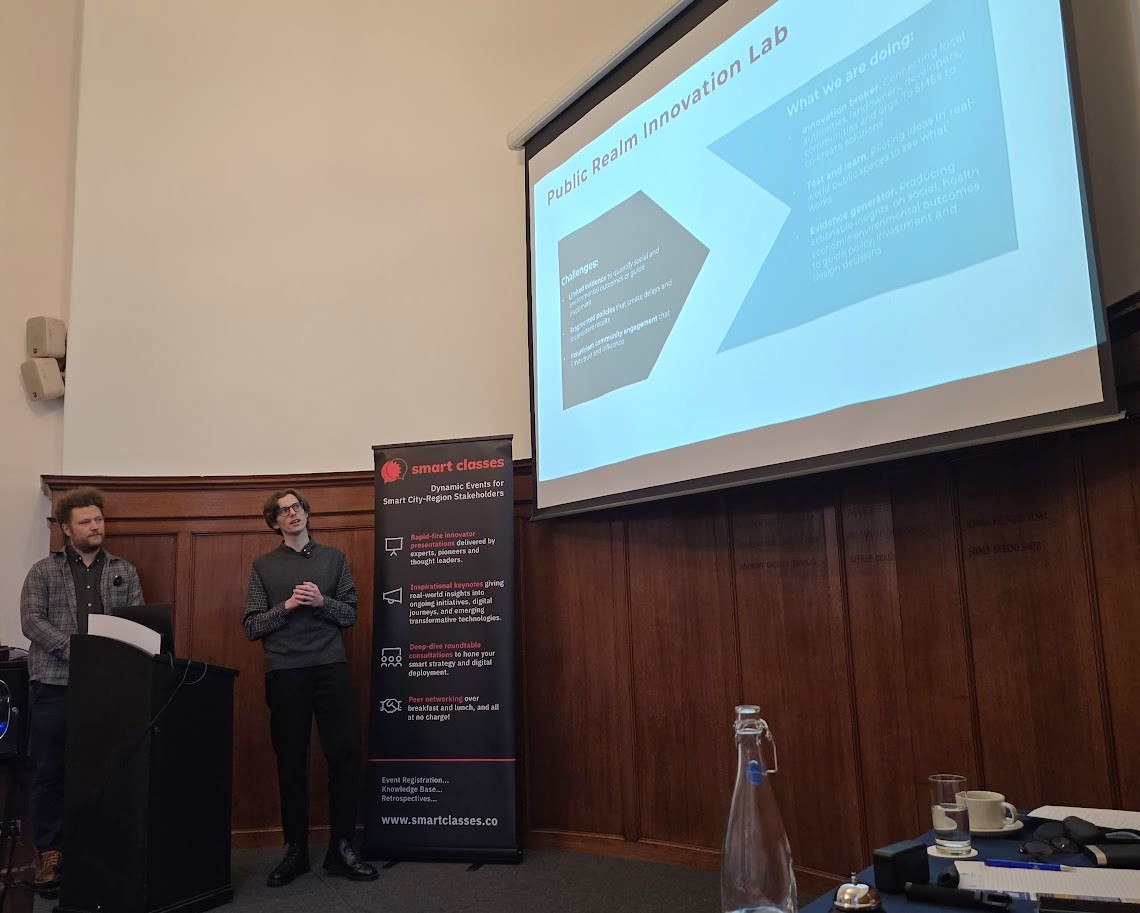
- Public Realm Innovation Lab – “Supporting innovation in public spaces – helping to create places that are more inclusive, sustainable and commercially successful”…
- High-quality public spaces drive economic growth, improve wellbeing and strengthen climate resilience; They attract investment, increase property values and deliver social benefits; Yet their full potential remains untapped;
- Challenges – Limited evidence to quantify social and environmental outcomes or guide investment; Fragmented policies that create delays and inconsistent results; Insufficient community engagement that limits trust and influence;
- What CPC are doing: Innovation broker – Connecting local authorities, landowners, developers, communities and orgs to SMEs to co-create solutions; Test and learn – Piloting ideas in real-world public spaces to see what works; Evidence generator – Producing actionable insights on social, health, economic and environmental outcomes to guide policy, investment and design decisions;
- How the lab works:
- 1) Understand and Align Strategic Interests – Map priorities across government, delivery teams and communities; Build shared goals to connect strategy with action and deliver impact for people, planet, and prosperity;
- 2) Activate spaces around a theme – Implement specific, purposeful innovations focused on a theme (e.g. health and wellbeing) to show how the strategic design, management and use of public spaces can deliver measurable outcomes;
- 3) Turn themes into actionable challenges – Shape each theme around systemic, policy-linked opportunities, combining top-down and bottom-up perspectives to tackle complex public realm problems;
- 4) Work in partnership with place partners and theme experts – “We know we can’t do this alone. Working with partners allows us to test and learn on local challenges” – exploring how tackling local issues can help solve the national challenges;
- 5) Bridge innovation and the market – Our test and learn approach allows organisations and end-users to trial innovative solutions in real-world settings; This enables stakeholders to explore, refine and validate new ideas before wider implementation, making sure they are practical and scalable;
- 6) Create a sustainable SME market – Embed innovative SMEs within places to activate spaces, attract tenants and stimulate local activity, delivering value for developers and local authorities while giving SMEs pathways to grow and scale;
- Delivering trials in public spaces – Roles & Responsibilities of each Stakeholder: Innovators/solution providers, Trial participants/testers (Local residents, solutions’ end-users), Connected Places Catapult, Place partners (Landowners, developers, Local Authorities etc), Expert support (Private, public or third party sector, academia);
- Current partnerships – CPC is partnering with the River Roding Health Corridor Consortium; The consortium has identified the River Roding as one of London’s most undervalued natural corridors, with significant potential to support community health, yet largely invisible and inaccessible to local residents; The consortium brings together expertise in NHS health data, spatial design, regeneration and community engagement, putting people at the heart of the project; Focused innovation challenge – Helping children and young people achieve a healthy weight by making public spaces more inclusive, inviting, and connected; The next step is co-designing and piloting targeted interventions with communities and partners along the River Roding in early 2026;
- The Roding Health Corridor Vision – Infographic depicting 1) Need – Why are we doing this? 2) Opportunity – Our desired outcomes? 3) Test & Learn – What will we do? 4) Delivery – Implementation and evaluation;
- Expected Outcomes – “Our goal is to develop a new framework and language to hard-wire healthy placemaking into the development of UK infrastructure”; Key Partnership Outcomes – 1) Tangible Public Realm Prototypes 2) Evidence-Based Case for Healthy Placemaking 3) Improved Local Systems & Capacity 4) Innovation Delivery Model 5) Policy and Sector Influence 6) Replicable Public-Private Collaboration Model;
- Testing Environment:
- The Roding Health Corridor spans seven sites along the river in Barking & Dagenham; Three have been selected for trials this year – 1) Harts Lanes Estate 2) The Viewing Platform 3) Barking Barrage & Mill Court; Why these sites? 1) Represent different urban settings and connections to the river 2) Offer opportunities to test a range of healthy lifestyle interventions 3) Used by varied groups for different activities; Trials may take place on one or several sites, depending on the solution being tested;
- River Roding – Site 1/Harts Lane Estate & Gardens: Harts Lane Estate sits next to the River Roding and close to Barking town centre and station; The estate comprises two 17-storey towers – Colne House and Mersea House – built in 1971; Its location near Barking Barrage and Town Quay Wharf positions it as a key anchor site for green infrastructure and public realm improvements; The estate is earmarked for regeneration, presenting an opportunity to embed preventative health strategies into placemaking; Increasingly, elements like green spaces, play areas, active travel routes and access to food and nature are recognised as drivers of healthier behaviours and stronger community cohesion;
- Current pattern of use – Main users are Harts Lane Estate residents and river boat communities; Hard-surfaced areas with benches see limited use; The park and fitness area appear underused; The bridge is occasionally used but functions as an out-of-town crossing; No vehicle access to this part of the site; Wildlife and habitats are important factors;
- River Roding – Site 2/The Viewing Platform at Town Quay Wharf: Town Quay Wharf is a prominent waterfront site with strong potential to anchor the River Roding Health Corridor; Positioned at a key junction between river and town, it offers an opportunity to deliver inclusive, health-focused public realm that reflects Barking’s heritage, ecology and community; The site could become a leading example of a therapeutic, nature-rich public waterfront integrated with community use, heritage, and well-being;
- Current pattern of use – Main users are local and new river communities; The space is underused; Primarily accessed by cars, though infrequently; Some pedestrian crossings occur for commuting to town or the station;
- River Roding – Site 3/Barking Barrage Bridge Connection: The Barking Barrage is a distinctive and underutilised piece of civic infrastructure, offering a powerful setting for reimagining how the public realm can support health, learning and community life; This site has the potential to be a landmark destination for preventative health, learning and ecological awareness, reinforcing Barking’s identity as a place where river, community and innovation meet;
- Current pattern of use – The site sees limited use; Occasional crossings by the general public; River access is mainly by the canoe club and some anglers; The park is sometimes used, but the site feels disconnected from the town; Opportunities should consider connections to Abbey Park;
- Challenge Theme – Supporting children and young people to achieve a healthy weight by making public spaces more inclusive, inviting and connected:
- How can we support more children and young people in Barking and Dagenham achieve a healthy weight by activating underused River
Roding spaces through integrated public realm interventions that improve health provision and outcomes? Barking and Dagenham has the highest childhood obesity rate of any London borough, linked to wider health determinants such as deprivation, food inequality, and limited access to safe, active public spaces; The borough’s Health and Wellbeing Strategy 2023–2028 prioritises early intervention, community resilience, and place-based care to tackle these systemic challenges; There is an opportunity to transform the River Roding corridor into a health-promoting environment; How can the river and adjacent open spaces be used to enhance health and wellbeing, foster community pride and create thriving, nature-centred neighbourhoods?
- Test & Learn Framework/<Stakeholders and Communities Engagement>: 1) Innovation Foundation – Challenge Definition, Scoping the Test & Learn Intervention 2) Solution – Designing or Picking Solution(s) 3) Deployment Support, Testing and Monitoring Solution(s), Impact Assessment & Capacity Building;
- Stakeholders – Supporting team:
- Running trials require multiple and complementary expertise; Stakeholder map highlights the key areas of support to run the trials on sites as well as the roles within the Core supporting team and the support provided in some areas by the Extended supporting team;
- Supporting team comprises Connected Places Catapult, Be First, Makower Architects, NHS North East London, and Care City; Chart identifies Stakeholder roles & activities grouped by Trial operational support, Technical, Participants recruitment & management, M&E and Impact assessment, Challenge domain knowledge & support, Local communication & engagement, and Scaling & funding opportunities;
- What’s next? We’re Approaching A Key Milestone…
- Trials conclude in March, and CPC will be sharing the findings in full; These insights will shape the next phase: bringing the right partners together to turn ideas into action;
- Next, CPC plans to: Present the results from the trials; Share their framework for doing this in more places; Convene the organisations they’ve been engaging across the spectrum – from technology innovators and public sector leaders to investors, developers and designers; Set the agenda for collaboration to scale health-positive solutions in real places; “This is where we move from pilots to impact. Your role matters – partner with us to make healthy places the norm, not the exception”;
- Towards An Outcome Based Public Realm – Try Out Prototypes CPC Developed With Dark Matter Labs…
- Can digital tools help? Digital tools can integrate community voice, policy requirements, ecological data and developer goals; Hackathon with 50+ stakeholders co-created practical prototypes;
- Prototypes that came out of it: Wiff Waff – Turns community insights into actionable design briefs; Urban Habitat Planner – Recommends species and habitats using geospatial + ecological data; Steward Your Community Spaces – Connects community groups to spaces, simplifying permissions, governance, and sustainability reporting;
- The shift – Moving from traditional planning to outcomes-driven design and stewardship; Prototypes show how digital tools can unlock more inclusive, resilient and ecologically sound public spaces; Pathways to outcomes-based public space.
If you satisfy our regular delegate qualification criteria but were unable to join us in Westminster on December 4th for the live in-person event at The Wellington Hotel, CLICK HERE and complete the short “Download form” (located at the bottom of the post) to receive a unique link enabling free access to the presentation video recordings and slides (including the film footage and slides from Geoff and Joshua’s initial presentation).
Those qualifying to receive the rich presentation content from this event include commissioning, procurement, trialling, partnering and policy leads, senior influencers, strategic decision makers, planners, place makers, architects, green space managers, urban designers, communities & neighbourhoods, highways & street scene, transport & mobility and high streets & regeneration professionals from councils and local authorities (city, borough, metropolitan, district, county and combined); people and place partnerships; developers, landowners and creators of privately owned public spaces; prime contractors and city centre management companies; DfT, DEFRA, MHCLG, EA and supporting governmental bodies; transport authorities, highways agencies and public transport operators; civic organisations and community groups; and other key players from the public realm ecosystem with responsibility for managing, maintaining and operating our streets, squares, forecourts, parks, pathways, retail centres, car parks, airports, ports, travel hubs, hospitals, housing estates, campuses, communal gardens and the assets contained within these public or semi-public spaces.