
Today, I presented to Parliament at the Westminster Energy, Environment and Transport Forum Policy Conference, on the future of public transport and connectivity in towns and rural areas. The session brought together policymakers, local leaders, and practitioners to consider how we can build a transport system that is not only functional but transformative, enabling growth, supporting communities, and addressing the climate challenge.
The reflections shared here build on that discussion, drawing on my lived experience from the Cambridgeshire and Peterborough Combined Authority (CPCA) over the last 6 years. The region’s geography, encompassing the global city of Cambridge, the growing city of Peterborough, expanding market towns, and deeply rural communities, gives us a front-row seat to a national challenge. If we can make integration, fairness, and efficiency work across such diverse places, the lessons are relevant across the whole of the UK.
The CPCA area mirrors the complexity of England’s transport landscape. Cambridge’s urban pressures sit alongside the needs of market towns such as Wisbech, Huntingdon, and St Neots, and the distinct challenges of Fenland and other rural communities where transport options are sparse and journeys are long. This diversity means we operate simultaneously within different realities: high bus demand in one corridor and near-complete car dependency in another.
This is precisely why we need to approach public transport not as an isolated product but as one part of a whole-system framework. Transport is a tool for delivering economic, social, and environmental outcomes. It underpins Local Growth Plans by connecting people to opportunity, and contributes to a healthier, more equitable future.
Devolution gives areas like the CPCA, the chance to align local priorities with national ambitions. But flexibility, adequate resourcing, and long-term certainty are essential. Short-term competitive funding rounds and siloed national programmes often distort local planning and impede delivery. For devolution to work, it must provide not just powers, but the capability and stability required to use them effectively.
The English Devolution and Community Empowerment Bill, alongside the Planning and Infrastructure Bill, marks a pivotal moment. Proposals for a unified Spatial Development Strategy (SDS) create new possibilities for integrating transport, land use, housing, and economic development. Too often, transport has been treated as something that reacts to development rather than shaping it. The SDS approach begins to correct this imbalance.
Embedding transport within wider place-making allows growth to be planned strategically, recognising that homes, jobs, and movement are inseparable. It supports long-term sequencing of infrastructure and offers the potential to reduce costly retrofitting.
That said, there are risks. Without careful design, new responsibilities could create fragmentation or widen the gap between well-resourced authorities and those with limited capacity. Smaller authorities would face significant demands when aligning statutory duties, evidence bases, and delivery mechanisms across multiple policy areas.
My own experiences from my time at CPCA have highlighted the value of strong relationships with constituent Councils. Shared datasets, joint evidence bases, and frameworks enable better decision-making and reinforce a common vision. These foundations will be essential as the new legislation comes into force.
Good planning is about coordination. Transport, housing, and employment must be planned together if growth is to be sustainable. Cambridge is the clearest example of why these matter: rail enhancements, local bus improvements, new homes, and job creation are deeply interdependent. Without a joined-up approach, each part of the system becomes less efficient.
One of the strengths of Mayoral Combined Authorities is the ability to build a coherent investment pipeline. The aim should be to combine funding sources to create a strategic whole rather than a patchwork of projects. This not only supports delivery but gives partners confidence that investments sit within an intelligible longer-term plan.
Digital and data integration are also critical. Real-time information, passenger flow data, ticketing records, demand patterns, and demographic insights would help us plan more effectively. By understanding how people actually travel, not how models assume they travel, we would be able to design services that respond to need across different geographies.
A key insight from our work is that rural areas require different solutions. They cannot sustain traditional fixed-route models at the same frequency as urban corridors. Demand-responsive services, community-led routes, and hybrid models must be seen as integral parts of the network.
Tiger On Demand, the CPCA’s flexible rural transport solution, demonstrates the potential. Customer feedback highlights that the app-based service provides the predictability and reassurance valued by neurodiverse individuals, disabled people, and by women and girls who particularly appreciate the added sense of safety it offers. The service has also enhanced accessibility more broadly, making rural public transport a viable option for those who might otherwise be excluded.
Another example from the CPCA area is the Tiger Pass. It was created for young people and is helping them reach education, apprenticeships, and weekend jobs. Early feedback shows it is starting to shift long-held views in areas with limited further-education options and is opening up opportunities where transport has been a barrier for a long time.
These examples demonstrate why long-term revenue support is essential. Capital funding alone cannot sustain a bus network. Vehicles, depots, and digital systems matter, but the service only exists if the operating revenue is secure. Without multi-year commitments, rural services in particular will remain fragile.
From my conversations with other transport leads across the country, ambition remains high, but capacity is stretched – we are all fishing from the same small pond for valuable resources too. Devolution brings new statutory duties and responsibilities, yet local authorities face chronic staffing pressures. Modelling, appraisal, community engagement, procurement, and contract management all require specialist expertise.
There is a requirement to invest in shared analytical resources, regional skills development, and collaborative planning with districts and partners. This helps to build resilience but cannot replace the need for stable national resourcing. Multi-year settlements would help avoid the stop-start delivery patterns created by short funding cycles. The flexibility to move between capital and revenue, something that could be enabled through access to City and Regions Sustainable Transport Settlement 2 and similar mechanisms, would unlock more efficient planning.
Looking ahead, mass rapid transit (MRT) could play a role in shaping the future of Cambridge, Alconbury Weald, and the Fens. While the form and timing will require careful study, the broader point is clear: strategic growth areas need integrated mobility solutions that span both urban and rural contexts.
Devolution should empower collaboration, not simply shift responsibility. Powers must come with the means to deliver.
A future national transport strategy must recognise the diversity of England’s places such as those experienced in the CPCA region. If I had to choose, I would personally advocate a bottom-up approach: aggregating real Local Plans into a national framework rather than imposing a rigid top-down model. However, this does not have to be an either-or choice. A hybrid model, nationally coherent but locally informed, could provide clarity while enabling innovation.
Integration should be the guiding principle. This means more than connecting services physically; it requires joining up governance, funding, data, and objectives. A truly integrated national strategy would recognise rural connectivity as essential, not peripheral, place decarbonisation at the heart of planning, embed social equity in investment decisions, and align highways and public transport thinking, recognising the road network as part of whole-system mobility.
A stable national framework would give Mayoral Combined Authorities and local Councils the confidence to invest, innovate, and coordinate effectively. The aim should be to reduce fragmentation and create a system where local decisions contribute to national outcomes.
Ultimately, connectivity is not about vehicles or infrastructure alone, it is about people. Understanding why people travel matters as much as understanding how they travel. Journeys enable access to education, healthcare, family life, leisure, and work. Good transport shapes opportunity and identity.
Trust between national and local government will be crucial for delivering the ambitions ahead. Effective collaboration requires shared objectives, open communication, and certainty over roles and resources.
My goal is to build a system people choose because it works for them, not one they use by necessity or tolerate reluctantly. This means designing services that are inclusive, accessible, and reflective of local needs and culture.
Future technology may also shift what is possible. Autonomous vehicles have the potential to make rural transport more affordable and flexible in the long term, complementing human-operated services where demand is low or highly variable. Technology should not be seen as a replacement for human-centred design but as an enabler of broader, more connected networks.
A resilient transport system blends long-term vision with effective day-to-day delivery. It must anticipate how travel patterns will evolve, while staying responsive to the needs people have right now, and remain grounded in the principle that transport exists to strengthen communities and improve quality of life.
Achieving meaningful connectivity starts with understanding the purpose behind people’s journeys, whether for work, education, care, or leisure. This insight shapes a network that works today and is adaptable for tomorrow, ensuring operational reliability while enabling future innovation.
So, the challenge for national and local leaders (both officers and politicians) is not merely to maintain existing networks or deliver incremental improvements. It is to reimagine connectivity as a driver of opportunity, equity, and resilience, to see transport not as a service to be provided, but as a framework for shaping lives, communities, and places. If integration, flexibility, and fairness are to move from rhetoric to reality, decision-makers must confront difficult questions: Are funding mechanisms designed to enable long-term planning, or do they entrench short-termism? Are governance structures truly empowering local authorities, or simply shifting responsibilities without the means to deliver?
The test for our future transport system is whether it can reconcile complexity with coherence, diversity with common purpose, and ambition with capacity. Real progress demands more than technical solutions; it requires courage to challenge ingrained assumptions, a willingness to collaborate across silos, and the humility to learn from local experience. The path ahead will not be simple, but the alternative, a fragmented, reactive system that leaves rural communities isolated and growth unbalanced, is no longer acceptable. The question is whether we are ready to match ambition with action, and in doing so, build a transport network that truly serves people, places, and the planet.
Tim Bellamy is Assistant Director – Transport at Cambridgeshire & Peterborough Combined Authority
Tim originally published this article on LinkedIn on 25th November 2025
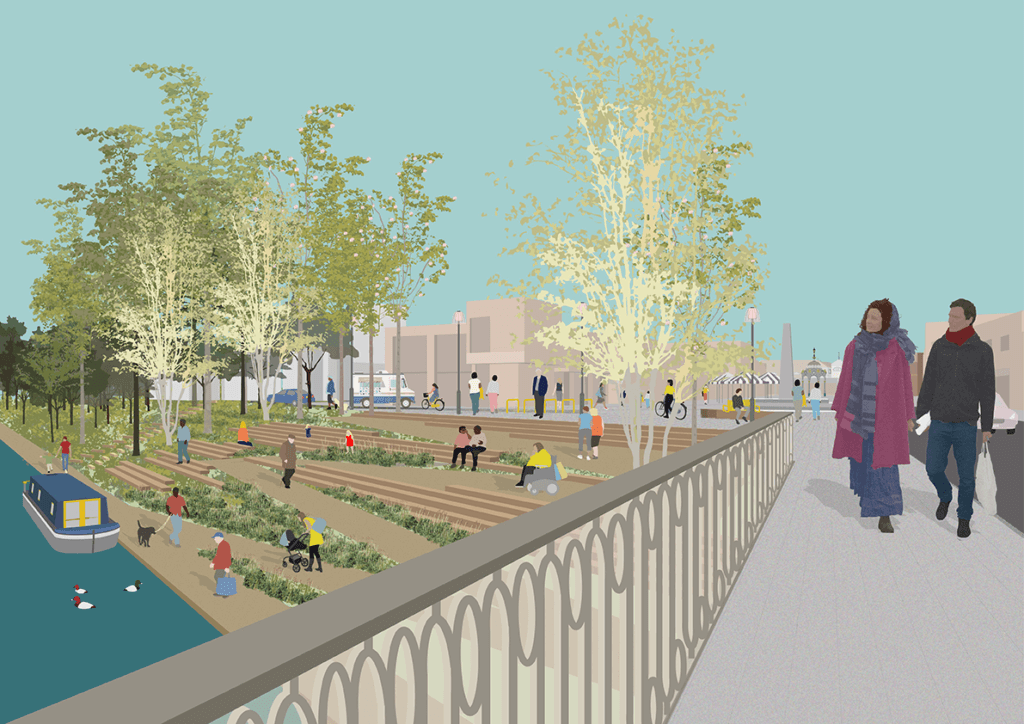
Feature Image: March Riverside