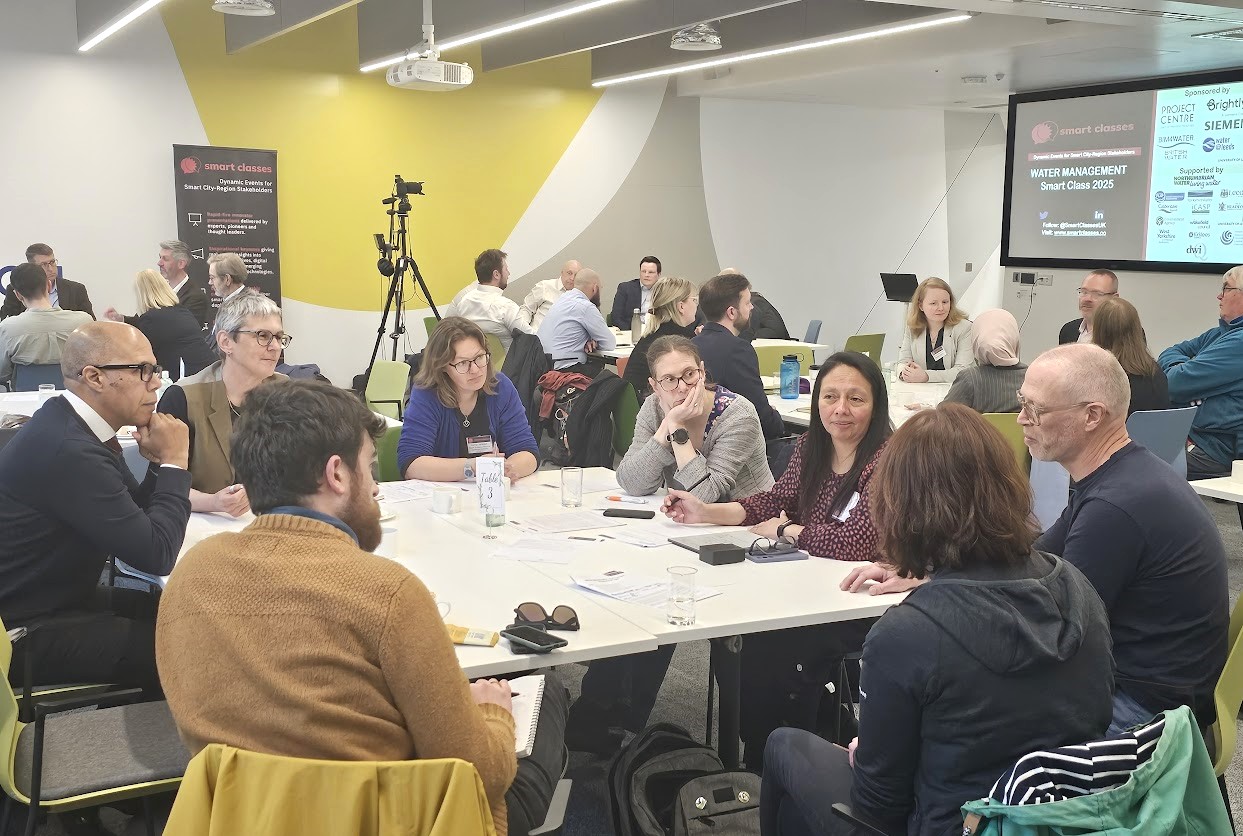
The University of Leeds interdisciplinary water centre was created in 2009 to provide interdisciplinary solutions to water challenges. water@leeds works with partner organisations internationally, nationally and regionally to tackle water-related problems at various scales.
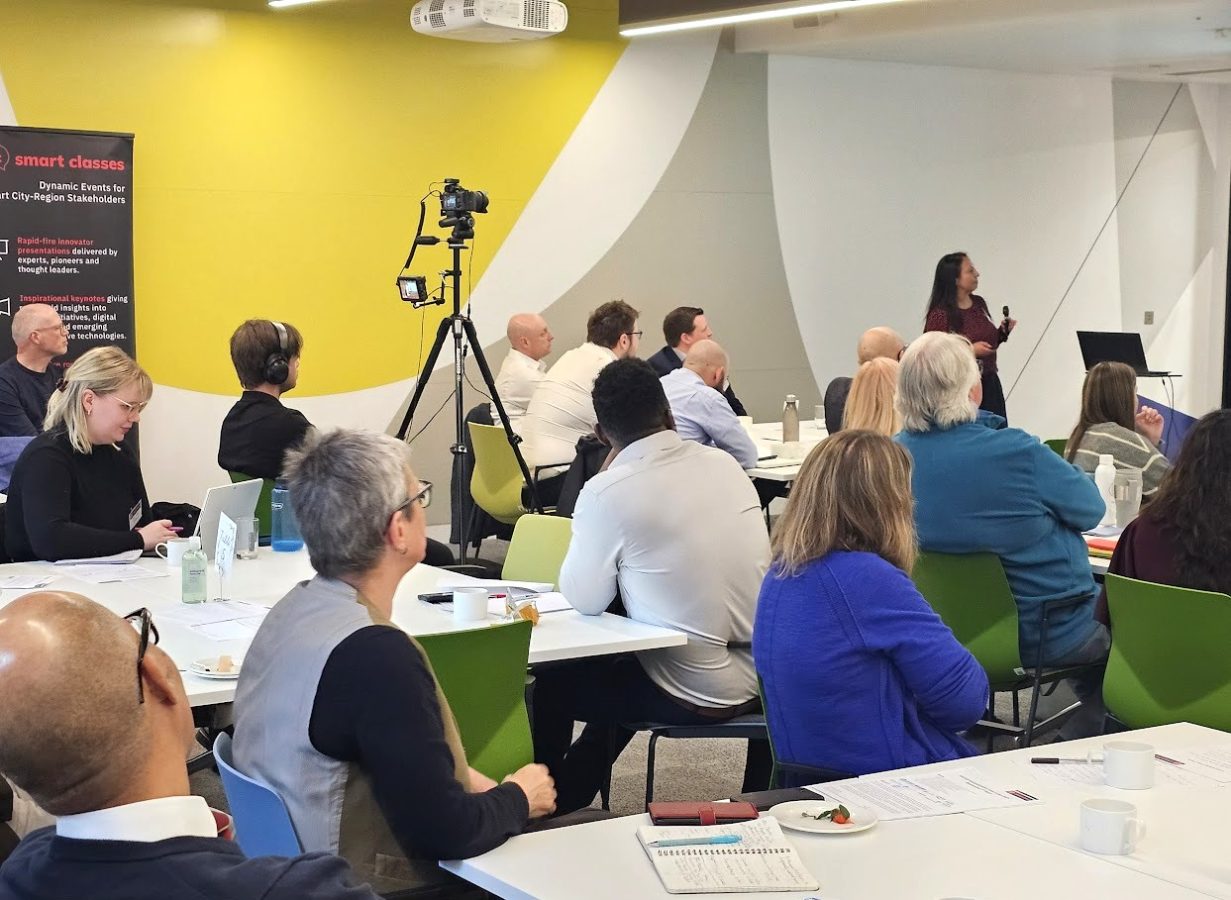
At WATER MANAGEMENT Smart Class 2025, Dr Gabriela Lopez-Gonzalez (Head of water@leeds) presented water@leeds’ journey from horizon scanning to innovative solutions, highlighting the importance of an interdisciplinary approach. Gabriela’s talk addressed how to identify priority water research questions, water@leeds research strategy, translating research and opportunities for collaboration, and the challenges and benefits of collaborations between interdisciplinary research centres and non-academic stakeholders.
Dr Dylan Young (Research Fellow) and Dr Devakunjari Vadibeler (KTP Associate – Environmental Engineer) then shared some of their collaborative experiences, including case studies on managing water for carbon storage in peatlands, ecosystem modelling, and optimising flood resilience. They also teamed up with Gabriela after the presentations and Q&As to host water@leeds’ deeper dive roundtable sessions with the delegates.
Presentation highlights and notes:
- water@leeds is one of the sixteen interdisciplinary research centres. They aim to bring together staff from all faculties to address challenges and are constantly exploring how to collaborate with other interdisciplinary centres;
- Main collaborators are Leeds Institute for Fluid Dynamics, Global Food and Environment Institute, and Priestley Centre for Climate Futures; others include Energy Leeds, Leeds Institute for Data Analytics, Horizons Institute, Bragg Centre, Leeds Arts and Humanities Research Institute, Language at Leeds, Astbury Centre, Leeds Social Sciences Institute, Cultural Institute, HealthTec Innovation, Mechanobiology and Mechanotechnology, and Leeds Cancer Research Centre;
- The focus is interdisciplinary grand challenges for water – from local to global; water@leeds research covers all areas of the hydrosphere, has projects on all continents, and covers a wide disciplinary range, encompassing expertise from across the physical, biological, chemical, social and economic sciences, engineering and the arts and humanities;
- Four missions inform water@leeds’ strategy and activities:
- 1) Undertake transformational, fundamental and applied research that enables us to be at the heart of the global water research and innovation community;
- 2) Enhance and develop partnerships with global and local organisations to maximise the value of water research;
- 3) Generate research outcomes which have major positive impacts on society and the environment, reduce inequalities and shape a better future for humankind;
- 4) Empower the next generation of water experts with the knowledge, skills and interdisciplinary awareness to develop the solutions to water-related challenges;

- How does water@leeds identify priority water research questions?
- In partnership by engaging actively with non-academic stakeholders – e.g. in 2009, consultation in partnership with practitioners and policy makers including Weetwood Environmental Engineering, Natural England, Consumer Council for Water, Yorkshire Peat Partnership, RSPB and Environment Agency;
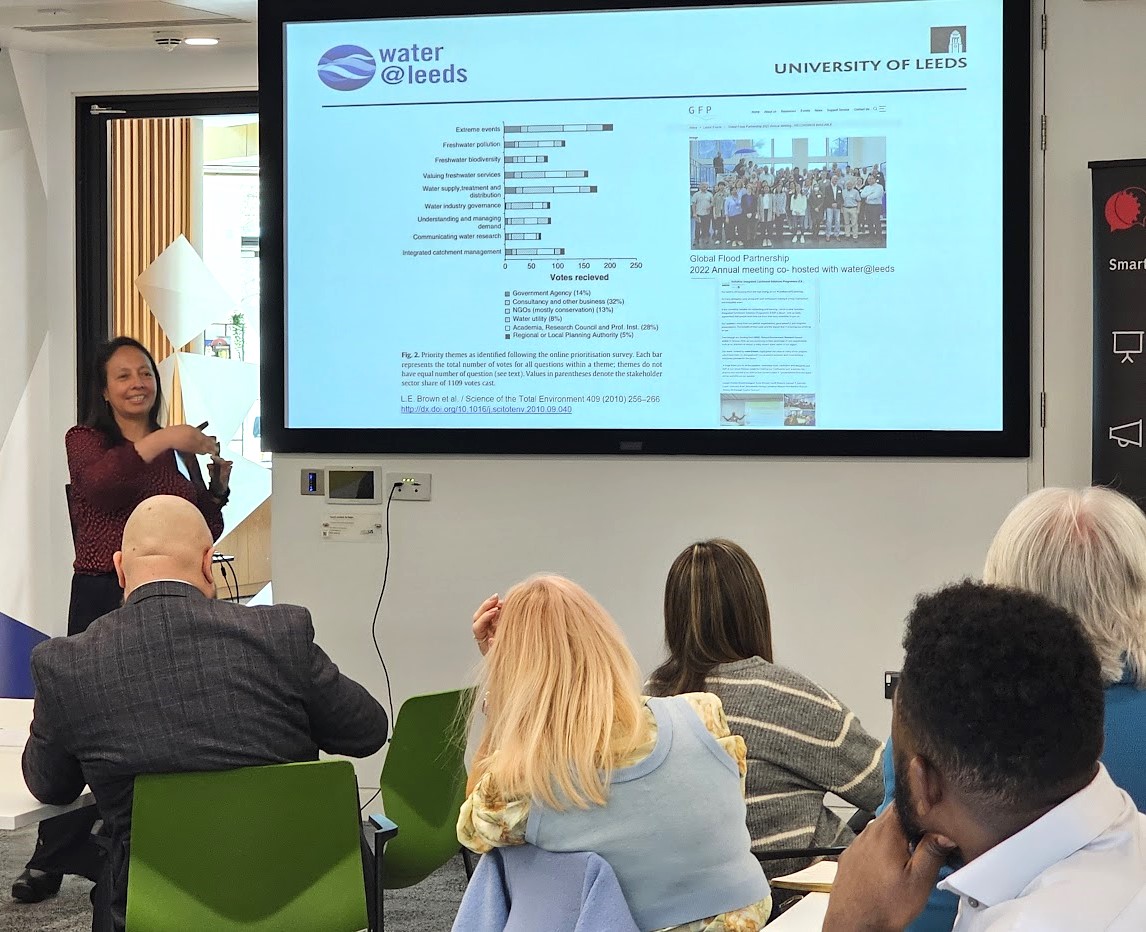
- Priority themes identified following online prioritisation survey – Extreme events, Freshwater pollution, Freshwater biodiversity, Valuing freshwater services, Water supply treatment and distribution, Water industry governance, Understanding and managing demand, Communicating water research, Integrated catchment management; These themes allow water@leeds researchers to understand the wider water community needs; Regarding extreme events, flooding is an area of research where Leeds has extensive experience and has supported initiatives at local and international level e.g. water@leeds hosted the Global Flood Partnership in 2022, and in February 2025, funded the iCASP programme annual event, which provides scientific advice to the WYFLIP;
- The top 100 global water questions: Results of a scoping exercise in 2019 – These questions offer a shared framework for interdisciplinary water research; Governance and Knowledge production were identified as crosscutting themes; 44% academic responses, 14% NGOs, 10% private companies;
- Members research covers all 17 SDGs and grand challenges around water are what motivate e.g. changing climate, growing populations, migration, urban development, changing consumption, water for food, energy & environment, shifting land use etc;
- £25M value of active research collaboration and 51 active projects;
- Knowledge co-production and Research translation – Collaborations with Industry can provide an opportunity for knowledge production and research translation; Examples include supporting PhD and MSc projects and partnerships, supporting independent Early Career fellows GtR (NB. Yorkshire citizen science project with community groups, Yorkshire Water, EA, an SME) and co-developing bespoke CPD programmes;
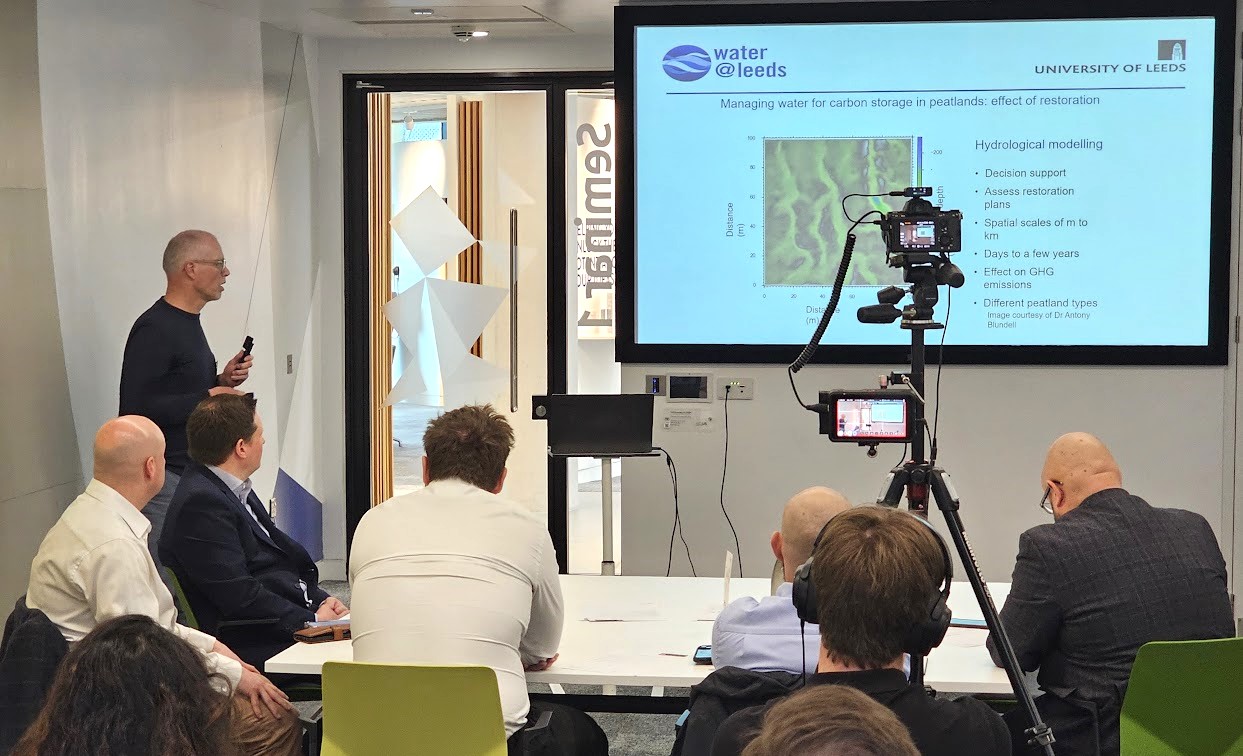
- Managing Water for Carbon Storage in Peatlands: effect of restoration – Hydrological modelling e.g. Decision support, Assess restoration plans, Spatial scales of m to km, Days to a few years, Effect on GHG emissions, Different peatland types;
- Ecosystem Modelling: effect of climate on peatland carbon stocks (decades to centuries) – Peat thickness (Global warming level, Shared Socioeconomic Pathways), Water-table depth;
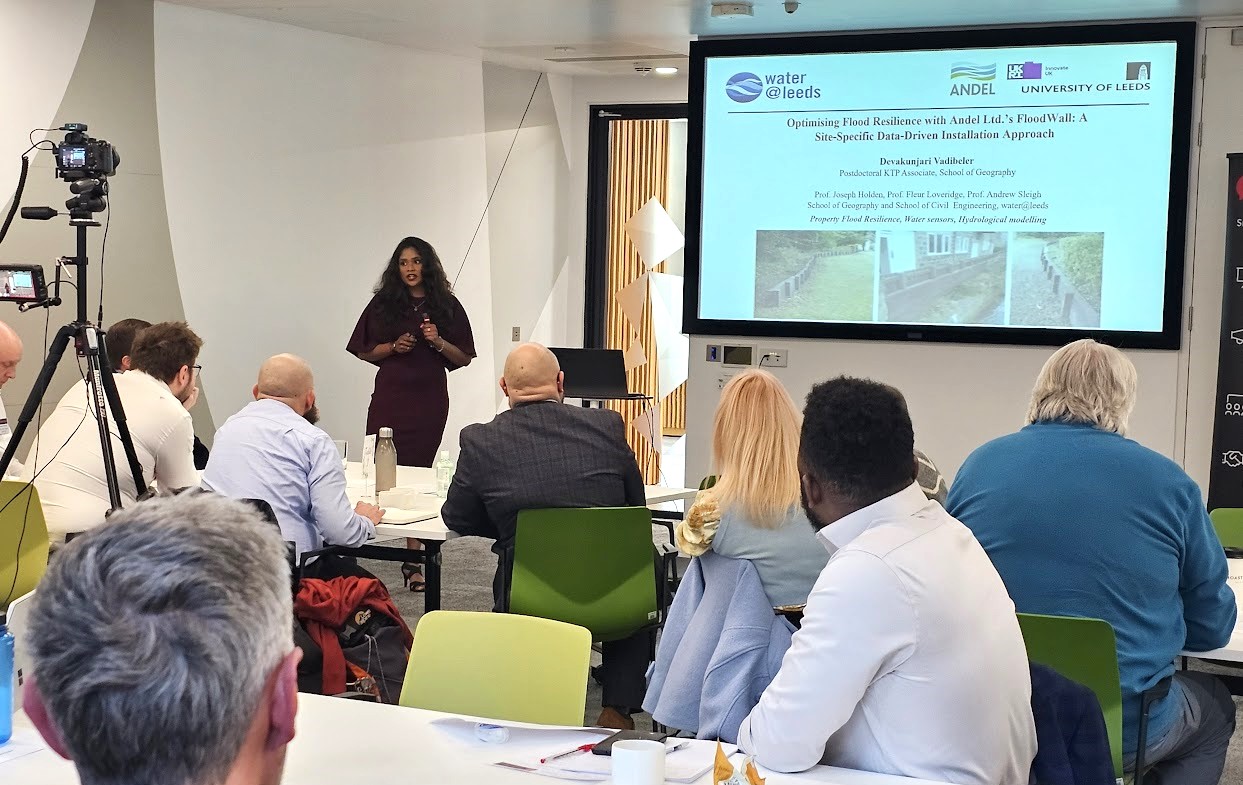
- Optimising Flood Resilience with Andel Ltd’s FloodWall: A site-specific data-driven installation approach – Property flood resilience, Water sensors, Hydrological modelling;
- EIT Knowledge & Innovation Community (KIC): Water, Marine and Maritime Sectors and Ecosystems – water@leeds are a core partner on a submission to the Water KIC by Aarhus Universiy Allwaters; Allwaters is an international consortium that is building an ecosystem of diverse and disruptive partners from across Europe, each contributing different perspectives and insights to tackling global water issues
If you meet our regular delegate qualification criteria but were unable to join us at Nexus Leeds for the live in-person event on April 2nd, CLICK HERE and complete the short “Download form” (located at the bottom of the post) to receive a unique link enabling free access to the presentation video recordings and slides (including the film footage and slides from Gaby, Dylan and Deva’s initial presentation).
Those qualifying to receive the rich presentation content from this event include commissioning, procurement, innovation, trialling and partnering leads, senior influencers, strategic decision makers, environmental managers, policy makers and planners from UK water companies and utilities, wastewater and sewer operators, lead local flood authorities (unitary authorities and county councils), city/borough/metropolitan councils, district councils, combined authorities, internal drainage boards, regional flood & coastal committees, highways authorities, prime contractors, general insurers, large water consumers, national agencies, central governmental and regulatory bodies (e.g. Defra, DCLG, Ofwat, Environment Agency, DWI, SEPA), independent industry and consumer organisations (e.g. Water UK, CCW), river trusts, NGOs etc.