Pete Dyson is co-author (with Rory Sutherland) of the book Transport for Humans. He is currently undertaking a PhD at the University of Bath, researching policies designed to promote sustainable travel habits in UK towns and cities, and is also the Bicycle Mayor for Bath, an independent position within the BYCS NGO global bicycle mayor network. Back in 2013, Pete was a founding member of the Ogilvy Behavioural Science Practice and, in 2020, he joined the UK Department for Transport as its first Principal Behavioural Scientist.
Pete joined us at TRANSPORT Smart Class, Wales & West of England 2024 to explain how we can re-think and re-balance our approach to transport experience, design and policy:
“Too often, people have been treated like cargo, yet contemporary insights from social and behavioural sciences show we are often guided by more human hopes and fears. The previous Secretary of State for Transport, Louise Haigh MP (succeeded on November 29th by Heidi Alexander MP), outlined a commitment to put people first, so how might this be achieved? How do people want and need to travel? Where can change be influenced? Which investments are most valuable?”.
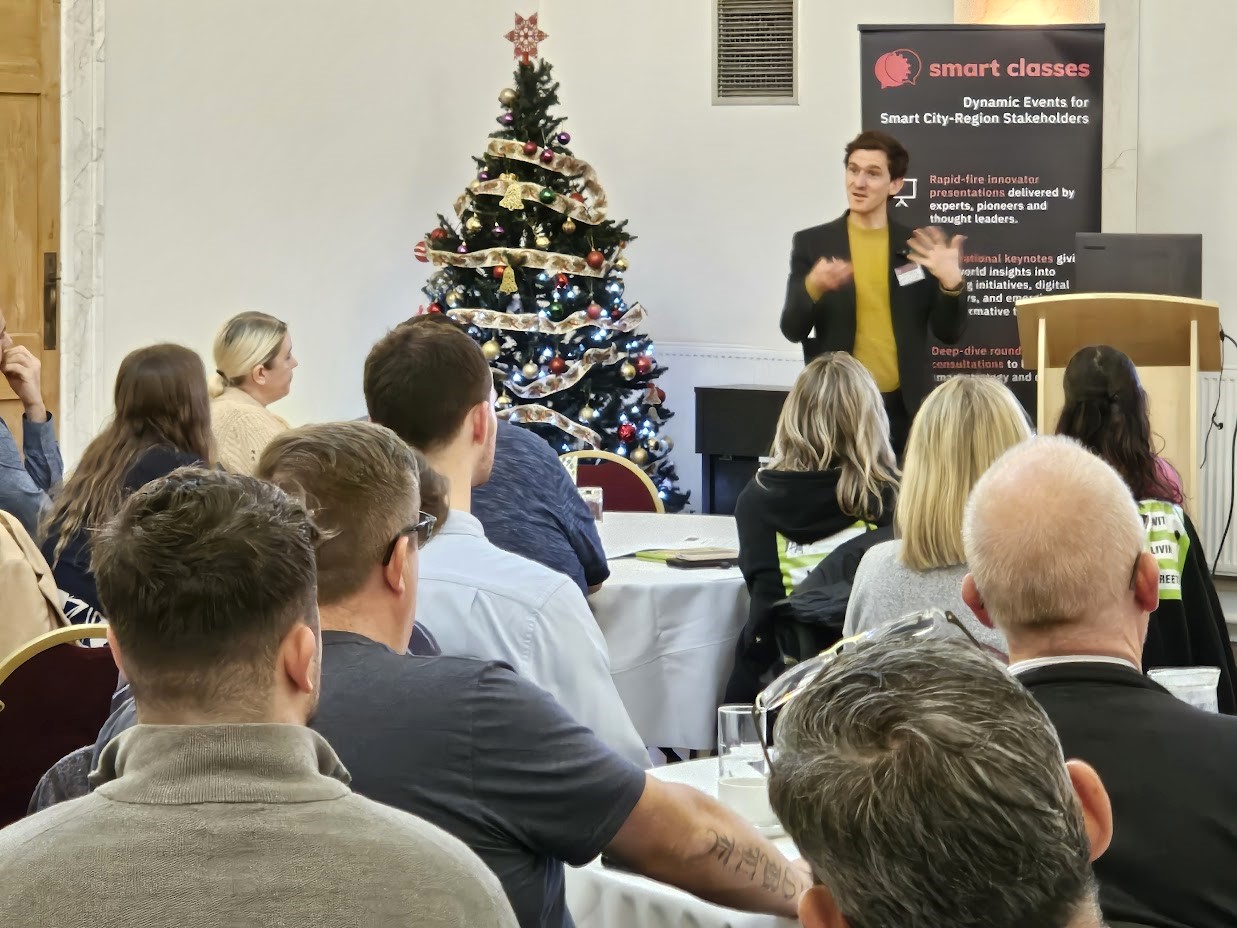
Leveraging his breadth of experience, Pete demonstrated how a human-friendly and sustainable future for transport can put people first. His keynote illustrated the problems and solutions with examples from UK local transport planning. It also made recommendations about shifting mindsets, organisational change, reforming policy design, commissioning research to understand how people want and need to travel, co-creation and public engagement.
Summary of presentation highlights:
- The greatest hope for a brighter future lies in adapting transport to more human wants and needs. Behavioural science has immense potential to improve the design of roads, railways, planes and pavements – as well as the ways in which we use them – but only when we embrace the messier reality of how people travel;
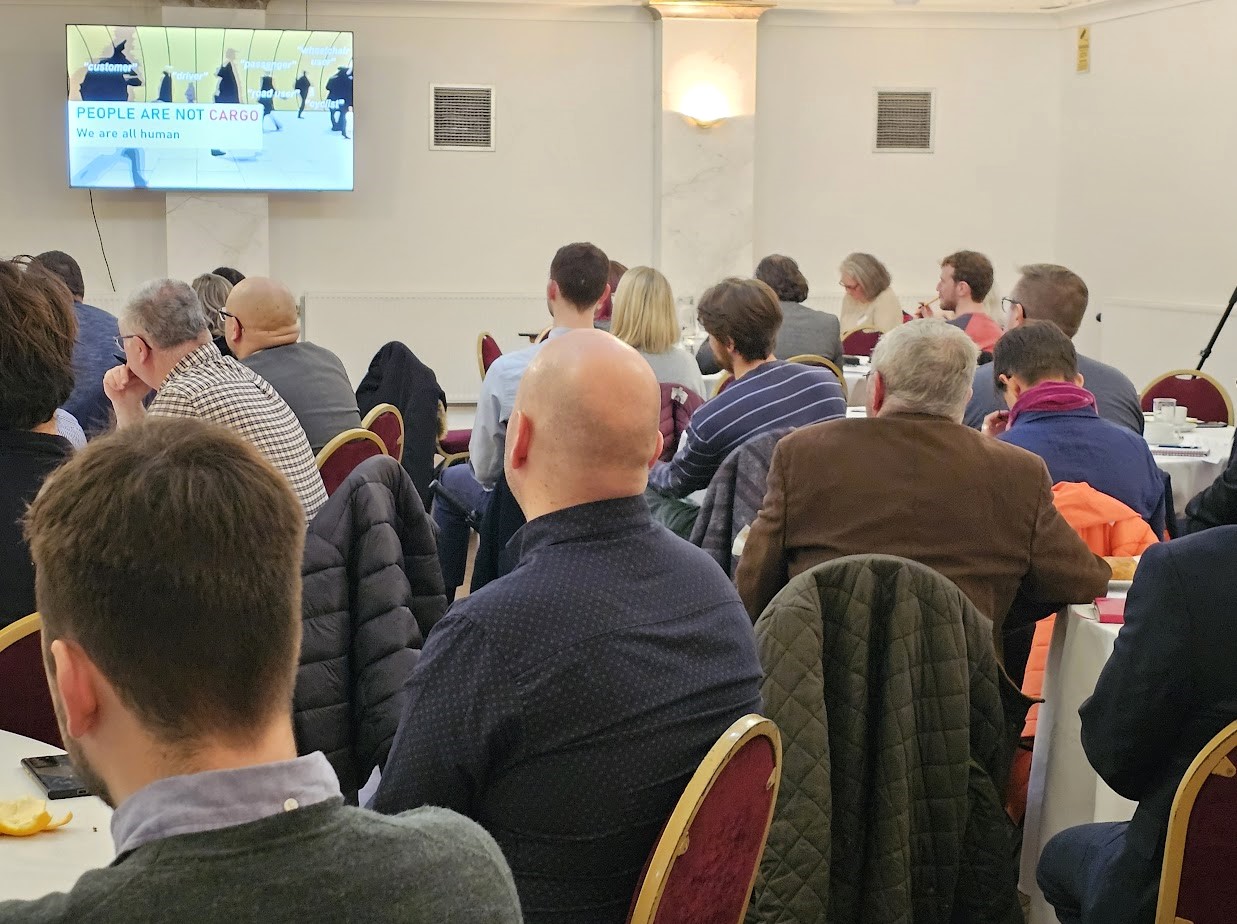
- People Are Not Cargo…
- Yet many transport policies and technologies still treat people as though they follow such simple rules;
- People who travel go by many names (e.g. passengers, customers, drivers, cyclists, pedestrians) but we are all human – Our travel choices ROAM, being influenced by habit, status, comfort, connectivity and many factors that have sat outside the economic and engineering equations shaping our world;
- For good reason, to make transport ‘go’, we have engineers to build roads, rails and infrastructure, but the ways an engineer measures success (journey time, efficiency, total revenue) are not the way that passengers thinks about a good trip;
- Being humans means there’s hope – We do already design the engineering for our physical bodies e.g. a steering wheel accommodates the shape of your hands, taking advantage of our apposable thumbs that were never evolved to steer cars;
- But we aren’t yet so good at designing the way we live to accommodate our brain’s characteristics – We often endure signage, tickets and instructions designed to suit the brains transport planners wish we had!
- We’re using a Stone Age brain in a high-speed world and this is a world with many new priorities – Our ancestors never worried about being stuck in traffic or missing a flight. Crammed into the past 250 years are all the transport and communications technologies we now take for granted. The transport infrastructure and social systems we build should adapt to us, not the other way round;
- In fact, we share many transport systems with freight and cargo;
- We frequently find ourselves confronted by a hotchpotch of competing tariffs, timings and bundles built from years of complex arrangements;
- The airline industry refers to people as ‘self-loading freight’, UK railways insist on closing the doors 1-2 minutes ‘before’ departure, and wheels were added to suitcases (known as ‘rolling luggage’) only 50 years ago;
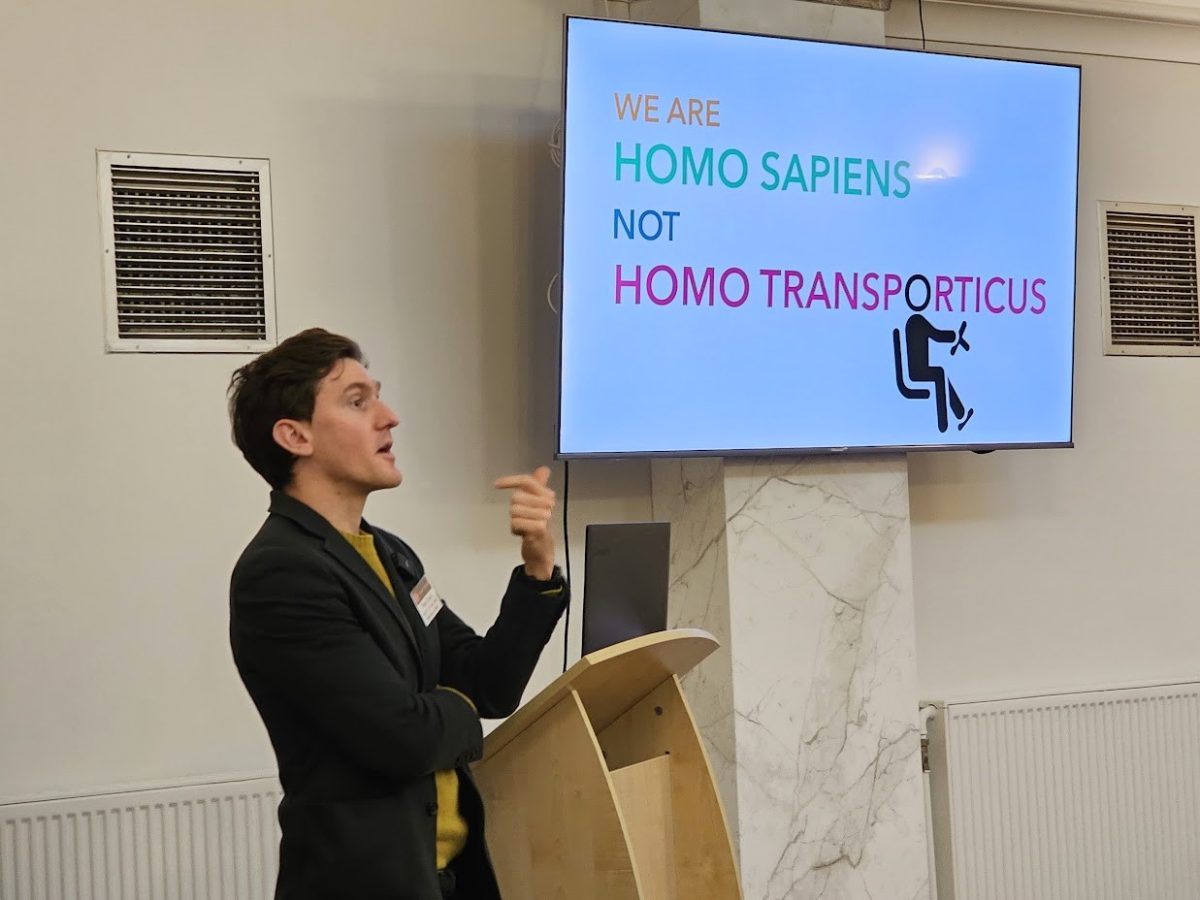
- We Are Homo Sapiens, Not Homo Transporticus…
- Because transport is a business, economics has come to simplify our colourful nature into a black and white caricature. Homo Transporticus (a character introduced in Pete’s book) is a cousin of ‘economic man’ with specialist transport traits – knowing routes, unshaken by stress and seeking to minimise travel time. Simple assumptions make the maths work, but they don’t change us from being human and we’d do well to embrace our humanity – body and mind!
- We’re not wired to perceive reality even if we we wanted to – Experiments show that a hill or a flight of stairs will be perceived several degrees steeper by someone who is less fit or older or mentally exhausted. Given a heavy backpack to wear, studies show you’re likely to grade the hill as steeper. Seeing in believing!
- The latest behavioural science is already revealing ideas for improvements travellers won’t and can’t tell us – Research has found journey time passes faster in cleaner and quieter train carriages than busy and dirty ones, and the return-trip effect shows how the way back feels, on average, 17% quicker than the way out;
- But also, within this short space of time (less than 10 generations), the economic thinking of just a few individuals have created the convenient fiction that society and the economy can be modelled by the laws of physics. To understand the future of transport, you don’t have to be a quantum physicist, but it helps. Much as classical economics takes it’s cue from Newtonian physics, psychology takes a reference point from quantum physics;
- Transport for Humans Quiz…
- Question 1. – Which square, A or B, is a lighter shade of grey? They’re the same but why do they look different? We process information relatively to it’s context and your experience with the scene. Your brain is expecting a pattern, our memories strongly influence what we actually see. Whilst our eyes are actually very good light meters they often go above and beyond compensating for different lighting conditions so that we have a more seamless experience of the visual world. Opposing luminance gradients that meet at an edge make physically identical adjoining regions look differently bright. By removing the context we can prove that the squares are the same;
- Question 2. – What came first, putting a person on the moon or putting wheels on a suitcase?
- Question 3 – Which London Underground route would you take between Liverpool Street and Victoria?
- Answering question 3 with reference to a trusty tube map reveals 3 big things for transport policy and behavioural science:
- 1) Data isn’t enough – Just seeing dots on a map doesn’t tell you how or why people are travelling 2) Biases don’t make sense – Can we really say that you have a ‘comfort bias’ or ‘avoid lots of escalators bias”? 3) People are not cargo;
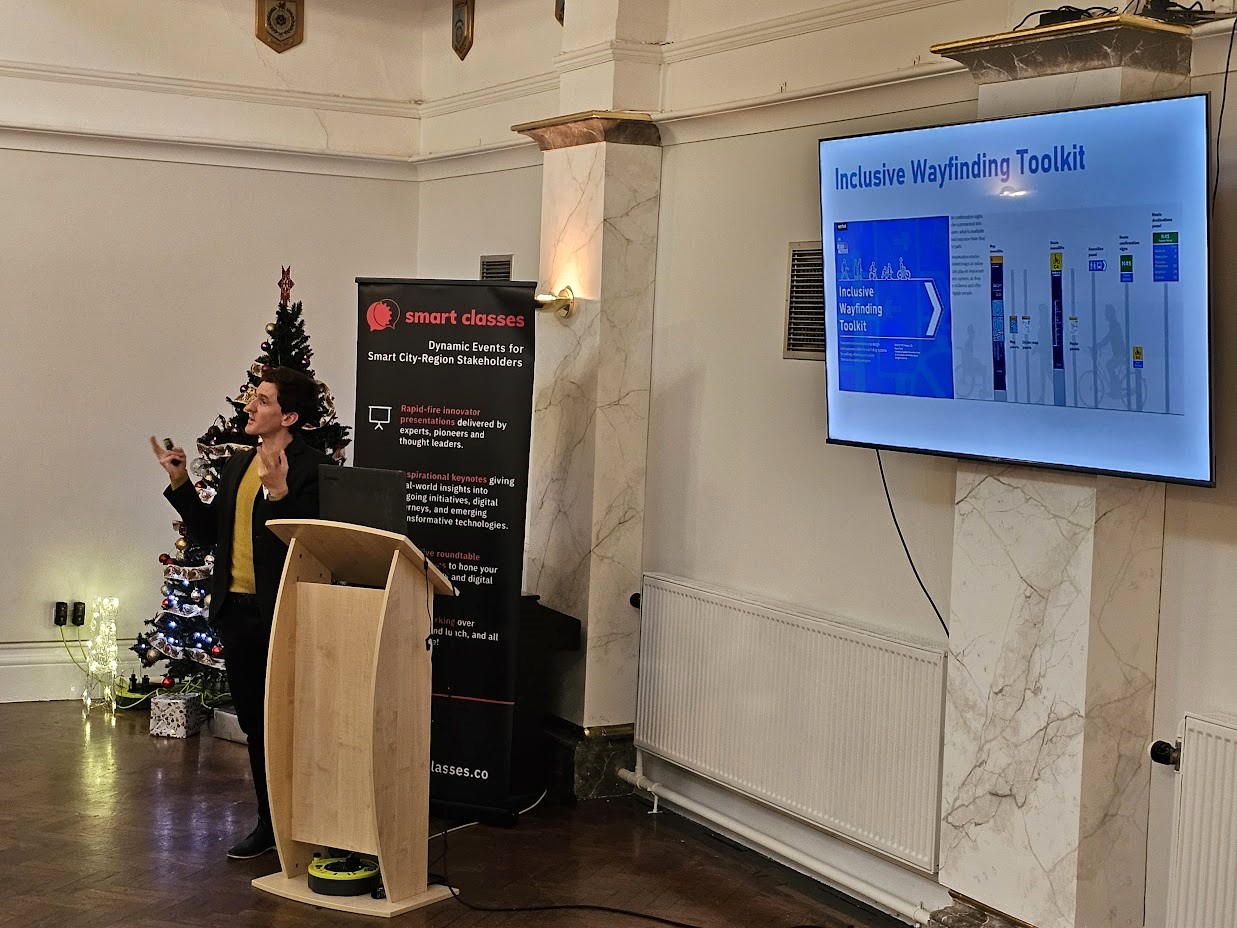
- Travel As A Skill – A skill we should embrace; A requirement we should make it less skillful; Unpacking ease…simplicity, seamless, no friction – Easy to choose, Easy to use; Design for reality & perception; Counter intuitive travel; Psychology when people design transport;
- Inclusive Wayfinding Toolkit – Design Age Institute tools and recommendations to design and implement effective wayfinding systems for walking, wheeling and cycling that can be used by everyone;
- Walking Bus – BrightWayz inspiring active travel;
- Better Integrating Transport Networks: Fares – Free transfers, no fare difference between modes; Routes – Local routes intersecting or feeding high capacity transport, bus stations and railway stations in the same place; Schedules – High frequency, time connections and takt schedules, coordinated last trip times;
- Transport Focus asked local people in the Liverpool City Region for their ‘Passenger Voice’ – This 18-month research project was conducted both online and face-to-face with interactive engagement sessions on board two life-size mock ups of a carriage; Then, full-size mock up showcased many aspects of this work and went on public display at venues across the City Region, which was visited by over 10,000 people and attracted hugely positive feedback;
- Spotlight on Reliability and ‘Variance’ – Addressing reality and perception: Make more reliable, correct misperceptions about reliability and help people travel within an unreliable system…
- Watkins et al 2011 is one of the few studies that untangled it in a very systematic way – They found a two-minute (or 30%) drop in perceived wait times, and also a two-minute drop in actual wait times for people who used real-time information;
- By leveraging studies by Pettor and Whitte on social influence, an understanding of social norms led to the UK pioneering the Green Number Plate;
- An understanding of how size is viewed relatively and cars signal social status, would help keep vehicle size proportionate to societal constraints;
- An understanding of what captures driver’s attention, led Brighton Buses gaining more by replacing their advertising space with route information – So drivers knew where the buses that sped past in priority lanes were going;
- Physical and digital connectivity are inseparable – Mobile signal map showing patchy rural coverage (OFCOM);
- Making policies easier to choose and use – Smart motorways; High Speed 2; Low Traffic Neighbourhoods;
- The upcoming DfT ‘Connectivity Tool’ for Local Authorities;
- From seeing people as the problem…to solving people’s problems – The fundamental problem is looking at people as the problem, rather than solving their problems. Working on Covid Response measures at DfT, Pete learnt the importance of framing “what you want people to do, not wat you want them not to do”;
- Other language and frameworks, used by the IPCC, IEA, Transport Scotland and UCL’s ‘Achieving Behaviour Change’ guide for local government;
- Ingredients For Easy Sustainable Travel…
- Enablers – Knowledge, training and advocacy; Social research; Data on travel behaviour; Behavioural scientists; Customer/User Experience (UX); Communications & Marketing; Diversity & culture;
- Barriers – Long-term funding; Reform transport governance; Re-balance subsidies and incentives; Measurement/Accounting; Legislation (e.g. micromobility/TROs)
If you meet our regular delegate qualification criteria but were unable to join us at Cardiff Masonic Hall for the live in-person event on December 5th, CLICK HERE and complete the short “Download form” (located at the bottom of the post) to receive a unique link enabling free access to the presentation video recordings and slides (including the film footage and slides from Pete’s keynote).
Those qualifying to receive the rich presentation content from this event include commissioning, procurement, trialling, partnering and policy leads, senior influencers, strategic decision makers, programme managers and planners from local authorities (e.g. city, borough, metropolitan, district and county councils); public transport operators; regional transport partnerships, sub-regional transport bodies, combined authorities, integrated transport authorities and passenger transport executives; highways authorities and road operators; government and supporting national transport agencies; non-governmental organisations; fleet operators, parking operators, prime contractors etc.