
Gartner has reported that the simulation digital twin market is expected to reach $379 billion by 2034, up from $35 billion in 2024. Mordor Intelligence predicted a similar trajectory for the broader digital twin market, forecasting nearly $131 billion by 2029 compared with roughly $26 billion in 2024. Other projections may vary in terms of specific numbers, but consistently point to extraordinary growth.
This is largely being driven by increased integration of the Internet of Things (IoT), artificial intelligence (AI), and cloud computing. As these enabling technologies have evolved, so has the potential of digital twins. CEOs have taken note; according to one report, “70% of C-suite technology executives at large enterprises are already exploring and investing in digital twins.”
What is a digital twin?
For many, the first thing that comes to mind when discussing digital twins is a 3D replica of real-world objects. But in reality there is more to it than that. A digital twin is a digital representation of a physical object, system, or process with synchronised bidirectional interaction with its real-world counterpart. They are primarily categorised into the following types:
- A component twin, sometimes referred to as a part twin, represents the most granular level of digital twins. As the name suggests, it focuses on modeling a single part of a larger real-world object.
- A product twin is basically an integrated assembly of component twins representing a complete product or device. This digital twin representation can capture the entire product development lifecycle, from the initial concept design to full-scale production.
- A process twin is a digital representation of a real process, mirroring interactions and dynamics among various components of a system. While still an emerging concept, it’s gaining significant traction in the industry.
- A system twin is a comprehensive digital representation that shows how multiple product or process twins interact and function together as an integrated system.
Digital twins are ideally suited for real-time monitoring, simulation, scenario planning, and predictive analysis. While their integration with cybersecurity is relatively recent, there are already several successful use cases highlighting their potential.
Using digital twins for cybersecurity
1. Physical security
Designing an effective security system for a physical environment requires careful consideration of many variables. Inadequate or poor placement of security equipment such as CCTV can create vulnerabilities. On the other hand, overloading the system with cameras and high-tech gadgets can lead to significant and often-unnecessary expenses.
In this context, a digital twin of the physical environment provides a range of benefits, from real-time monitoring to optimised resource allocation. It enables predictive analysis and scenario planning, helping organisations to anticipate threats and develop effective and proactive defense strategies.
A digital twin solution can drive 10%-50% cost savings in physical security projects by optimising security setups and configurations.
2. Network twins
As networks grow increasingly complex, organisations face significant challenges in maintaining comprehensive network visibility, ensuring compliance and verification, and identifying potential vulnerabilities. This can create security gaps, increase operational risks, and slow down the response time to various requests. A network digital twin cuts through these challenges by providing a comprehensive, real-time replica of the network, enabling seamless validation and verification of configurations and security policies across individual network components.
Network digital twins are identified as a transformational technology and can cut request delivery times by up to 20%.
3. SOC twining in IT and OT worlds
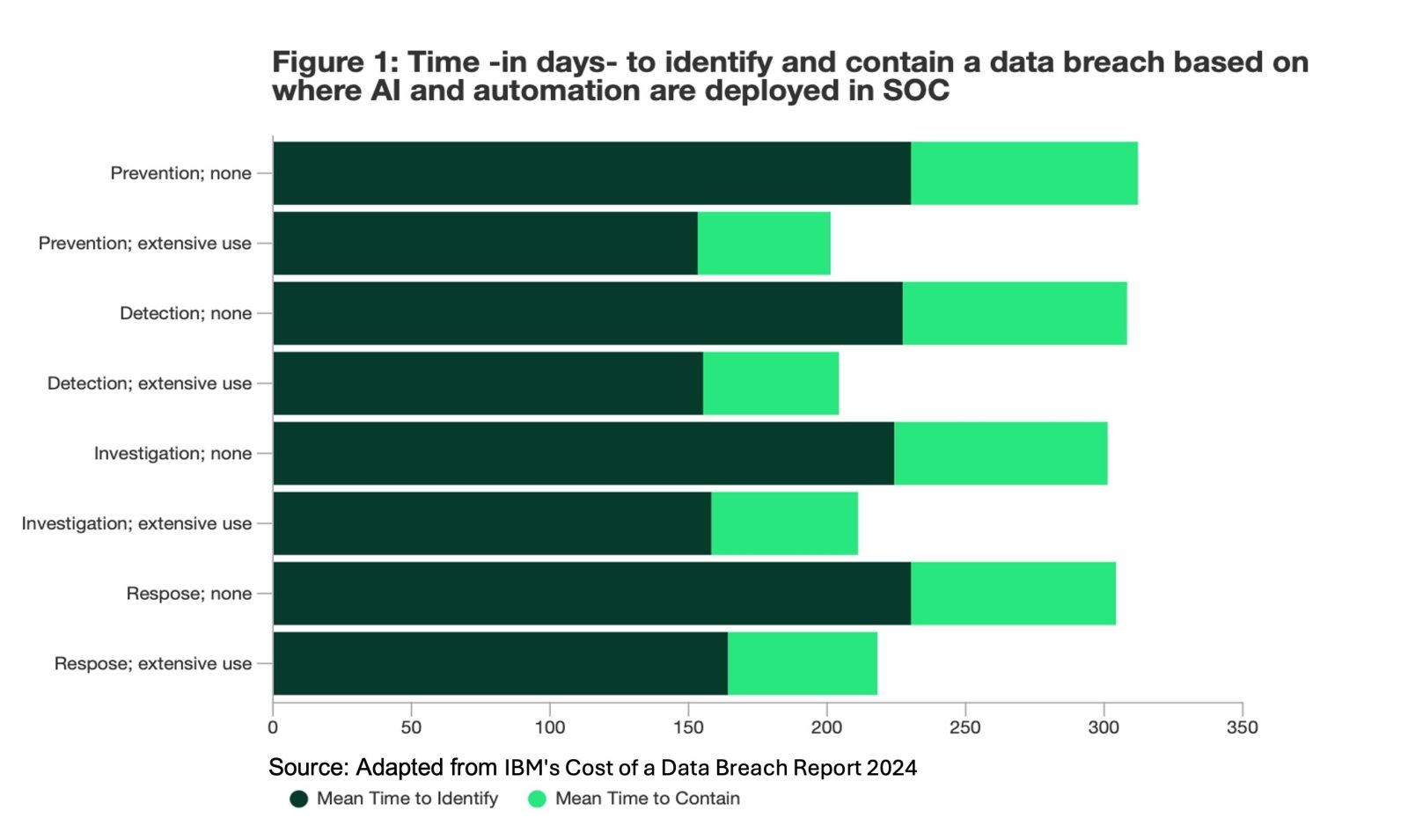
As cyber threats evolve in complexity, traditional security measures increasingly fall short. IBM’s Cost of a Data Breach Report 2024 revealed that 70% of organisations experienced significant operational disruptions due to security breaches, with an average dwell time of 199 days before detection and an additional 73 days required to fully contain the compromise.
Digital twin technology offers a powerful approach to cybersecurity threat modeling and incident response. By creating a virtual replica of an organisation’s IT or operational technology (OT) infrastructure, security teams can simulate potential cyber threats in a controlled environment. For example, a digital twin can model the impact of a ransomware attack on an accurate replica of the system, helping organisations develop, test, and optimise their incident response plans.
AI has reduced breach detection times by 33% and containment times by 43% in security operations centre (SOC)(see Figure 1), demonstrating the impact of automation in incident response. Digital twin technology builds on this, by creating real-time virtual replicas, enabling SOCs to simulate attacks, and optimising defenses. This enhanced visibility can drive even greater improvements, potentially surpassing AI-only results.
Integrating digital twins into cyber strategies
The digital twin market has enjoyed explosive growth and demonstrated its value across cybersecurity applications, from physical security optimisation to network management and SOC operations.
Organisations can conduct impact analyses to assess how this technology may benefit their value chain, and identify challenges it might introduce. A pilot implementation can provide valuable insights, allowing organisations to evaluate effectiveness, refine strategies, and ensure smooth integration before scaling across operations.
Manar Alohaly is Senior RDI Executive at Saudi Information Technology Company (SITE)
This article was originally published by the World Economic Forum on 4th March 2025 and is part of the Centre for Cybersecurity
Feature Image Source: Gerd Altmann on Pixabay