
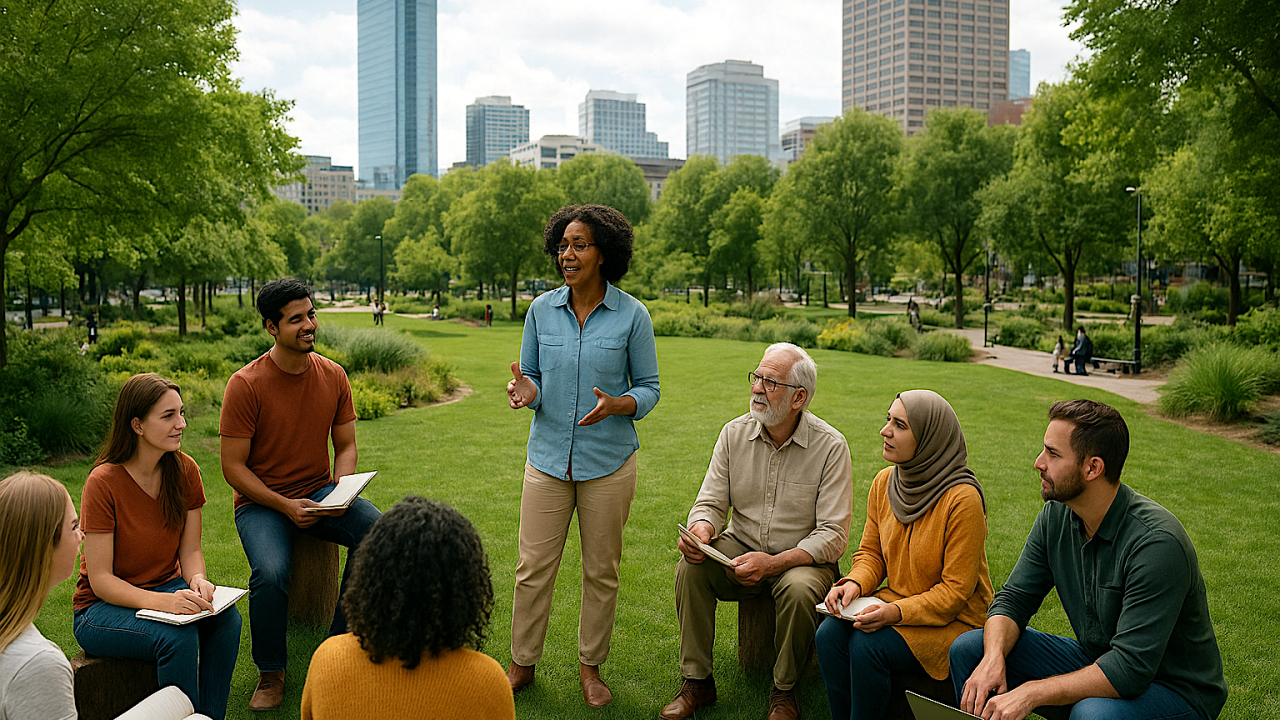
Look around.
Our cities are growing fast — sometimes too fast. Streets are busier, temperatures are rising, and divides between people feel wider than ever. Yet, amid these pressures, something new and hopeful is quietly taking shape: the learning city.
It’s a simple but radical idea — a city that learns and grows with its people. A place where learning doesn’t end with graduation but continues as a lifelong habit. Where libraries, workplaces, and even public parks become spaces for discovery. Where learning fuels connection, inclusion, and resilience.
This isn’t just a dream. It’s a new blueprint for how cities can thrive in the 21st century.
The Cities We Built — and Outgrew
Traditional cities were marvels of ambition. They rose from fields and rivers into skylines of glass and concrete. They symbolised progress — factories, highways, and bustling markets. Growth was measured in numbers: population, output, profit.
But something vital got lost along the way.
Many of these cities were built to move goods, not nurture people. They created wealth, yes, but often at the expense of social balance, environmental health, and shared belonging.
Now those same cities are on the front lines of global challenges — climate change, AI, automation, inequality — that their old designs can’t fix. What’s needed isn’t just more intelligent infrastructure, but a more innovative culture: one that learns, adapts, and includes.
What Exactly Is a Learning City?
According to UNESCO, a learning city puts lifelong learning at its heart. It uses every available resource — schools, workplaces, food pantries, police stations, technology, and community life — to make learning accessible to everyone, at every age.
That means:
- Education doesn’t stop when you leave school.
- Learning happens everywhere — in homes, parks, libraries, and even on buses.
- No one is left behind — not seniors, immigrants, or people with disabilities.
The goal is to build a learning society — a place where knowledge flows freely, helping everyone adapt to change, find purpose, and contribute to the common good.
The Spark: Learning Organisations
The foundation of a learning city lies in a simple yet profound idea: the learning organisation.
Peter Senge, who coined the term in 1990, described it as “an organisation where people continually expand their capacity to create the results they truly desire.“
In other words, it’s about creating cultures — in businesses, schools, or governments — where curiosity, reflection, and collaboration are part of everyday life.
When a whole city embraces that mindset, it becomes a living network of learners — flexible, creative, and ready for whatever comes next.
What Makes Learning Cities Different
1. Learning Never Ends
In a learning city, education is a lifelong right, not a privilege. Citizens of all ages can pick up new skills, whether that’s coding, cooking, or climate literacy. UNESCO’s Global Network of Learning Cities helps communities build inclusive systems so that everyone can keep learning — especially those who’ve been left out in the past.
2. Bridging Divides
Where old cities often deepen inequality, learning cities bring people together. Community centres, food pantries, music, workshops, non-profit organisations, police stations, and local learning festivals help neighbours meet, share, and grow — turning strangers into collaborators.
3. Building Economic Resilience
Learning cities connect continuous learning with real-world opportunities. For example, Cork, Ireland, aligns lifelong learning with local business needs through the EcCoWell model. This model integrates Ecology, Economy, Community, Culture, and Wellbeing & Lifelong Learning to create holistic and sustainable cities. It links economic growth, wellbeing, and sustainability into a coherent vision.
4. Caring for the Planet
A learning city teaches its citizens how to live sustainably. Chiang Mai, Thailand, has made environmental learning part of everyday life — from public parks that double as classrooms to community programs that promote green living. When people understand their environment, they protect it.
5. Staying Agile in Times of Crisis
When the COVID-19 pandemic hit, learning cities showed remarkable resilience. They shifted to digital education, organized neighbourhood learning circles, and kept people connected. Their secret? They were already used to learning — and adapting — together.
6. Aligning with Global Goals
Learning cities advance key Sustainable Development Goals (SDGs), especially SDG 4 (Quality Education) and SDG 11 (Sustainable Cities and Communities). They turn global vision into local action — one neighbourhood at a time.
Learning Cities in Action
Chiang Mai, Thailand: Green spaces like the Ping River Park invite people to learn about sustainability through experience. These programs have not only improved the city’s environment but also strengthened its sense of community.
Bucharest, Romania: The city put QR codes on buses and trams that link passengers to free e-books — transforming commutes into moments of learning and reflection.
Cork, Ireland: Every year, the Cork Learning Festival fills the city with a contagious energy for discovery. For a few days, the entire city becomes a hub where curiosity connects us, showing that learning isn’t just enlightening—it’s a joyful and shared human experience.
Road Ahead.
The learning city is more than an urban trend — it’s a quiet revolution. It asks us to see cities not just as places to live, but as places to grow.
Instead of measuring success by what we build, it challenges us to measure it by how much we learn — and how deeply we care for one another and our shared future.
As cities evolve, the ones that will truly thrive will be those that embrace this spirit of learning: open, adaptive, inclusive, and alive.
Michael Armanious is a Business Research Analyst and an expert in developing learning organisation strategies that help organisations improve and expand their core competencies to survive in a rapidly changing business environment.
Article originally published on LinkedIn on 11th November 2025
Feature Image: Author Sourced
References:
- Osborne, M., Kearns, P., & Yang, J. (2013). Learning cities: Developing inclusive, prosperous and sustainable urban communities. International Review of Education, 59(4), 409–423.
- Poonsukcharoen, N., & Auttarat, S. (2024). Chiang Mai Learning City: Raising Awareness of Urban Environmental Development and the Production of Green Spaces. The International Journal of Architectonic, Spatial, and Environmental Design, 19(1), 1-22.
- Senge, P. M. (1990). The Fifth Discipline: The Art and Practice of the Learning Organization. Doubleday/Currency.
- UNESCO Institute for Lifelong Learning. (2013). Beijing Declaration on Building Learning Cities. Hamburg: UNESCO Institute for Lifelong Learning.
- UNESCO Institute for Lifelong Learning. (2020). Embracing a Culture of Lifelong Learning. Hamburg: UNESCO Institute for Lifelong Learning.