
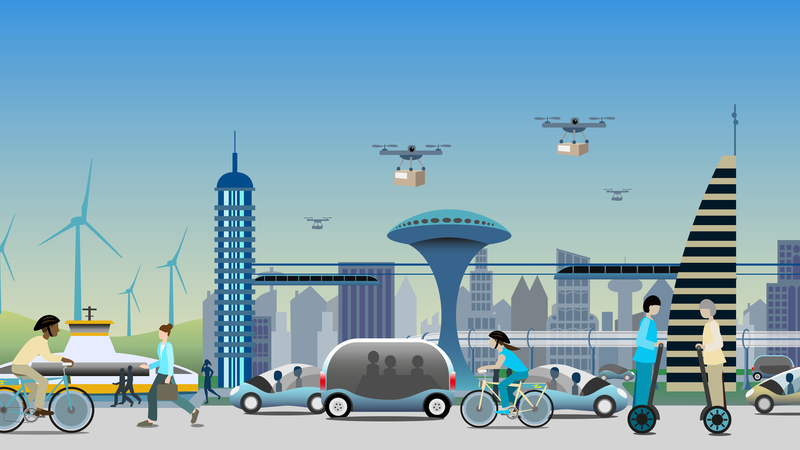
Transport is more than just a way of getting from A to B – it is the backbone of our economy, a driver of innovation, and an essential component of everyday life. Yesterday’s launch of the government’s Integrated National Transport Strategy (INTS) has shone a spotlight on the need for ambitious, joined up thinking to tackle the challenges of the next decade. As we embark on this transformative journey, we are not just asking how we can meet today’s needs, but what the future of transport could look like if we dared to challenge the status quo and embrace the art of the possible.
It appears that this new strategy will set the stage for tackling the climate crisis, providing for good economic growth, and social equity through transport. But translating high-level ambition into real-world impact will require collaboration at all levels of government, as well as innovative solutions that combine technology, policy, and community engagement. Against this backdrop, I was keen to explore the future of transport over the next 10 years, diving into the transformative trends and ideas shaping how we’ll move – and why.
It seems clear that electric vehicles (EVs) will play a central role in the government’s INTS, emerging as a cornerstone in efforts to significantly reduce greenhouse gas emissions. As a key component of the nation’s decarbonisation plan, EVs are poised to drive transformative change in the transport sector, aligning with ambitious sustainability goals and contributing to the broader shift towards cleaner, greener mobility solutions. As highlighted at Wednesday’s Prime Minister’s Questions, the UK’s impending 2030 ban on the sale of new petrol and diesel vehicles marks a bold step toward a greener future. However, this monumental shift to EVs is far from straightforward. It represents a transformative moment in transport history – one filled with opportunities but also significant challenges. From scaling up charging infrastructure to addressing the environmental and ethical concerns of battery production, the journey to widespread EV adoption will require innovation, collaboration, and a commitment to leaving no community behind.
While EV adoption is accelerating, the infrastructure to support it needs to keep pace. The challenge lies in creating a network of accessible, reliable, and fast-charging points, particularly in rural areas and underserved communities. Initiatives like the UK’s On-Street Residential Chargepoint Scheme and the Local Electric Vehicle Infrastructure (LEVI) funding are promising steps, but far more investment is needed to ensure no one is left behind in the EV revolution.
Beyond infrastructure, the environmental sustainability of EVs remains under scrutiny. Current battery technology relies heavily on rare earth minerals like lithium and cobalt, raising ethical and ecological concerns about mining. However, breakthroughs in solid-state batteries and alternatives like sodium-ion could mitigate these fundamental issues, promising cheaper and more sustainable EVs.
Perhaps the most exciting possibility is the rise of shared electric mobility services. Instead of owning a car, future transport users may subscribe to a service offering access to autonomous EVs that pick them up on demand. This shift could significantly reduce urban congestion and parking space needs while making transport more equitable and sustainable.
Looking slightly further into the future, the idea of self-driving cars, capturing imaginations for decades, is now edging closer to reality. Autonomous vehicles (AVs) are being tested in cities worldwide, promising a future of safer roads, less congestion, and a radically different relationship with transport. But the road to autonomy is not without its concerns.
Safety remains the primary concern. AVs rely on advanced sensors, machine learning, and decision-making algorithms to navigate complex and unpredictable environments. While technological advances are impressive, questions about how AVs will interact with human drivers, pedestrians, and cyclists are far from resolved. Cities might need to create designated “autonomy-first zones” to facilitate their adoption while ensuring safety.
The ethical dimension is equally challenging. In life-and-death scenarios, who decides how an AV should react? For example, should it prioritise the safety of passengers or pedestrians? Addressing these moral dilemmas will require robust public debate and clear regulatory frameworks.
The benefits of AVs are immense, but realising them will demand massive investment in infrastructure, regulatory reform, and cultural change. If successful, AVs could redefine the concept of ownership and personal mobility, aligning closely with the government’s vision for an integrated, sustainable transport system.
I truly believe that the next decade is likely to see a micromobility boom. E-scooters, electric bikes, and other compact vehicles are ideal for short urban trips, providing a cleaner and more efficient alternative to cars. Their rise aligns perfectly with the INTS’s focus on reducing congestion and emissions while improving urban liveability.
Cities worldwide are recognising the potential of micromobility and investing in infrastructure to support it. Bike lanes, scooter-sharing schemes, and car-free zones are becoming increasingly common, encouraging residents to embrace smaller, more sustainable modes of transport.
However, the micromobility revolution is also not without its challenges. Safety concerns, a lack of regulatory consistency, and accessibility issues must be addressed. To fully integrate micromobility into broader transport networks, Local Authorities must work with private operators and communities to create equitable, safe, and efficient systems.
Buses have long been the unsung hero of urban mobility. However, it is now poised for a renaissance, driven by the need to decarbonise, reduce car dependency, and provide equitable transport options for all. The next decade must see public transport become more user-friendly, efficient, and sustainable than ever before.
Investment in high-quality public transport will be key to the INTS’s success. In cities like Copenhagen, Tokyo, and Singapore, sleek and reliable public transport networks have demonstrated how infrastructure can transform urban living. The UK has an opportunity to replicate this success, through the delivery of plans and policies aligned with the emerging INTS’s objectives.
Technology will be a driving force behind public transport’s reinvention. Artificial intelligence (AI) and big data will optimise timetables, predict maintenance needs, and manage passenger flows in real-time. On-demand buses and autonomous shuttles could revolutionise suburban and rural transport, ensuring that public transport works for everyone, not just city dwellers.
Moreover, innovations like maglev trains and hyperloop systems could eventually reshape our intercity travel, making public transport faster and more competitive with cars and short-haul flights. However, achieving these ambitious goals will require sustained investment, collaboration, and political will.
As outlined in my last article, freight transport often flies under the radar in public discussions and within the sector itself, but its impact is enormous and should not be under-estimated. As e-commerce continues to grow, so does the demand for fast and efficient delivery. The next decade will see significant innovations aimed at decarbonising and optimising freight and logistics systems.
Electric and hydrogen-powered trucks are already being developed and will likely become commonplace by 2035. Autonomous trucks, capable of operating 24/7 without breaks, could further revolutionise long-haul freight, reducing costs and emissions. Meanwhile, last-mile delivery is being transformed by drones and robots, offering faster and more flexible solutions for urban areas.
However, these innovations bring challenges. Job losses in the logistics sector, privacy concerns around drones, and the potential for increased congestion all need careful consideration. Policies must balance technological advancement with social and environmental responsibility.
As a sector and as transport continues to evolve, so too must our understanding of its purpose. Do we always need to travel, or can digital connectivity provide an alternative? The pandemic highlighted the potential of remote work, online education, and virtual events to reduce our reliance on physical movement, but this must be balanced against the need to address social exclusion.
Over the next decade, digital technologies will become even more immersive and interconnected. Virtual and augmented reality could make remote meetings feel as real as in-person interactions, while smart home systems and 5G connectivity will allow people to work, shop, and socialise more seamlessly than ever before.
For example, the Cambridgeshire and Peterborough Combined Authority, for instance, continues to drive forward its Connecting Cambridgeshire project, enhancing broadband, mobile, and digital infrastructure to ensure the region is ready for a more connected future. Such projects highlight the potential for digital innovation to complement and transform traditional transport systems.
By reducing the need for physical travel, digital connectivity can play a crucial role in achieving sustainability goals. However, it also raises questions about social equity and digital access. Ensuring that everyone can benefit from these advances will be a key challenge in the years ahead.
Whilst national strategies set the vision, the real work often happens at the local level. Local Transport Plans are critical for tailoring transport solutions to regional needs and ensuring that investments align with broader goals. In Cambridgeshire and Peterborough our Local Transport and Connectivity Plan (LTCP) exemplifies how local strategies can address unique challenges while contributing to national priorities. By focusing on sustainable modes of transport, improving rural connectivity, and supporting economic growth, the LTCP demonstrates the importance of regional leadership in shaping the future of transport.
Collaboration between Local Authorities, businesses, the third sector, and communities will be essential to implement these plans successfully. Local governments must also advocate for the funding and policy support needed to bring their visions to life.
However, the future of transport is about more than technology or infrastructure – it is about rethinking how we live, work, and move. As we look ahead, we must challenge deeply ingrained assumptions about car ownership, urban design, and even the necessity of travel itself.
The government’s INTS alongside local and regional strategies and policies offer a framework for this transformation. But achieving these ambitions will require bold leadership, innovative thinking, and a willingness to embrace uncertainty.
Transport can be a powerful tool for addressing some of the most pressing challenges of our time, from the climate crisis to social inequality. The next decade offers an opportunity to reimagine transport as a force for good – building stronger communities, creating a fairer society, and protecting our planet for future generations.
The future of transport is not a distant dream – it is a challenge unfolding in real time, demanding your attention and action. The ideas and innovations shaping the next decade are brimming with potential, but they depend on us – the policymakers, the industry leaders, our communities, and us as individuals – to bring them to life.
So, what role will you play in this transformation? Will you champion greener technologies, advocate for equitable access, or rethink your own travel habits? Will you push for more inclusive policies, support local initiatives, or contribute to the bold leadership needed to challenge the status quo?
As we stand on the threshold of this critical decade, remember transport is more than movement. It is an enabler of opportunity, a bridge to progress, and a reflection of our collective priorities. Together, we can choose to embrace this pivotal moment and shape a future where transport is not only sustainable but transformative.
The question is: how will you reimagine the journey?
Tim Bellamy is Assistant Director – Transport at Cambridgeshire & Peterborough Combined Authority
Tim originally published this article on LinkedIn on 29th November 2024
Feature Image: Author sourced