
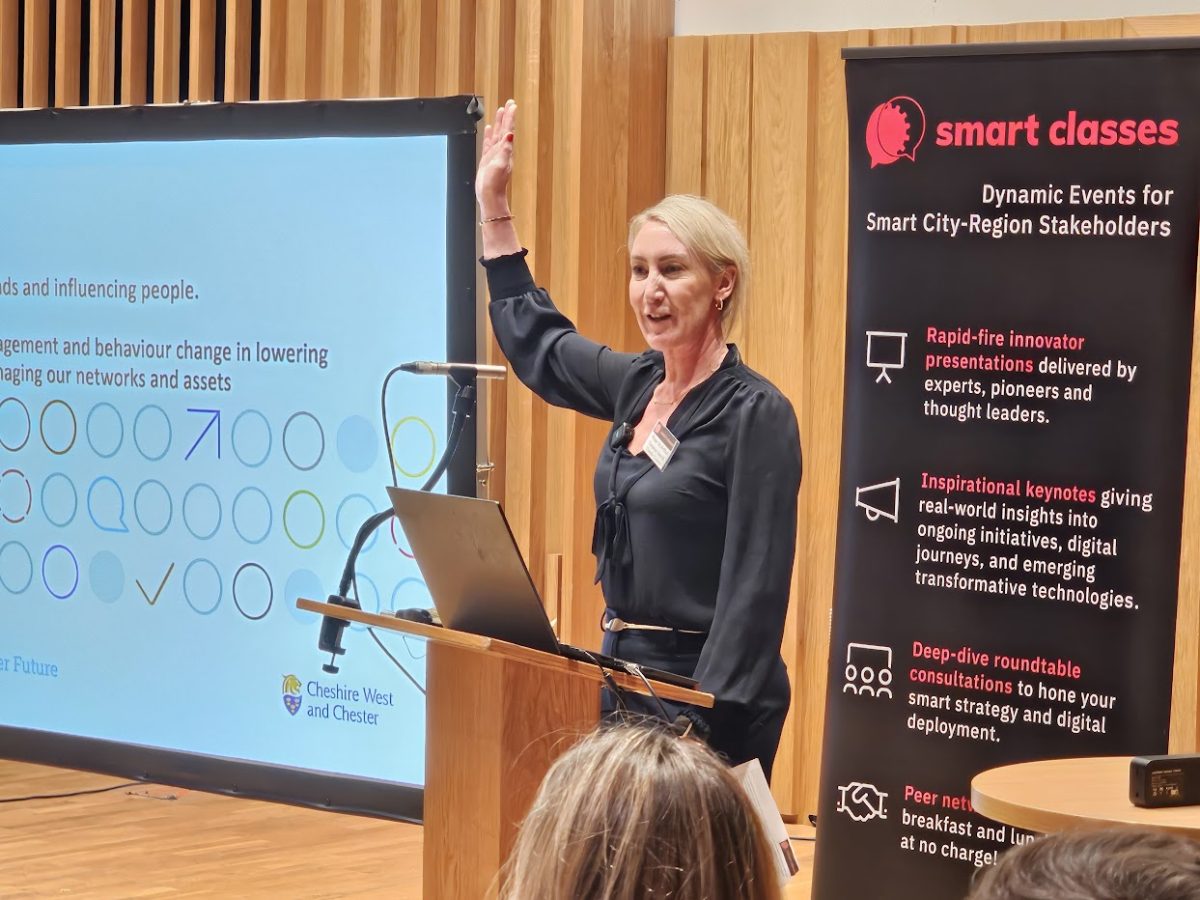
Rose McArthur is Director of Transport, Highways and Climate at Cheshire West & Chester Council: As a “non-devolved unitary with a beautiful mix of rural and urban settings, we’ve grand ambition to decarbonise industry, connect people to jobs and skills, education and each other, and we have exceptional people working really hard to develop thriving places. We just have this little problem of 2 year transport funding settlements, deregulated buses, limited active travel networks and being one of the easiest accessible boroughs by car with bountiful car parking and an unhealthy obsession with potholes. I want to bring a bit of The Olympics Travel Demand Management thinking to this beautiful borough but I don’t have the data or the catalyst for change”.
Prior to joining Cheshire West and Chester in 2021, Rose worked for Mott MacDonald where she was a Technical Director and global practice leader for macro travel demand management. She’s been involved in projects that include the delivery of transport strategy and outcomes behind the London Olympics, the Commonwealth Games in Glasgow and the Gold Coast Commonwealth Games as well as the movement strategy behind the build of the Sydney Light Rail and Melbourne Metro. Rose has worked additionally as a strategic advisor to the DfT developing their covid recovery strategies for transport, and was also heavily involved in the surface access strategy for Heathrow airport. She has a specific technical specialism in Travel Demand Management: “This is a data driven approach to influencing travel behaviours which seeks to deliver a balanced transport network, better social outcomes and a reduction in carbon emissions”.
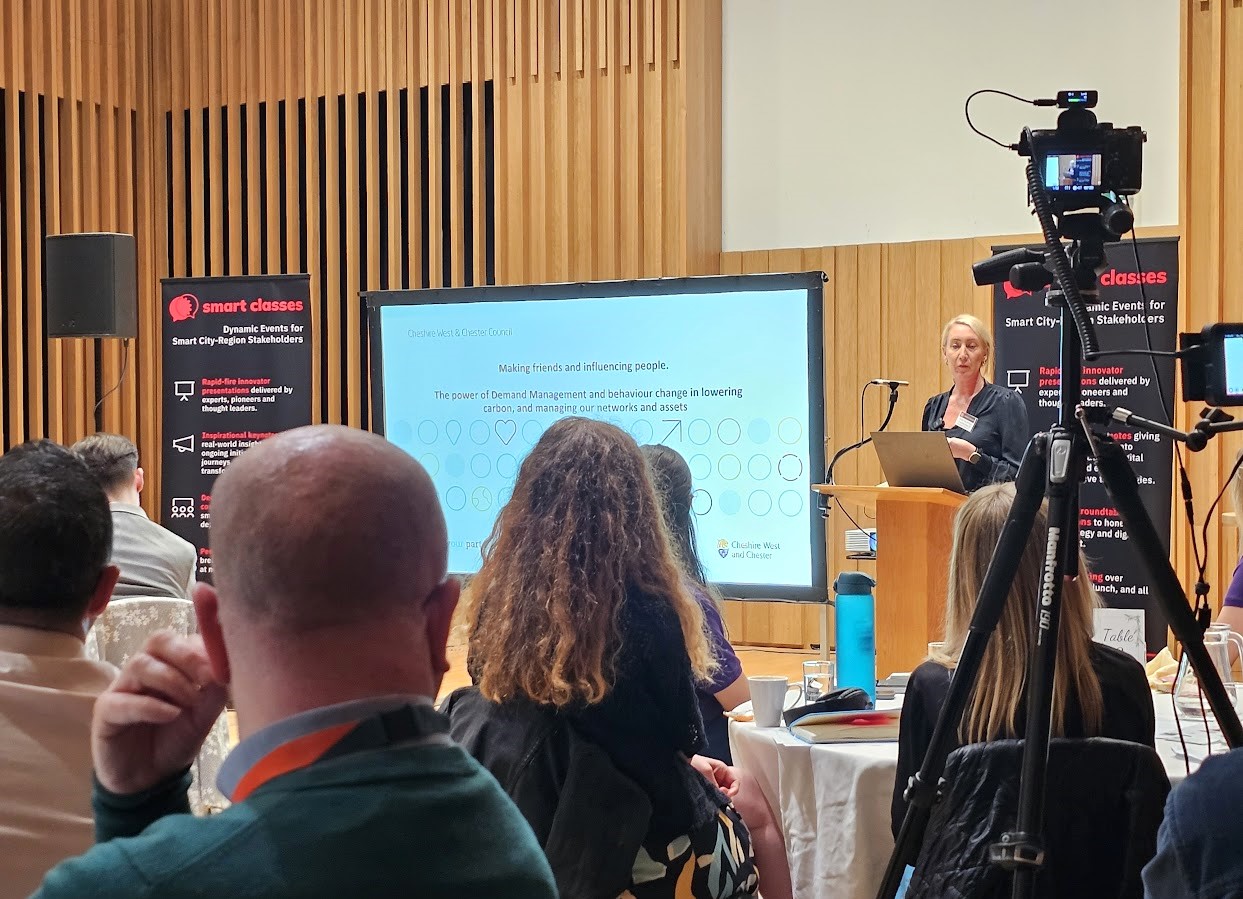
Last month we were delighted to welcome Rose to TRANSPORT Smart Class, North of England 2024 where, in a highly engaging keynote, she shared her wealth of experience around applying demand management and behaviour change principles to travel, expanded upon Cheshire West and Chester’s challenges, strategic transport vision and ongoing development of a new Local Transport Plan, and explored how stakeholders in the room might assist in finding the catalyst for change in a “Car first Borough”.
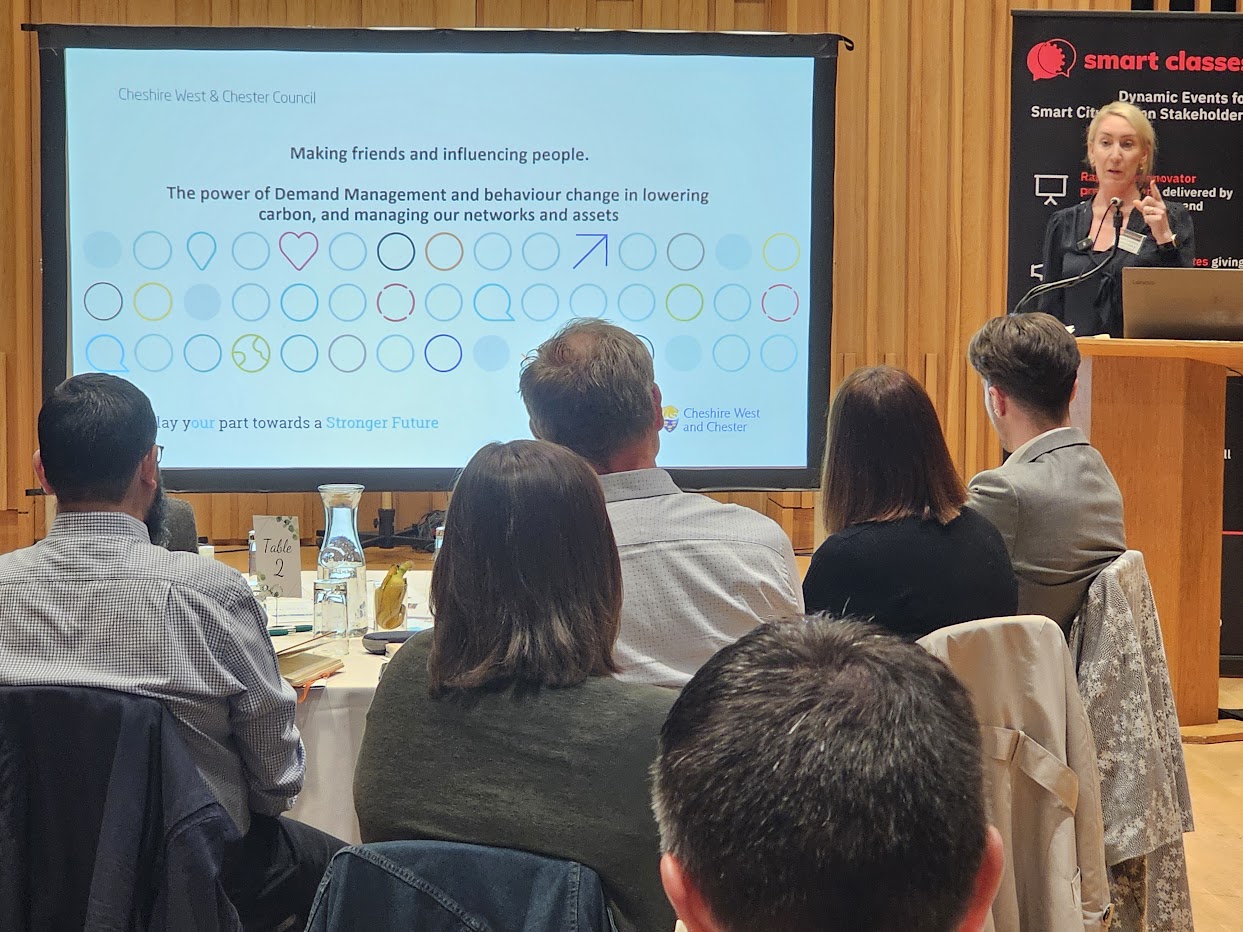
Summary of Rose’s keynote highlights:
- Main impact of being a non-devolved administration, as opposed to a Combined Mayoral Authority, is no funding settlement so “hand to mouth” from one year or two year’s funding;
- Transport and highways role is extremely important to “Place”;
- As the Director for Transport and Highways and Climate in Cheshire West, Rose manages a hugely diverse portfolio that includes maintaining a safe highway across 2282 KM of carriageway and 2445 KM of footway, strategic transport, transport commissioning, transport infrastructure, trees, climate change and climate adaptation, public transport, school transport, community transport, active travel, flooding, local bus and park and ride, asset management, highways development control, fleet, and much more…”developing teams who work hard to deliver what it takes to keep Cheshire West moving”;
- Only 1% of Cheshire West’s population commutes by rail and there are decreasing levels of public transport usage;
- A deregulated bus market means social outcomes and value is lost because it’s about cost, so services are being decommissioned;
- “Transport inequality is enormous” – There are high levels of deprivation in the North of the borough and car travel between the market towns of Northwich and Winsford takes 20 minutes compared to 1 hour 40 mins by public transport. This is replicated across the borough…”Nothing compares to the journey times by car”;
- “In-work poverty is massively masked” – There are great pockets of wealth in the borough but also huge pockets of social inequality and deprivation which are masked by car ownership. There’s also a mismatch between skills and connectivity to the employment. e.g. In Ellesmere Port – one of Cheshire West’s biggest industrial clusters – Encirc have to pay graduates £4.5k extra per year to get to their factory;
- “We’re car-led completely, but not by choice”;
- “Chester has the most incredible potential for active travel” – Chester has 16 suburbs which are all within a beautiful travel active distance but cycling levels are low due to the severance of a ring road plus crossing and speed issues;
- Financial challenges – Cheshire west only get £1.4 million a year for all modes; Nil settlement for BSIP and £2.4 million is just propping up services that are about to be deregulated; From a highway perspective, £3.8 million a year for road maintenance vs required £19.9 million just to keep a steady state of managed decline, and £168 is needed to look at the structural integrity of Cheshire West’s highway assets (“Most highways have 15 years left”); 72p from every £1 in council tax goes to adult social care and children;
- “Place can’t be squeezed” – Access to education, strong neighbourhoods, strong communities, social cohesion, parks, activity etc play a huge role solving the issues Cheshire West have with adults and children;
- Mode shift needs to happen to tackle the in-work poverty and not having enough money shouldn’t stop you being innovative – “We’re so ready for strong innovative thinking. We’ve got to digitise, transform and use AI better”;
- Catalyst for Change Olympic Experience – Before the London Olympics, from a business of 100 people perhaps 10 cycled. During the Olympics this increased to 40. After the Olympics it went down to around 20 but it never dropped to a pre-Olympic level because of that catalyst which forced people to try something new;
- “In God we trust. All others must bring data” – This quote by W.Edwards Deming refers mainly to the importance of data measurement and analysis when doing business. It is also the cornerstone of Travel Demand Management – Nothing should be done that is not data and evidence based and led: “My absolute ambition for Cheshire West is data because we cannot do anything unless we have a massive data focus”;
- With double anonymised mobile phone data, a network of bluetooth sensors, video analytics sensors, CCTV and more, the likes of TfGM have, on limited budgets, unlocked the potential of open data to enable invaluable insights into journey time and journey habit; Rose wants to bring in the whole demand management from behaviour approach from the Olympics as she “needs to get people on buses and walking and cycling” and “prove that people are using these facilities” – this will provide “the baseline” to request DfT funding and help demonstrate a “massive appetite for change and modal shift” in Cheshire West;
- TDM seeks to balance transport supply with demand using solid project management and influential stakeholder engagement – In essence you need to:
- 1) Get the right advise – What do you want people to do based on what your data is telling you about supply and demand?
- 2) To the right people – Audience segmented by mode, geography and journey purpose;
- 3) At the right time – Pre-journey, on-journey, after journey (all 3?);
- 4) In the right way – What communication channel will get to that transport user and which message will initiate change? “It’s about communicating brilliantly!”;
- Using the behavioural change principles of ‘EAST’:
- Easy – Reduce the hassle and make simple;
- Attractive – Attract attention, reward activity;
- Social – Use the power of networks and show most people perform the desired behaviour;
- Timely – Prompt people when they are likely to be most receptive;
- What makes for great TBC design and delivery? “It’s system led thinking and everything starts with data…What have you got? What do you need? What are you trying to get from it? Who do you want to move? Where, when and how? A data led approach is required to understand the scale of the challenge and deliver the desired behaviour change with the right marketing and communications:
- Data > Core narrative (e.g. Do I want more people cycling or using bus?) > Your Audience (e.g. Who are they? Why do I want them to do that and on which routes and journeys?) > Travel advice for business > Messaging matrix > Engagement > Monitoring and evaluation (feeding back the data) > Operational delivery > Legacy > and “constantly re-evaluating”, which informs Governance, Programme and Risks;
- Predicted delays at London Bridge if no one made any changes to their journey – An excellent example of data used during the London Olympics that forced people to change their travel behaviour;
- Marcoms element of London 2012 Olympic Games used maps, twitter feeds, journey planners etc (e.g. to help discourage driving, promote cycling as the quickest mode, highlight rewards for cycling and walking, encourage early ordering/out of hours deliveries etc) and the messages were spread with the help of partners such as Mayor of London, National Rail, Department for Transport, Highways Agency and Transport for London;
- Train Line Hotspots – Used effectively at Glasgow 2014 Commonwealth Games to show people how to move differently;
- For freight trips, the travelling public, businesses and leisure, the strength of message and TDM incentives offered during the Glasgow Games were successfully measured along with £ invested, communication channels used and the Behaviour Change achieved;
- Public face of the Glasgow Games TDM programme based on civic pride;
- Sydney Light Rail and ‘Tomorrow’s Sydney Travel Choices’ – Record investment over next ten years; Great example of a build and road closure catalyst; Collateral combined reactive (construction) and proactive (benefits of alternate travel options) messaging as a stronger method of achieving behaviour change and incentives offered to make the first step to TBC;
- Gold Coast Games in 2018 – To reduce congestion on the M1, there were lots of focus groups to test phasing and strength of message and establish what would resonate & encourage behavioural change; TDM launch collateral (e.g. water bottles, polo shirts, drawstring bags etc) also played key role etc.
If you meet our regular delegate qualification criteria but were unable to join us at The Stoller Hall, Manchester, for the live in-person event on June 6th, CLICK HERE and complete the short “Download form” (located at the bottom of the post) to receive a unique link enabling free access to the presentation video recordings and slides (including the film footage from Rose’s keynote).
Those qualifying to receive the rich presentation content from this event include commissioning, procurement, trialling, partnering and policy leads, senior influencers, strategic decision makers, programme managers and planners from local authorities (e.g. city, borough, metropolitan, district and county councils); public transport operators; regional transport partnerships, sub-regional transport bodies, combined authorities, integrated transport authorities and passenger transport executives; highways authorities and road operators; government and supporting national transport agencies; non-governmental organisations; fleet operators, parking operators, prime contractors etc.


