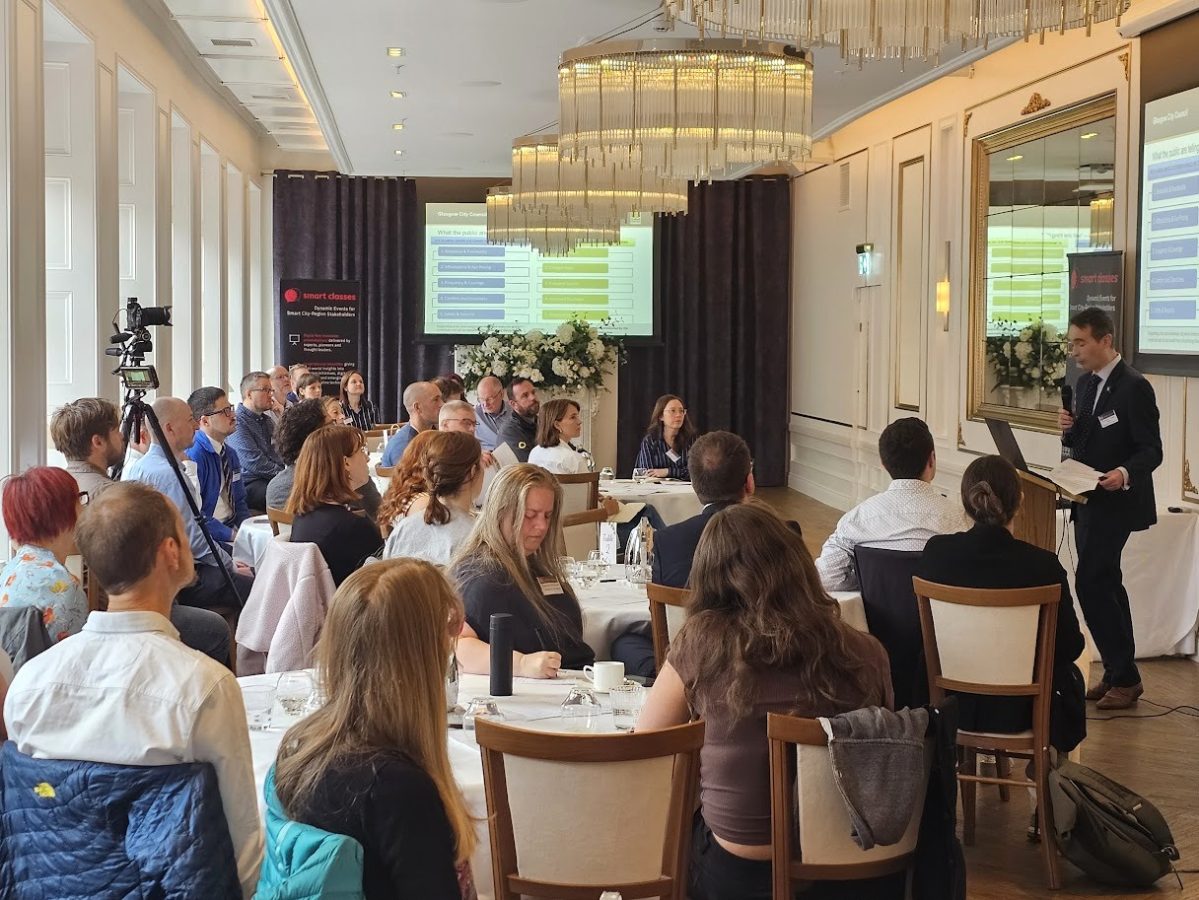
Councillor Angus Millar is Glasgow’s Convenor for Climate, Glasgow Green Deal, Transport and City Centre Recovery. He leads on the city’s journey to Net Zero, promoting sustainability and a just transition to a greener economy, and developing the city’s transport strategies. Brian Davidson is Engineering Officer within the Traffcom Team of Glasgow City Council, with over 30 years’ experience in traffic engineering.
Their opening keynote at TRANSPORT Smart Class, Scotland 2026 addressed the challenges and incentives for bus patronage across Glasgow, and explored:
– Developing a self-calibrating AI traffic system to balance movement, access and place to reduce bus delays
– Demonstrating quantifiable improvements in journey times during the pilot via AI-generated peak timing plans layered on SCOOT
– Data-driven scaling through fusing SCOOT, radar, thermal imaging, Bluetooth, HD cameras and live bus feeds to enable corridor-level optimisation now, with expansion planned across the network and live bus-delay heat mapping

Summary of presentation highlights:
- The Problem – Long term trend of declining bus passenger numbers…
- 2009 to 2019, bus passenger numbers across the region declined by over 30% (steepest of any UK City). Despite this, more people travel by bus than other forms of public transport;
- Bus speeds over previous 30 years fell faster in Glasgow (1.5% p/a) compared to UK average (1.0%) – Caught up in congestion and delays; Subject to local road conditions; Impact by emergency and programmed works;
- Changes in travel behaviour due to the COVID-19 pandemic increased the rate of patronage decline;
- Buses have a poor image;
- What the public are telling us – “what one thing?” (2024 Market Research Survey commissioned by the Glasgow Bus Alliance; >2,600 interviews)…
- Top 10 Areas Where Customers Would Like To See Changes: 1. Reliability & Punctuality 2. Affordability & Fair Pricing 3. Frequency & Coverage 4. Comfort and Cleanliness 5. Safety & Security;
- Key Improvements To Encourage Bus Use (Non-Users): 1. Reliable Services 2. Cheaper Fares 3. Frequent Service 4. Improved Bus Stops 5. Accessibility;
- Strategic Bus Corridors in Glasgow – Mapped;
- Bus Priority Corridors – Analysis of travel demand data highlights the importance of radial movements at a city and regional level; GCC have established a core set of strategic bus priority corridors to support high frequency bus services; GCC through the GCRBP are providing incremental improvements across corridors for bus priority measures to improve bus journey times and reliability, and increase bus patronage;
- Corridor Project Objectives – Giving greater priority to public transport; Reducing bus journey times; Improving reliability of bus services; Enhancing passenger information provision; Creating a safer environment for all road users; Improving conditions for pedestrians; Minimising air and noise pollution; Improving conditions for local businesses;
- Corridors Can Include…
- Improved Journey Times – Bus lanes; Traffic signal improvements; Kerbside control/management changes; Restricted movements to/from side road;
- Improved Accessibility – Enhanced bus stop cages with more space for easier kerb alignment by drivers; Raised kerbs for easer boarding/alighting; More seating at stops;
- Improved Connections – Locating stops closer to key attractors and crossings; Integration with potential mobility hubs and cycle hire;
- Improved Passenger Experience – Better bus shelters with more cover/seating; Improved safety perceptions at stops (lighting, CCTV etc.); Public realm improvements;
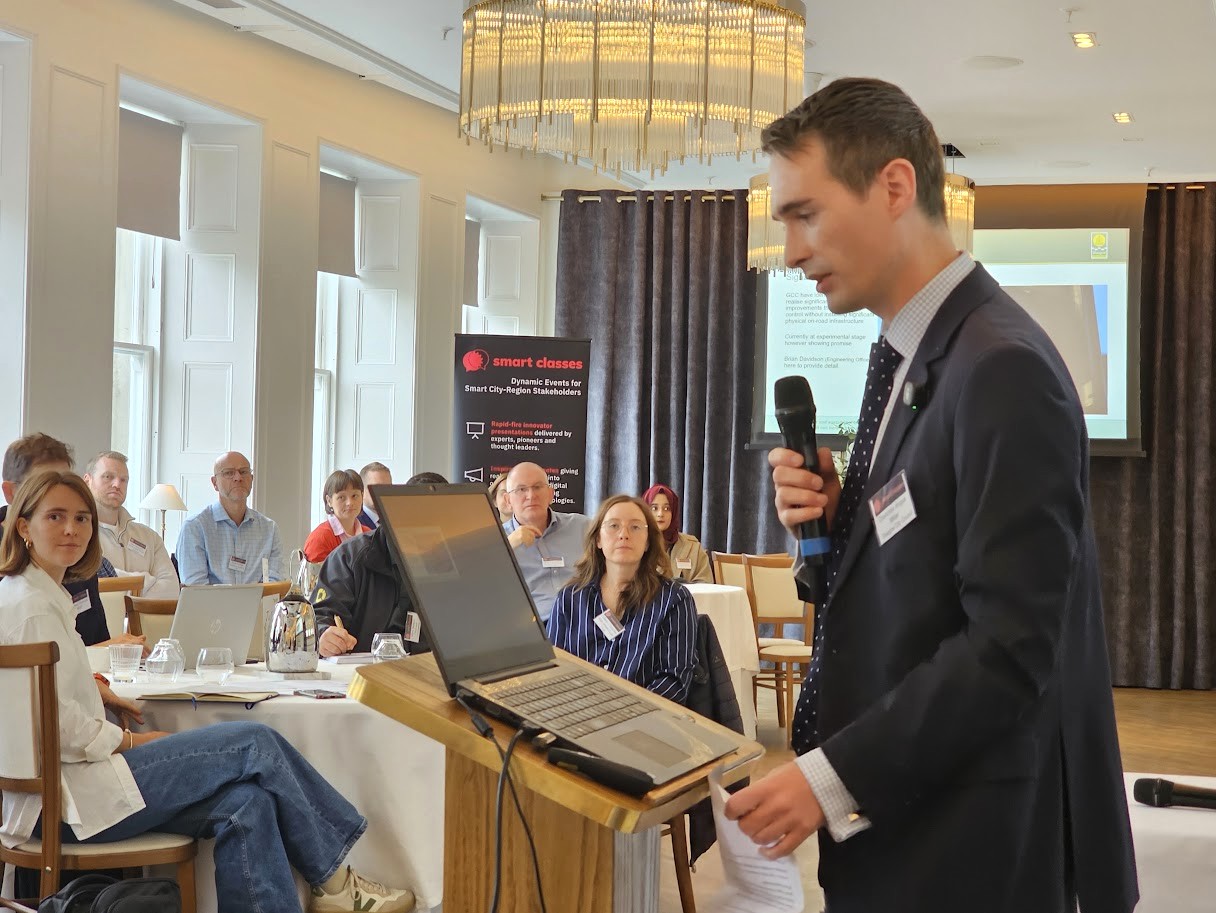
- Signal Based Improvements – GCC have identified potential to realise significant bus journey time improvements through signal control without installing significant physical on-road infrastructure; Currently at experimental stage, however showing promise; Brian Davidson provided the detail…
- From SCOOT to SCAITS – Initial results for Pollokshaws Rd: Journey time improved by 33% (average for all vehicles);
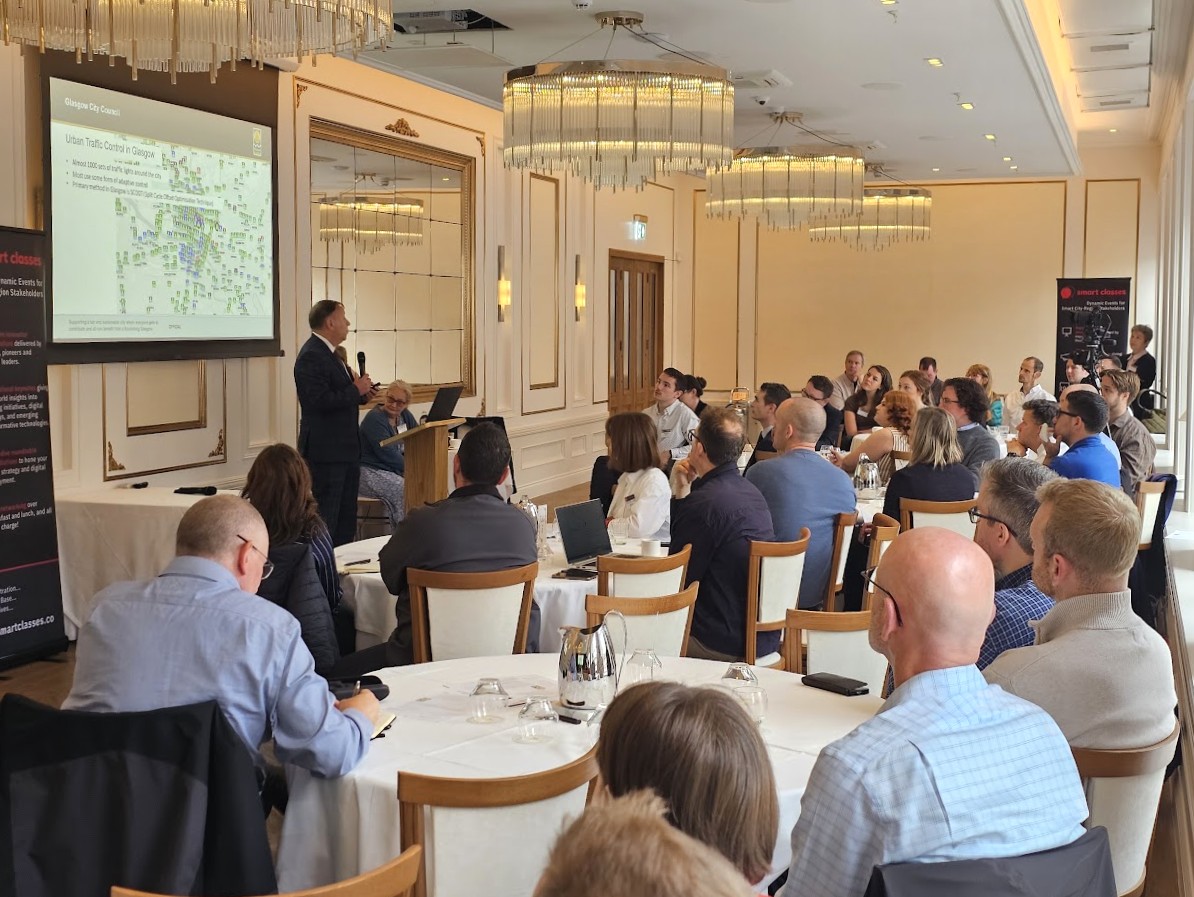
- Urban Traffic Control in Glasgow – Almost 1000 sets of traffic lights around the city; Most use some form of adaptive control; Primary method in Glasgow is SCOOT (Split Cycle Offset Optimisation Technique);
- SCOOT and Bus Priority – Bus Operator AVL server <> SPT AVL management server <> Local Authority UTC server;
- SCOOT and Bus Priority – Graphic depicting “Denied”, “No action”, “Granted”;
- SCOOT detection – SCOOT system effectiveness depends on accuracy and availability of vehicle detectors; Inductive loops have been standard detection used since 1960s; These create ongoing maintenance issues, for a variety of reasons; GCC upgrading from loops to above ground radar technology as funding permits;
- Journey time sensors – GCC have a network of journey time sensors around the city; These capture bluetooth signature from vehicles as they pass each enabled junctions; Journey time is calculated when the same vehicle passes another enabled junction; Last 24 hours – Extended Journey Data (seconds) illustrated;
- Journey time sensors – An alternate system is currently being trialled, using HD cameras and AI; Journey times by class (Car, Bus) over time illustrated;
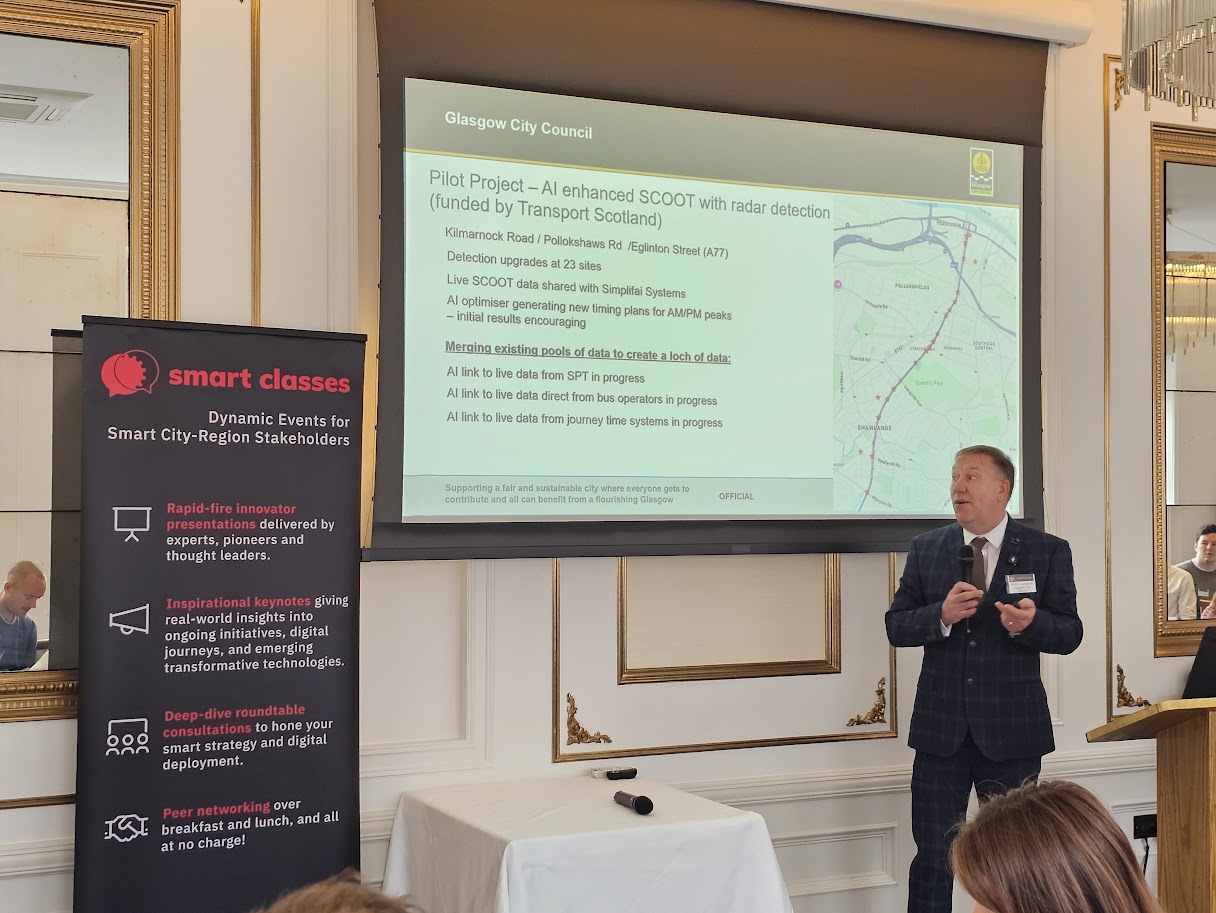
- Pilot Project – AI enhanced SCOOT with radar detection (funded by Transport Scotland) – Kilmarnock Road/Pollokshaws Rd/Eglinton Street (A77); Detection upgrades at 23 sites; Live SCOOT data shared with Simplifai Systems; OFFICIAL AI optimiser generating new timing plans for AM/PM peaks – initial results encouraging; Merging existing pools of data to create a loch of data: AI link to live data from SPT in progress, AI link to live data direct from bus operators in progress, AI link to live data from journey time systems in progress;
- Pollokshaws AI Project – Initial results (average speed): Typical PM Peak speeds – w/comm 27/4/26; PM Peak speeds – 11/5/26;
- Pollokshaws AI Project – Initial results (journey time): Standard Pm Peak 5-6pm 27th April 2026 – Average outbound JT –450 Seconds; Modelled impact of AI – estimated outbound journey time of 236 second (47% reduction); AI plan was implemented on 11th May 5-6pm the outbound journey time was 301 seconds (33% reduction);
- From SCOOT to SCAITS – Self Calibrating Artificial Intelligence Traffic System: Smoother journeys with less delays; Increased reliability of bus services; Includes journey time info to fine tune AI model; Able to detect buses at longer range and make changes at multiple junctions; Provides rich data for scheme evaluation or further hot spot analysis; Potential to include other data sources (roadworks/major events);
- AI Pilot Project – Next Steps: AI to identify traffic trends and adjust model; Plans created by AI currently manually added to UTC system – work underway to automate this process; Operator interface to be developed; Real time data feed from bus operators will be critical for next phase. This will be use this to generate plans to directly assist buses; Heat map of live bus delays to be developed;
- AI Pilot Project – Next Steps: Bus speeds and journey times per service to be monitored; Bus timetables may require alteration when overall journey time reduces;
- AI expansion to other corridors – If pilot successful and future funding approved, this approach may be extended to other important corridors: Paisley Road, West Dumbarton Road, Great Western Road, Maryhill Road, Aikenhead Road, OR any other area.
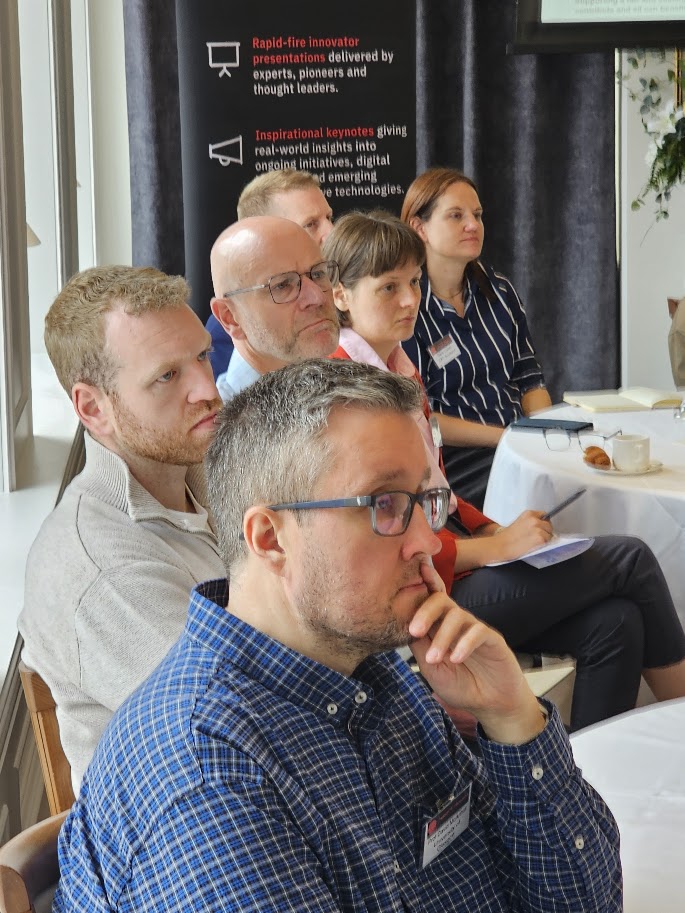
If you meet our regular delegate qualification criteria but were unable to join us at The Exchange, Glasgow, for the live in-person event on September 10th, CLICK HERE and complete the short “Download form” (located at the bottom of the post) to receive a unique link enabling free access to the presentation video recordings and slides (including the film footage and slides from Angus and Brian’s keynote).
Those qualifying to receive the rich presentation content from this event include commissioning, procurement, trialling, partnering and policy leads, senior influencers, strategic decision makers, programme managers and planners from local authorities (e.g. city, borough, metropolitan, district and county councils); public transport operators; regional transport partnerships, sub-regional transport bodies, combined authorities, integrated transport authorities and passenger transport executives; highways authorities and road operators; government and supporting national transport agencies; non-governmental organisations; fleet operators, parking operators, prime contractors etc.