

Transport for the North’s Strategic Transport Plan was adopted in May 2024, setting out the regions shared pan-regional transport ambitions and policy priorities. Once published, TfN’s attention turned to how best to rapidly implement the STP.
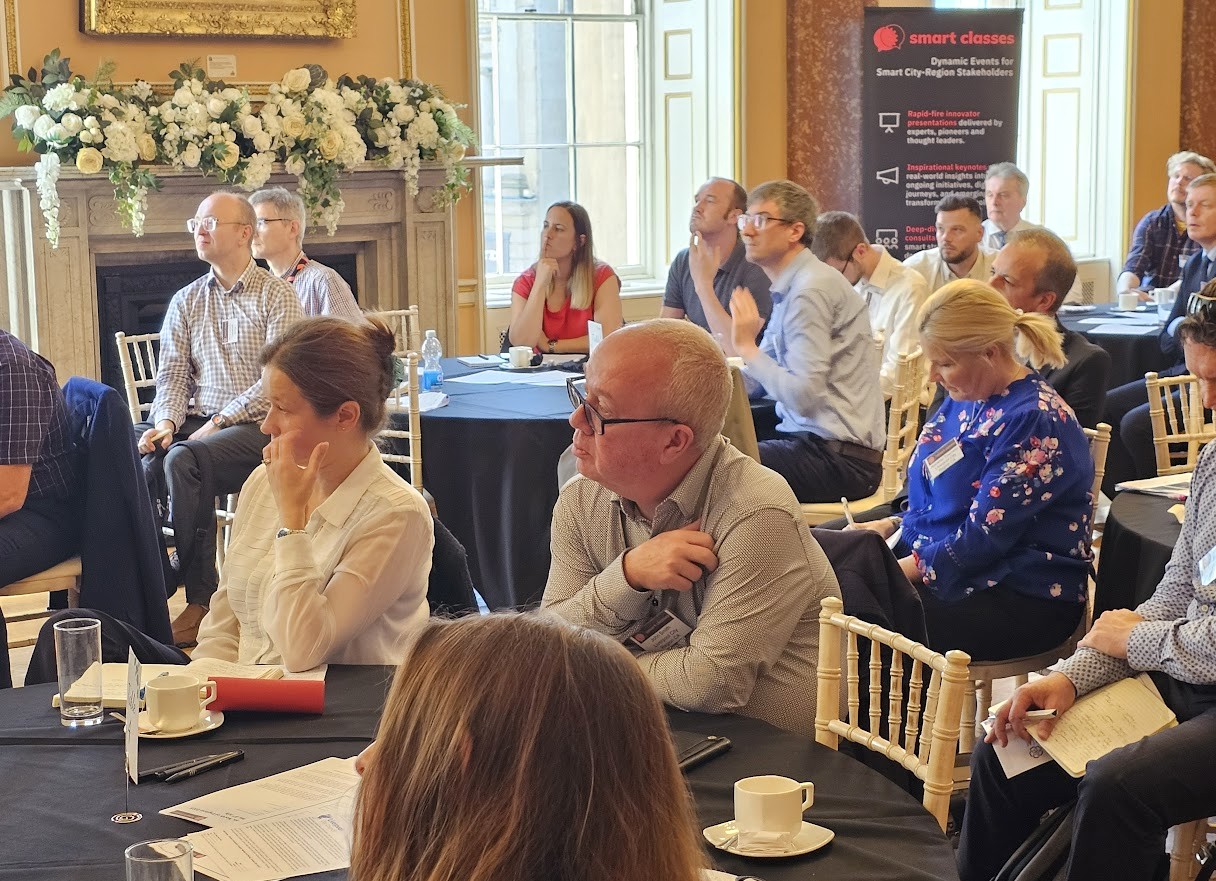
In his keynote presentation at TRANSPORT Smart Class, North of England 2025, Peter Cole, Head of Strategy, Policy and Research at TfN, revisited the evidence and data that underpins TfN’s STP. He also explored some of the activities TfN is undertaking to operationalise that evidence so that it can be used to help local partners take the practical steps toward achieving the shared ambitions and objectives set out in the STP.
Summary of presentation highlights:
- The Strategic Transport Plan – “Transforming the North”…
- As a partnership, TfN bring the North’s local transport authorities and business leaders together with Network Rail, National Highways, and HS2 Ltd, while working closely with Central Government;
- TfN’s STP is essentially a regional plan agreed with their partners. It outlines North of England priorities for transport investment and TfN’s cross-border policy priorities. It also sets out the unique opportunities and challenges facing the North’s economy, people and communities, showing how transport investment can enable regional economic growth. As a statutory authority, TfN submit this back to Government for due consideration;

- The main ways TfN operationalise their evidence is through…
- 1) Advocacy – for pan-regional or cross border schemes, or policies – where they are asked to do so (or local priorities of pan-regional significance) 2) Convening their partners for the purpose of that advocacy, but also task forces and working groups to accelerate delivery of cross border priorities. Often this means providing forums for that advocacy to happen alongside wider public and private stakeholders 3) Technical support to help partners in the development of their LTPs and priority schemes;
- Advocacy and Convening…
- The Government is working to improve connectivity with the integrated national transport strategy published before the end of the year. Bringing a Westminster Hall debate on transport connectivity in the north-west, Labour MP Jo Platt: Noted that her constituency sits in the commuter belt between Liverpool and Manchester; Suggested that local road networks cannot cope with increasing volumes of traffic; Noted that Leigh lacks a rail or Metrolink connection to the city centre and suggested that this is a barrier to economic growth; Cited a 2024 Transport for the North report, which highlighted that people in the north-west with access to a car can reach nearly six times as many jobs as those who rely on public transport; Noted that emergency service response times are slower in Wigan compared to other Greater Manchester boroughs because of increased road congestion;
- At this year’s Convention of the North, TfN led the transport policy session and helped to draft the Transport Game Changer Policy, which everyone in the room could get behind. It’s wholly appropriate that it’s focused on cross border infrastructure, and TfN is perhaps best placed to help coordinate this type of advocacy;
- The Great North Partnership, spearheaded by Northern Mayors, recently launched at UKREiiF 2025. A new report by The Great North revealed at the event that, with the right investments, the North could add £118 billion additional GVA per annum to UK PLC by 2050. This headline figure came from the NPIER (Northern Powerhouse Independent Economic Review) prepared by TfN in 2024, which formed a valuable part of the evidence base for their STP;
- After a Transport for the North survey of more than 2,000 people in the North found that, for too many people, stations are not accessible enough, Greater Manchester Mayor Andy Burnham wrote to the transport secretary demanding that stations are made more accessible for all;
- So, mayors, MPs and other partners can actively use TfN evidence and the forums that TfN convene to advocate for change, and their local priorities;

- “Transport issues that limit full and meaningful participation in society”…
- When getting to work, education, healthcare, and basic shops & services; Costs so much it forces people to cut back on everyday essentials; Damages people’s wellbeing or contributes to poor mental health; Takes so long that it leaves no time for leisure, family, and community life; Is impossible at some or all of the times when its needed; … it causes transport-related social exclusion;
- TRSE is where you can’t get to a reasonable range of job opportunities, or key and basic services by virtue of the fact that you don’t have access to a car and there aren’t viable alternative travel options available; Or where that travel costs so much, either because of the cost of alternative transport, or because of the high costs of car ownership, that it means you may be cutting back on other every day essentials. And that in turn affects your quality of life and your productivity. This is an area of work that the social research function in Peter’s team leads on, in fact at a national level;
- What causes TRSE?
- It’s typically a series of self-reinforcing factors – where poor public and active transport provision leads in turn to higher levels of car dependency and forced car ownership, which in turn then leads to less case for investment in public transport infrastructure and even worse conditions for active travel in car dominated environments…
- And it affects: People on lower in comes or in insecure work/zero hour contracts – and of course to some extent that is self reinforcing as it’s the lack of connectivity that means people don’t have access to those better jobs; People with disabilities and long-term health conditions; Young people; Carers, particularly informer carers and those with childcare responsibilities;
- In 2024, 11.2 million people in the UK were at high risk of TRSE. And what we see when we map this is that the populations at high risk of TRSE are significantly more rural and coastal than the population of England as a whole….and there’s a lot in the North! So we can see how this can be a driver for investment decisions, particularly investment decisions that are place based and could be genuinely transformational;
- Supporting Local Prioritisation – Investing for Social Inclusion…
- Identify areas and communities most in need; Strengthen cases for the right kinds of investment; Evaluate local & regional impacts over time; Highlight success and advocate for change;
- Operationalising TRSE data – TfN’s Investing for Social Inclusion Programme supports investments that address local TRSE needs. It involves actually working with local or combined authority officers to apply the data and use that evidence to drive the right kind of interventions and policies within their transport and spatial development planning. This sort of data is really about helping to quantify those wider benefits;

- Case Study Example: Expansion options for Cheshire West and Chester’s DRT service…
- Wanted to look at the characteristics of the population within several zones which could be options for expansion, and compare them with the existing zones; TfN are able to apply their evidence and compare existing accessibility between proposed zones, to differing kinds of places, such as employment opportunities, educational facilities, health car facilities and so on; They could also compare by levels of vulnerability – for example those vulnerable because of disability vs those vulnerable due to age, or low income, and then combine to understand how a DRT service might best connect those particular demographics with where they need to get to; And crucially, whilst that information might be useful for making that wider strategic case in the business plan, the fact that TfN update that data every year, means they can help those authorities evaluate the impacts of their decisions over time – which leads us back to the value of evidence in advocating for further change;
- Northern Appraisal Playbook (NAP)…
- Phase 1 – Testing existing flexibilities in the green book and development of ‘Tips and Best Practice’ guide;
- Phase 2 – Research (alongside academics/industry) around areas of more fundamental change which could make a bigger difference to Northern business cases e.g. Value of Time Savings, Job Displacement and Enabling Housing; Engagement with DfT & HMT officials to discuss, and convening a forum for them to engage with local partners; Applying the NAP findings to live northern business cases;
- It’s those are areas of existing wider socio-economic and health inequalities that really makes the North such an obvious place to invest – because of the potential for those wider ‘transformational’ benefits. We’re coming from quite a low base in terms of productivity, health and wellbeing and connectivity;
- One institutional barrier that exists is our project business case appraisal system. There are some fundamental pillars within it which work against investing in places like the North – namely, schemes that service areas that are already more productive, make better business cases. The appraisal system values the time of well paid business travellers, far more than the time of other groups, who may earn less and be less productive in terms of GDP, but are actually more ‘time-poor’ and carrying out really vital services that help the UK economy in other ways;
- Peter’s team is working with their transport appraisal and modelling colleagues focussed on issues like Value of Time Savings, Job Displacement and how we better capture the value of transport connections that enable housing. In some cases, they’re engaging with a broader spectrum of stakeholders from various universities and in the case of the Value of Time Savings workstream, working with the Independent Transport Commission, to: 1)Really define the problems 2) Why we think those aspects don’t work for the North, and where we feel they work against some of the Government’s missions 3) Potential solutions, or at least areas for further investigation by Government 4)Ultimately – advocacy material. Have already convened a meeting between HMT and some leaders from across the North, and in the recent GB review made some headway around the need for place based appraisal and the approach to job displacement – but this as an ongoing negotiation, certainly up until the new GB is published next year and actually probably beyond that;
- So this is a pan-regional issue, which TfN can lead – but that support those local priorities;
- TfN’s Climate Change Vulnerability Assessment…
- For use in future road and rail workstreams when looking at how the relative needs for adaptation investment can help shape the overall case for investment in that infrastructure;
- Phase 1 – Looked across four climate hazards which are most relevant to the North; Mapping the vulnerability of our strategic transport networks to flooding, extreme temperature, high winds and ground instability;
- Phase 2 – Automate methodology; Scope of ‘impact options’ defined locally; Extend to sections of local road network; Data available for local partners in QGIS;
- Potential to combine with other datasets on TRSE, Natural Capital opportunity mapping, Grid Upgrade planning (rail and road).
- TfN’s Carbon Tools…
- Carbon Baseline Dashboard and Carbon Assessment Playbook; Policy builder tool to help authorities to understand the ‘emissions gap’ in their areas; Quantify the carbon impact of their strategies or plans;
- The Carbon Assessment Playbook tool is where a lot of TfN’s carbon modelling resources have been directed over the last few months. The playbook is a policy builder tool that allows partners to do that – utilising carbon footprints and projections that are bespoke to those LA areas. And as the tool is being adopted by all the STBs, and has been developed in close liaison with the DfT team responsible for the as yet unpublished LTP guidance, it provides outputs which are directly relevant to the LTP preparation and is consistent across all authorities;
- Evaluating Progress – STP Monitoring and Evaluation Dashboard…
- Monitoring & Evaluation (M&E) Strategy identifies a framework of metrics that will be used to measure progress towards achieving STP strategic ambitions and associated targets;
- Progress over time for the headline metrics is presented in an online M&E dashboard, used to track and monitor performance e.g. Number of people killed or seriously injured in traffic incidents in the North (Vision zero by 2040), Demand Management: Vehicle kilometres per year (comparing East, London, Midlands, North, South – aiming for Zero overall increase in car and taxi vehicle milage on the North’s road network to 2030 and 2050), Rail Public Performance Measure (comparing Northern Trains, London Overground, South Western Railway, Southeastern and TransPennine Express, each quarter) etc
If you meet our regular delegate qualification criteria but were unable to join us at Liverpool Town Hall for the live in-person event on July 3rd, CLICK HERE and complete the short “Download form” (located at the bottom of the post) to receive a unique link enabling free access to the presentation video recordings and slides (including the film footage and slides from Peter’s keynote).

Those qualifying to receive the rich presentation content from this event include commissioning, procurement, trialling, partnering and policy leads, senior influencers, strategic decision makers, programme managers and planners from local authorities (e.g. city, borough, metropolitan, district and county councils); public transport operators; regional transport partnerships, sub-regional transport bodies, combined authorities, integrated transport authorities and passenger transport executives; highways authorities and road operators; government and supporting national transport agencies; non-governmental organisations; fleet operators, parking operators, prime contractors etc.


