
Market context
By 2025, Frost & Sullivan expects smart cities to be a US$ 2.4 trillion market,¹ whilst Grand View Research anticipates a cumulative worth of US$ 2.57 trillion and a compound annual growth rate registering 18.4% over 2018-2025.² The latest forecast study published by Persistence Market Research determines that US$ 3.48 trillion will be spent across the globe for implementation of smart cities during the 10-year assessment period, 2016-2026, and that the market will showcase staggering growth at a CAGR of 18.8%.³ GVR estimates that the UK market alone should surpass US$100 billion by 2025 and the Future Cities Catapult (now the Connected Places Catapult) has identified more than 32,000 companies in the UK offering smart cities solutions and associated products and services.
The smart city concept describes the use of digital technology and data to promote performance and wellbeing, effectively respond to citywide and global challenges, and ensure that critical infrastructure and public services are more interactive. Rapid urbanization, ageing infrastructure, adoption of new technologies, need for improved quality of life, scarcity of resources and an increased focus on environmental sustainability are all placing demands on the operations of our cities and, in the face of diminishing public budgets, driving industry growth. According to a white paper by ABI Research, implementation of smart city technologies could have saved enterprises, governments and citizens globally over US$5 trillion annually by 2022.4 IDC predicted that by 2019, 40% of local and regional governments were already using the internet of things to turn infrastructure like roads, streetlights, traffic signals and refuse bins into assets instead of liabilities.5
Adoption of open data, exploiting big data analytics, citizen engagement, cyber-physical systems and the IoT, cloud and edge computing, 3/4G evolution, 5G networking, social media and digital platforms, low-power WAN, machine learning and AI, robotics and drones, VR, gamification, blockchain, digital twins and the sharing economy are amongst the myriad of technologies and trends advancing smart city transformation. Essential ‘smart’ sectors utilised by burgeoning smart cities include transport, energy, water, waste, healthcare, assisted living, governance, security, buildings and public realm. The market encompasses an overwhelming number of application areas and addresses a diverse set of requirements, from enhancing mobility, reducing traffic congestion, boosting air quality and minimising travel waiting time for public transport commuters to efficient delivery of public utilities, optimising energy for homes, increasing levels of well-being, and better administrative services.
Reports from Navigant Research6 and the Royal Town Planning Institute7 emphasise the unbounded nature of smart cities and the benefits associated with smart city programmes that develop collaboration networks across combined authorities, county authorities, and regional agencies. They also highlight the increasingly important role played by partner ecosystems – including public-private sector partnerships – in delivering a smart city vision and enabling the use of new data and technology at the scale of city-regions, county-regions and beyond.
Smart Classes helps bring these stakeholders together so that technology disruptors can inform, consult and collaborate with city-regions and key sector leads.
What is a Smart Class?
Smart Classes are collaborative, half-day, knowledge exchange and lead generation events, offering buyer side stakeholders the opportunity to find out exactly how they can deploy the latest innovations, digital technology-enabled solutions, data-driven strategies and best practices to tackle the challenges faced by aspiring smart cities, regions and communities, public service providers and critical infrastructure operators.
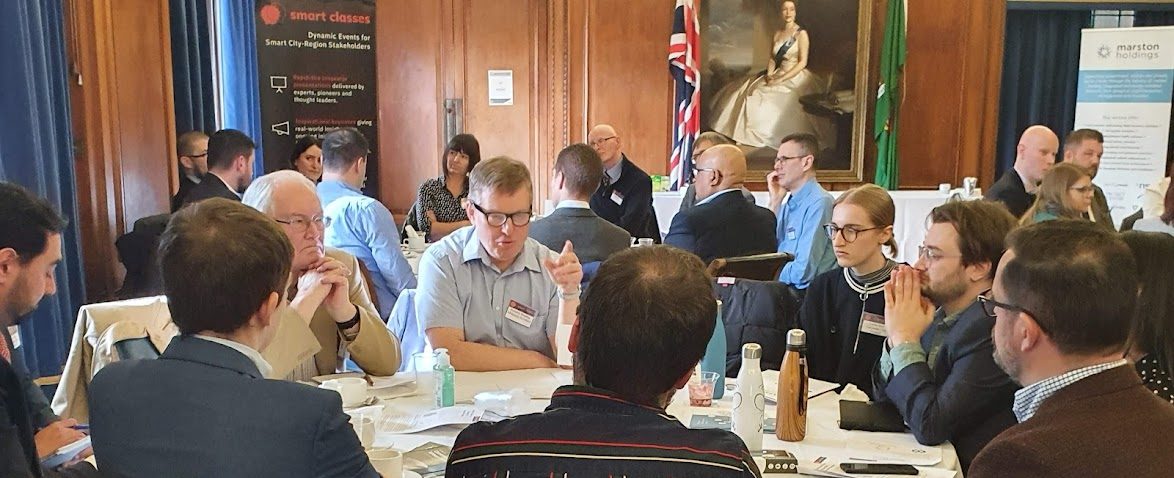
The Smart Class format is built around thought-leadership presentations from innovators, in-depth roundtable discussions with experts and peers, and insightful keynotes delivered by inspirational role models.

TRANSPORT Smart Classes show key buyer side stakeholders how they can deploy the latest digital technology-enabled solutions, data-driven strategies, policies and best practices to tackle their transport sector challenges (e.g. around congestion, traffic flows, air pollution and emissions, noise, first and last mile mobility, customer experience, cost effectiveness, connecting transport networks, managing and maintaining assets & infrastructure) and deliver a transport system that will allow passengers to travel efficiently, safely and with minimal impact on the environment.
Qualifying delegates include commissioning, procurement, trialling, partnering, policy and programme leads, senior influencers, strategic decision makers and planners from local authorities (e.g. city, borough, metropolitan, district and county councils); public transport operators; regional transport partnerships, sub-regional transport bodies, combined authorities, integrated transport authorities and passenger transport executives; highways authorities and road operators; government and supporting national transport agencies; non-governmental organisations; fleet operators, parking operators, prime contractors etc.
Core themes range from on-demand transport and MaaS applications, EVs and e-mobility, bus franchising, micro mobility, predictive traffic management, AI based journey monitoring, smart parking and enforcing CAZs and LEZs, to active travel and behavioural change, analysing people movements, new ways of visualising data, connected and autonomous vehicles, intelligent street lighting, real-time transport modelling, smart ticketing and fare collection, and ITS in a post-Covid/polycrisis world.
The 37 TRANSPORT editions that we’ve hosted to date (since 2017) for burgeoning smart city-regions around the UK have been universally commended! Check out the testimonials and feedback from some of our previous delegates, sponsors and supporters or take a look at the “Retrospectives Round-Ups” from our Midlands 2026, London & South East England 2025, Scotland 2025, North of England 2025, Wales & West of England 2024, London & South East England 2024, Scotland 2024, North of England 2024, Midlands 2023, London & South East England 2023, Scotland 2023, North of England 2023, Northern Ireland 2023, Scotland 2022, London & South East England 2022, North of England 2022, Wales 2022, South West England 2022, Midlands 2022, Scotland 2021, London & South East England 2021, North of England 2021, London & South East England 2020, Midlands 2020, Wales 2020, South West England 2019, London & South East England 2019, Scotland 2019, North of England 2019, Midlands 2019, South West England & Wales 2018, North of England 2018, Scotland 2018 and London & South East England 2018 editions.
Subsequent to the easing of lockdown restrictions in August 2021, we’ve hosted TRANSPORT Smart Class, North of England 2021 at Chetham’s School of Music in Manchester, TRANSPORT Smart Class, London & South East England 2021 at The Embassy, Belgravia, TRANSPORT Smart Class, Scotland 2021 at The RSE, Edinburgh, TRANSPORT Smart Class, Midlands 2022 at Nottingham Council House, TRANSPORT Smart Class, South West England 2022 at M Shed, Bristol, TRANSPORT Smart Class, Wales 2022 at voco St David’s Cardiff, TRANSPORT Smart Class, North of England 2022 at Chetham’s School of Music, Manchester, TRANSPORT Smart Class, London & South East England 2022 at Browns Courtrooms, Covent Garden, TRANSPORT Smart Class, Scotland 2022 at Citation, Glasgow, TRANSPORT Smart Class, Northern Ireland 2023 at Cultra Manor, Holywood/Belfast, TRANSPORT Smart Class, North of England 2023 at Nexus, University of Leeds, TRANSPORT Smart Class, Scotland 2023 at Riddle’s Court, Edinburgh, TRANSPORT Smart Class, London & South East England 2023 at Greencoat Place, London, TRANSPORT Smart Class, Midlands 2023 at Drapers’ Hall, Coventry, TRANSPORT Smart Class, North of England 2024 at The Stoller Hall, Manchester, TRANSPORT Smart Class, Scotland 2024 at Citation, Glasgow, TRANSPORT Smart Class, London & South East England 2024 at Greencoat Place, London, TRANSPORT Smart Class, Wales & West of England 2024 at Cardiff Masonic Hall, TRANSPORT Smart Class, North of England 2025 at Liverpool Town Hall, TRANSPORT Smart Class, Scotland 2025 at Riddle’s Court, Edinburgh, TRANSPORT Smart Class, London & South East England 2025 at The Wellington Hotel by Blue Orchid, Westminster, and most recently (on February 25th) TRANSPORT Smart Class, Midlands 2026 at The Old Library, Birmingham.
Since TRANSPORT Smart Classes are organised on a regional basis, a “series” sponsorship commitment equates to a genuine “Roadshow” opportunity!
This year’s schedule features:
- TRANSPORT Smart Class, Midlands 2026 – Wednesday 25th February, Birmingham
- TRANSPORT Smart Class, North of England 2026 – Postponed
- TRANSPORT Smart Class, Scotland 2026 – Thursday 10th September, Glasgow
In the spirit of collaboration, Early Bird sponsors can help determine the date of our next London & South East England TRANSPORT Smart Class which will take place at The Wellington Hotel, Westminster!
PUBLIC REALM & URBAN SPACES Smart Classes show key buyer side stakeholders how to harness innovation, data science, design, policies and best practice to create the next generation of smarter spaces and places in our cities and regions.
Delegates include commissioning, procurement, trialling, partnering and policy leads, senior influencers, strategic decision makers, planners, place makers, architects, green space managers, urban designers, communities & neighbourhoods, highways & street scene, transport & mobility and high streets & regeneration professionals from councils and local authorities (city, borough, metropolitan, district, county and combined); people and place partnerships; developers, landowners and creators of privately owned public spaces; prime contractors and city centre management companies; DfT, Defra, MHCLG, EA and supporting governmental bodies; transport authorities, highways agencies and public transport operators; civic organisations and community groups; and other key players from the public realm ecosystem with responsibility for managing, maintaining and operating our streets, squares, forecourts, parks, pathways, retail centres, car parks, airports, ports, travel hubs, hospitals, housing estates, campuses, communal gardens and the assets contained within these public or semi-public spaces.
Core themes range from connected LED street lighting, intelligent lighting of buildings, smart IoT enabled lamp posts and litter bins, smart urban furniture (benches, chairs, tables etc) and greening solutions (living walls and pillars, green corridors etc), and utilizing data to transform unused or ‘dumb’ spaces, to digital displays and signage (for streets, shop fronts, parks etc), interactive road crossings, parking and traffic management, civil enforcement technologies, outdoor fitness systems, innovative playscapes, and the future role of 5G in the proliferation of digital technology in the public realm. We’ll explore deploying digital technologies, data driven insights and progressive policies and design to support a variety of objectives (e.g. bringing nature and the environmental benefits to the built environment; managing the night-time economy to shape places; addressing crime and safety; reducing street clutter; managing kerbs and drainage; calming traffic, and promoting cycling and active travel; improving maintenance regimes; encouraging behavioural change and inclusivity; increasing commercial opportunities; creating clusters, flexible workspaces and innovation districts; protecting legacy and heritage etc) and also examine how innovation has helped the public realm to implement temporary changes and adapt to a post-Covid world in the context of climate, decarbonisation, biodiversity and socio-economic challenges (e.g. predicting footfall with technologies designed to monitor density; optimising navigation routing to help balance necessary urban traffic with pedestrianised zones; maintaining social distancing with electronic tags, track and tracing applications, and CCTV; repurposing spaces and recovering high streets, using 3D visualisation and digital twins to understand the implications of change etc).
PUBLIC REALM & URBAN SPACES Smart Class 2022 was hosted at Greencoats in London and highly praised by delegates and sponsors alike. Explore the Retrospectives Round-Up!
PUBLIC REALM & URBAN SPACES Smart Class 2023 took place at The Shipping Office, Manchester, to similar acclaim! Browse the Retrospectives Round-Up for highlights and event feedback.
As evidenced in this Retrospectives Round-Up, we then hosted an extremely well received PUBLIC REALM & URBAN SPACES Smart Class 2024 at The Catalyst, Newcastle upon Tyne.
PUBLIC REALM & URBAN SPACES Smart Class 2025 took place last December 4th at The Wellington Hotel, Westminster. Check out the Retrospectives Round-Up from that event, including lots more testimonials!
In the spirit of collaboration, Early Bird sponsors can help us determine the date and location of our next PUBLIC REALM & URBAN SPACES Smart Class!
WATER MANAGEMENT Smart Classes show key buyer side stakeholders how deploying the latest digital technology-enabled solutions, data-driven strategies, policies and best practices can help manage the distribution and management of water resources across our cities and regions, and also offers utilities and authorities an opportunity to improve efficiency and service, whilst reducing water scarcity and supporting the drive towards a net zero future.
Qualifying delegates include commissioning, procurement, innovation, infrastructure design, trialling and partnering leads, senior influencers, strategic decision makers, environmental managers, catchment managers/developers, asset managers, policy makers and planners from UK water companies and utilities, wastewater and sewer operators, lead local flood authorities (unitary authorities and county councils), city/borough/metropolitan councils, district councils, combined authorities, internal drainage boards, regional flood & coastal committees, highways authorities, prime contractors, general insurers, large water consumers, national agencies, central governmental and regulatory bodies (e.g. Defra, DCLG, Ofwat, Environment Agency, DWI, SEPA), independent industry and consumer organisations (e.g. Water UK, CCW), river trusts, NGOs etc.
Core themes range from smart leakage detection and miniaturisation of sensors, smarter pressure management, asset tracking and connected water operations, modelling and simulation (incl. digital twins), the water company of the future, smart water gully maintenance and utilising smart meters effectively, to water catchment and rainwater harvesting systems, digital apps and platforms for demand management, incentivising behavioural change, smart telemetry systems for managing flood risk, sustainable drainage systems, smart sewers and wastewater management, innovations in water purification, smart billing and payments, harnessing AI for automation of customer engagement, and using real-time analytics and drones for monitoring water quality and mapping assets.
WATER MANAGEMENT Smart Class 2022 took place at The BCEC, Birmingham in November 2022.
Following excellent feedback from that inaugural edition (see Retrospectives Round-Up), we hosted WATER MANAGEMENT Smart Class 2024 at Greencoat Place Conference Centre, London, to similar acclaim. Check out the Retrospectives Round-Up from that event!
The Nexus innovation and collaboration hub at University of Leeds played host to WATER MANAGEMENT Smart Class 2025. For highlights and testimonials, explore this “Retrospectives Round-Up”.
WATER MANAGEMENT Smart Class 2026 will take place in Bristol on Tuesday 3rd November!
EMISSIONS & AIR QUALITY Smart Classes show key buyer side stakeholders how they can deploy the latest digital technology-enabled solutions, data-driven strategies, policies and best practices to improve urban air quality and drive down emissions and air pollution in our cities and regions.
Qualifying delegates include commissioning, procurement, trialling, partnering, policy and programme leads, senior influencers, strategic decision makers, environmental managers, climate/sustainability/transport/public health officers and planners from local authorities (e.g. city, borough, metropolitan, district and county councils); public and private transport operators/service providers; sub-regional transport bodies, combined authorities, integrated transport authorities and passenger transport executives; freight and logistics operators; airports and port operators; vehicle manufacturers; energy providers; potential partners from industry (e.g. retail, construction, manufacturing and waste management sectors) and healthcare; DfT, Defra, EA, BEIS, DHSC, UKHSA and other and supporting national agencies; prime contractors; academia etc.
Core themes range from IoT smart emissions monitoring, hyperlocal air quality monitoring, indoor air quality innovation, air pollution forecasting models based on neural networks, air pollution abatement systems/technologies, mapping and visualising air quality in real-time, and utilising digital twins for future air quality scenarios, to compliance and standards, managing and enforcing clean air and low emission zones, decarbonising highways and infrastructure maintenance, machine learning techniques to analyse weather and emissions data, deploying telematics and geo-fencing technology, embracing biophilia, EVs and hydrogen buses, DRT and MaaS impacts, active travel impacts, innovative ways to clean polluted air, carbon capture and storage, and commercial sector initiatives such as net zero construction, emissions-free logistics, emissions based parking tariffs and anti-pollution bus stops. We also explore planetary crises – e.g. climate change, pandemic, biodiversity loss, and pollution and waste – as catalysts for change, accelerating the use of available solutions and motivating policies, behavioural change and investment in new innovation.
EMISSIONS & AIR QUALITY Smart Class 2019 in London was so well received (check out the Retrospectives Round-Up for testimonials and feedback!) that we added a 2nd half of year edition in Birmingham – EMISSIONS & AIR QUALITY Smart Class 2H 2019 – to the 2019 schedule (peruse this Retrospectives Round-Up for highlights/testimonials from that event). EMISSIONS & AIR QUALITY Smart Class, South 2021 was hosted at Greencoat Place Meeting and Conference Centre to equal acclaim!
Our 2022 schedule included EMISSIONS & AIR QUALITY Smart Class, South 2022 (Browns Courtrooms, London) and EMISSIONS & AIR QUALITY Smart Class, North 2022 (The Carriageworks Theatre, Leeds). Check out this Retrospectives Round-Up for feedback from the 2022 “South” edition delegates and stakeholders and this Retrospectives Round-Up from the 2022 North edition!
We then hosted EMISSIONS & AIR QUALITY Smart Class 2023 at Greencoat Place Conference Centre, London. Browse the Retrospectives Round-Up for highlights, and loads more positive feedback!
We were delighted to return to Greencoat Place to host a thoroughly enjoyable EMISSIONS & AIR QUALITY Smart Class 2024. Check out the “Retrospectives Round-Up”, including lots of additional testimonials!
EMISSIONS & AIR QUALITY Smart Class 2025 took place at Leicester City Hall. Explore our 2025 “Retrospectives Round-Up” for highlights and feedback!
In the spirit of collaboration, Early Bird sponsors can help us determine the date and location of our next EMISSIONS & AIR QUALITY Smart Class!
WASTE MANAGEMENT Smart Classes show key buyer side stakeholders how deploying the latest digital technology-enabled solutions, data-driven strategies, policies and best practices can help increase the efficiency of waste collection, separation, disposal, recycling and reuse, and facilitate the transition of the UK waste market to a circular economy.
Delegates include commissioning, procurement, trialling, partnering, programme and policy leads, senior influencers, strategic decision makers, environmental managers and planners from UK waste collection authorities (WCAs), waste disposal authorities (WDAs), private waste contractors, local authorities (city, borough, metropolitan, district and county councils)/combined authorities and their waste management & recycling partners (e.g. waste brokers, waste carriers and recyclers), retailers, health services, building and estate services, transport operations, manufacturers (and other major producers/industry generators of waste), utilities and renewable energy providers, reuse and waste prevention organisations, prime contractors, central government departments and environmental agencies.
Core themes range from collection vehicles logistics optimization, automated waste collection systems, smart bins and intelligent waste monitoring, analysing waste-related databases and new ways of aggregating, cleaning, visualising and sharing waste data, to connected asset management/using IoT to maintain assets, reuse and redistribution applications, innovative approaches to waste crime, digital waste tracking, sensor based sorting, robotics in recycling, AI based computer vision across the waste chain, smart waste compliance, mobile workforce management, ‘designing out waste’ in construction, waste-to-energy, applying blockchain technology to waste management, and new business models (e.g. cloud based platforms for waste bookings and recycling, digital sharing platforms, product as a service, sustainability as a service). We also examine the behavioural insights provided by waste and recycling data in a Covid and post-Covid world and explore the planetary crises as catalysts for change, altering the dynamics of waste generation, accelerating the use of solutions that reduce the risk of transmission and motivating net zero policies and investment in new innovation.
After the widely acclaimed editions hosted at Browns Courtrooms, Covent Garden (check out the feedback) and The Gather, Leeds (peruse this Retrospectives Round-Up for many more testimonials!), our next WASTE MANAGEMENT Smart Class will return to London and take place at The Wellington Hotel, Westminster. In the spirit of collaboration, Early Bird sponsors can help us determine the date for this event!
ENERGY Smart Classes focus on the energy challenges faced by UK cities and regions (security of supply, ageing infrastructure, fuel poverty, meeting carbon targets etc) and show key buyer side stakeholders how deploying the latest digital technology-enabled solutions, data-driven strategies, policies and best practices can help utilities and distributors to forecast and manage loads better, reduce the need for costly infrastructure expansion, improve service quality and customer satisfaction, and achieve a net zero environmental impact.
Delegate targets for our next ENERGY Smart Class (Birmingham, date TBC) include commissioning, procurement, trialling, partnering and policy leads, senior influencers, strategic decision makers and planners from UK electricity and gas utilities, independent energy companies, renewable energy suppliers, energy brokers and aggregators, local and combined authorities with energy provider partners, DNOs/DSOs/TSOs, prime contractors, insurers, large energy consumers, housing associations, energy authorities, central government departments and regulators.
Core themes range from smart grids and metering, automated demand response, intelligent energy storage, smart strategies for decarbonising UK power generation, software as a service and smart home automation, to energy disaggregation and machine learning, energy modelling and forecasting, predictive customer profiling and segmentation, smart billing and payments, leveraging AI to revolutionise the customer experience, energy efficiency in transport (EV infrastructure, smart street lighting etc), IoT potentials (e.g. aiding widespread adoption of renewable energy sources, utility monitoring, electric cars communicating with people and the grid) and disruptive energy service models (e.g. energy-as-a-service, heat-as-a-service, democratising energy with blockchain etc).
HEALTH & ASSISTED LIVING Smart Classes will show key buyer side stakeholders how deploying the latest digital technology-enabled solutions, data-driven strategies, policies and best practices can help people to make healthier choices, improve the health of the most vulnerable, provide consistently excellent care for people when they need it and enable health enterprise to prosper and flourish to the benefit of all citizens.
Delegates at a HEALTH & ASSISTED LIVING Smart Class (Date TBC) include commissioning, procurement, trialling, partnering and policy leads, senior influencers and strategic decision makers from UK public health services (NHS England, NHS Scotland, NHS Wales, NHS Trusts, NHS special health authorities etc), insurance and private healthcare providers, local/combined authorities with healthcare and homecare provider partners, care agencies/organisations and community services, housing associations, charitable trusts, clinical commissioning groups and pharmaceuticals companies, private monitoring centres, university hospitals and academic health science networks, DH and supporting agencies/public bodies.
Core themes range from telecare innovation, solutions addressing ethnic diversity, accessibility apps tailored to those with special needs, preventative monitoring and improving citizens health and fitness with wearable technology and devices, to connecting care in communities, gamification in digital healthcare, internet of medical things, chatbots and AI supported doctor-patient relationships.
Why choose Smart Classes?
Smart Classes bring together a carefully curated audience with a chance to interact with the experts and trailblazers. We create a warm event environment based around a truly tried-and-tested format to keep you engaged. Smart Classes provide a unique opportunity to see the technologies in use, learn about the latest trends and innovation breakthroughs, and ask on-the-spot questions. This goes further with our roundtables; dynamic discussion between experts and novices alike occur organically, and ensures you get all the information you need to make better decisions. You can look forward to taking everything you learn back to your own teams in your future endeavours at becoming a showcase smart city-region or a visionary key sector operator.

Smart Classes originally evolved from the “Masterclassing Smart Cities & Regions” series, co-launched and produced by DX Forum LTD (trading as Smart Classes).
¹ ‘Smart City Adoption Timeline’ Report; ² ‘Smart Cities Market Size, Share & Trends Analysis’ Report; ³ ‘Smart Cities Market: Global Industry Analysis and Forecast 2016-2026’; 4 ‘Smart Cities and Cost Savings’ Report’; 5 ‘IDC FutureScape: Worldwide Internet of Things Predictions’; 6 ‘UK Smart Cities Index’; 7 ‘RTPI Position Paper on Smart-City Regions’.
